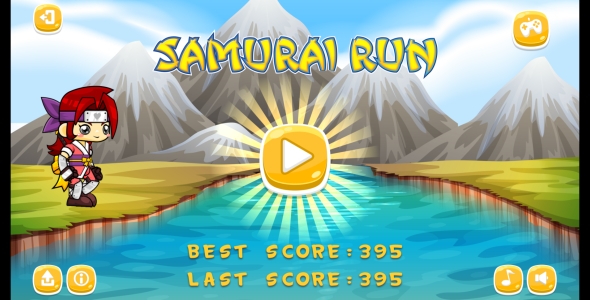
Samurai Run Games is a ready-made endless runner built in Construct 3 and Construct 2, supplied as an HTML5 project plus an Android export and the original .capx source file. It is aimed at developers, resellers and small studios who want a finished one-touch runner they can rebrand and publish quickly rather than build from scratch. At $14 on ThemeForest it sits at the impulse-purchase end of the game asset market, and the vendor, Games Masters Studio, has not disclosed a sales figure for this particular item.
The package is best understood as a template rather than a finished commercial product. Everything needed to open the project, change the art, adjust the difficulty and export to web or Android is included, but the buyer supplies the polish, the store presence and the marketing.
What Samurai Run Games Actually Includes and What Each Part Enables
The core deliverable is a complete, playable runner. The character moves forward automatically, the player taps or clicks to jump, and the game handles collision, scoring and the fail state without any additional scripting. Because the control scheme is a single input, the same build works on desktop with a mouse and on phones with a touch, which removes one of the more tedious parts of cross-platform development.
Two project files are provided. The HTML5 project contains 136 events, and the mobile project contains 145. The difference is not cosmetic: the mobile version carries the additional logic needed for the Android build, which is why the event count is higher. Buyers who only intend to ship on the web can work from the lighter file, while those targeting Google Play will want to start from the mobile project to avoid re-implementing platform-specific behaviour.
Construct 2 users are not left out. A .capx file is bundled alongside the Construct 3 project, so a developer who has not migrated to the newer editor can still open, edit and export the game. That backward compatibility is unusual for a template released in the Construct 3 era and it widens the pool of people who can realistically use the file.
Reskinning is the main selling point in practice. Art assets, sounds and text are separated from the logic, so swapping the samurai for a different character, replacing the background set and changing the menu graphics does not require touching the event sheets. The vendor explicitly states that no programming knowledge is needed, and for a straight reskin that claim holds up — replacing sprites and audio is an asset-management task, not a coding one. Adding new content, such as extra obstacle types or a second character, does eventually require editing events, though the structure is small enough to follow.
Monetisation is partly handled. AdMob integration is included, which means the plumbing for banner or interstitial advertising is already wired into the mobile project rather than left as an exercise. Audio effects are present, and the project targets a native 1920×1080 resolution, so it scales cleanly to most modern displays without pixelation on tablets or high-density phone screens.
The vendor also offers 24/7 online support and a somewhat unusual incentive: buyers who leave a five-star rating and post their email in the comments are promised an additional game as a gift. That is worth noting as a vendor practice rather than a product feature, and it is the kind of arrangement that inflates rating averages relative to the underlying quality of the item.
Where Samurai Run Games Fits and Where It Does Not
The strongest use case is a developer or publisher with an existing audience and a need for cheap, fast content. Someone running a portfolio of casual HTML5 games on a portal, or an AdMob-funded publisher pushing a steady stream of lightweight titles to the Play Store, can absorb a $14 template into a production pipeline and turn it around in days. The one-touch control scheme is also well suited to hyper-casual distribution, where session length is short and the install decision is made in seconds.
It also suits agencies and freelancers who need a working runner as a starting point for a client brief. Rather than quoting for a build from zero, a studio can quote for a reskin and a small feature set, which is a far easier sale and a far lower-risk delivery.
Education is a third fit. A project with 136 events is small enough to read end to end, which makes it a reasonable reference for someone learning how Construct handles spawning, collision and state transitions in a runner context.
Where it fails is any project that needs to stand out on its own merits. Endless runners are one of the most saturated categories on both the web and mobile stores, and a reskinned template competes directly against thousands of near-identical titles. A buyer expecting the template alone to generate revenue is likely to be disappointed. It is also the wrong choice for anyone wanting 3D, physics-driven movement, multiplayer, or a narrative structure — none of that is present, and bolting it on would cost more than building fresh. Finally, teams already working in Unity, Godot or a JavaScript framework will find the Construct dependency a poor fit; the source is only useful inside Construct.
Strengths and Limitations of This Runner Template
Strengths
- Complete and playable out of the box, with no missing systems to implement before the first build runs.
- Both Construct 3 and Construct 2 project files are included, which is rare and useful for teams on older tooling.
- Single-input control scheme works identically with mouse and touch, so no separate control logic is needed per platform.
- AdMob integration is already present in the mobile project, saving the fiddliest part of monetisation setup.
- Asset separation makes reskinning genuinely approachable for non-programmers.
- Native 1920×1080 resolution scales acceptably across desktop, tablet and phone.
- At $14 the cost is low enough that a single freelance reskin job recovers it many times over.
Limitations
- The vendor does not disclose a sales count for this item, so there is no independent signal of how widely it has been used or tested in the wild.
- The five-star-for-a-free-game incentive described in the listing means any rating shown on the marketplace should be read with caution.
- Adding new gameplay — extra obstacles, power-ups, a second character — does require editing event sheets, so the “no programming knowledge needed” claim only covers reskinning.
- No iOS project is included despite the iOS tag; the deliverable is HTML5 plus Android, and iOS would need a separate export path.
- There is no indication of a level editor, difficulty curve tooling or analytics integration, so balancing and retention measurement are manual.
- Support is advertised as 24/7 but is handled by a small studio through a single email address, which is a promise worth treating as best-effort.
How This Compares With Other Runner Templates and Game Asset Packs
The runner template market splits roughly into three tiers. At the bottom are free GitHub projects and stripped-down Construct examples, which cost nothing but typically lack AdMob wiring, mobile exports and any support channel. In the middle sit paid templates in the $10–$30 range, which is where this item lands. At the top are full game frameworks with level editors, analytics dashboards and multi-genre support, priced in the hundreds.
Against the free tier, the value here is time. AdMob setup, a working mobile export and a clean asset structure are the parts that eat hours, and they are already done. Against the top tier, the trade-off is flexibility: this is one game, not a platform, and it will not stretch to a different genre.
The more interesting comparison is against building from scratch in Construct. A competent Construct developer could produce a comparable runner in a weekend, which means the template’s real audience is people who are not competent Construct developers yet, or who value the weekend more than the $14. Both are legitimate positions, but they lead to different purchase decisions. Compared with other single-genre templates at the same price, the dual Construct 2 and Construct 3 support is the clearest differentiator, since most modern listings have dropped the older format entirely.
Frequently Asked Questions
Do I need to know how to code to use Samurai Run Games?
No, not for a basic reskin. Replacing sprites, audio and menu text is an asset swap that requires no scripting, and the vendor states no programming knowledge is needed. Adding new gameplay mechanics, however, does mean editing Construct event sheets, which is closer to visual scripting than traditional coding but still a skill.
Can I publish this game on the App Store as well as Google Play?
Not directly from the included files. The package ships an HTML5 project and an Android export, so Google Play and web portals are covered. An iOS release would require exporting the HTML5 build through a wrapper or rebuilding the project for iOS in Construct, which is possible but is not a supplied deliverable.
Is the game easy to reskin with my own artwork?
Yes, reskinning is the project’s main strength. Art and audio are kept separate from the game logic, so a full visual overhaul is mostly a matter of replacing files at the correct dimensions. The 1920×1080 native resolution sets a clear target for replacement assets, and the structure is small enough to navigate without prior familiarity.
What Construct version do I need to open the project files?
Either Construct 3 or Construct 2 will work. The package includes a Construct 3 project, a separate mobile project, and a .capx file for Construct 2 users. That means buyers on the older editor are not forced to upgrade or subscribe before they can open and export the game.
Verdict on Samurai Run Games
Buy this if the goal is to ship a working endless runner quickly and cheaply, particularly if the plan is a reskin for a client, a web portal or an ad-supported Android release. The dual Construct 2 and Construct 3 files, the pre-wired AdMob integration and the clean asset separation make it a practical tool rather than a demo. Freelancers and small studios with an existing distribution channel will get the most out of Samurai Run Games.
Do not buy it if the expectation is that a $14 template will produce a hit on its own, if the project needs iOS as a first-class target, or if the team already works outside Construct. The category is crowded, the vendor does not publish a sales count, and the rating incentive in the listing makes third-party validation weaker than it first appears. Treated as a head start rather than a finished business, it is priced fairly.