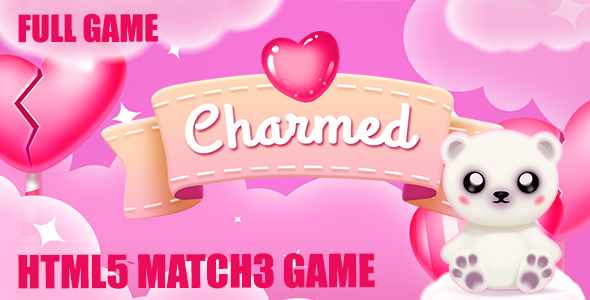
Charmed: Match 3 Game is a browser-based HTML5 puzzle game sold on ThemeForest for $16, built around a romance theme with 25 hand-built levels, a three-star scoring system and a level-select map. It is aimed at developers, publishers and small studios who want a ready-made casual game to embed on a website, bundle into a campaign or use as a starting point for a themed release. The package ships as playable HTML5 files plus documentation, not as an editable source project, which is the single most important fact for anyone evaluating it.
What Charmed: Match 3 Game Actually Includes
The deliverable is a finished game rather than a template. Buyers receive the HTML5 build and a set of help files; the Construct 2 project file is explicitly excluded, and the vendor states that the .capx can be obtained separately by contacting them directly. That distinction shapes everything else about the product, because it determines whether a buyer is purchasing a playable asset or a development kit.
Level structure and progression
Twenty-five levels is a modest but coherent content set for a casual puzzler. The inclusion of a map-based level select means the game presents as a journey rather than a flat menu, which is the conventional structure players expect from the genre and gives the title a sense of progression without requiring any additional work from the buyer. Each level is scored on a three-star system, so there is a reason to replay stages rather than simply clear them once.
Presentation and audio
The visual direction leans heavily on a romance palette — the vendor’s own tags reference flowers, hearts, marriage, proposals and pink — and the art is consistent with that theme throughout. Romantic background music and sound effects are bundled, which saves the buyer the licensing and sourcing work that usually accompanies a reskinned game. For a themed landing page or a seasonal promotion, that pre-matched audio-visual package is genuinely convenient.
Sharing and distribution
A Facebook share hook is wired in, letting players post results to the social network from inside the game. This is the kind of feature that matters more for marketing deployments than for standalone entertainment: a client running a Valentine’s campaign can use the share prompt to extend reach without commissioning custom code. The game runs in the browser via HTML5, so it can be dropped onto a web server or embedded in a page without a plugin dependency.
Where Charmed: Match 3 Game Fits, and Where It Does Not
The clearest fit is a promotional or seasonal microsite. A florist, jeweller, wedding venue or greeting-card brand running a February campaign could deploy this as a branded engagement piece with modest customisation, and the romantic art direction would need little adjustment. Agencies building a quick interactive element for a client pitch or a social media landing page are another natural audience, since the game is playable out of the box and requires no engine licence.
It also suits a developer who wants a finished casual game to publish under their own banner on a portal or app wrapper, accepting that the content stops at 25 levels. Educational or family-oriented sites looking for a non-violent, low-commitment distraction are a reasonable match too.
The wrong choice is any project that needs mechanical changes. Because the Construct 2 source is withheld, a buyer cannot adjust difficulty curves, add levels, change the match logic, localise text or rebuild the UI without either reverse-engineering the compiled output or negotiating separately with the vendor. A studio planning to extend a match-three game into a larger product, add monetisation, or integrate its own analytics and save system should treat this as a dead end and look for a source-included template instead. Likewise, anyone expecting a live-ops title with hundreds of levels, leaderboards or cloud saves will find the scope too thin.
Strengths and Limitations of This Match 3 Game Package
Strengths
- Complete, playable HTML5 build — no engine installation, no build step, no runtime licence to manage.
- Cohesive romance art direction with matching music and effects, removing asset-sourcing work for themed campaigns.
- Three-star scoring and a level-select map give the game a replay loop that a flat 25-level sequence would lack.
- Facebook share integration supports promotional use cases directly.
- Low price point relative to the cost of commissioning even a small custom match-three game.
- Help files are included, which at least documents what the buyer has.
Limitations
- The Construct 2 project file is not part of the purchase. The vendor directs buyers to make private contact for a separate offer, so the cost and terms of source access are unknown at the point of sale — a real risk for anyone whose plans depend on editing.
- Twenty-five levels is a small content base. There is no indication of additional level packs, and without source access the buyer cannot create them.
- The theme is narrow. Romance, hearts and pink are baked into the art and audio, so the game does not reskin cleanly for unrelated verticals without replacing assets the buyer cannot easily reach.
- No sales history or rating is disclosed on the listing, so there is no external signal of how the game performs with real players or how responsive the author is to support requests.
- Only a Facebook share hook is mentioned; there is no reference to leaderboards, analytics, save-state persistence or mobile-specific touch tuning, and the vendor does not state whether these exist.
- Documentation is described only as “help files,” with no indication of depth.
How It Compares With Other Match-Three Game Scripts
The match-three category on marketplaces splits roughly into two product types: full source templates built in engines such as Construct, Unity or Phaser, and finished HTML5 builds like this one. Source templates typically cost more and demand engine familiarity, but they let a buyer generate levels, tune difficulty and rebrand freely. Finished builds are cheaper and faster to deploy but cap what the buyer can change.
Judged against the source-template half of the market, Charmed: Match 3 Game is the weaker option for anyone with development capacity, precisely because the .capx is withheld. Judged against the finished-build half, it competes on presentation: the art and audio are consistent and theme-appropriate, and the three-star plus map structure is more complete than the bare grid-and-score builds that dominate the low end. The 25-level ceiling is typical for the price bracket rather than a deficiency unique to this title.
The honest positioning is that this is a deploy-and-play asset, not a platform. Buyers comparing it with engine-based alternatives should weigh the cost of source access — which must be negotiated privately — against simply purchasing a source-included template at a higher listed price.
Frequently Asked Questions
Can Charmed: Match 3 Game be edited or customised?
Not from the files included in the purchase. The listing supplies HTML5 output and help files only, and states plainly that the Construct 2 .capx is not included. The vendor invites buyers to make private contact to discuss obtaining the source, but the price and conditions of that arrangement are not published, so customisation should be treated as a separate negotiation rather than a feature of the $16 purchase.
Does the game work on mobile phones and tablets?
The vendor does not state mobile support explicitly. The game is delivered as HTML5, which is inherently browser-based and therefore capable of running on mobile browsers, but the listing makes no claims about touch controls, responsive scaling or performance on phones. Buyers who need confirmed mobile behaviour should test the build on target devices or ask the author before purchasing.
How many levels does Charmed: Match 3 Game include?
It ships with 25 levels, selected through an in-game map screen. Each level is scored on a three-star system, giving players an incentive to replay for a better result. The listing does not mention any expansion packs, level editor or add-on content, and because the source project is withheld, buyers cannot add further levels themselves without arranging separate access with the vendor.
What do I need to run this game on my website?
Only a standard web host capable of serving static files. The package contains HTML5 files, so the game runs in the browser without a plugin, engine runtime or server-side component. Deployment means uploading the files and pointing visitors at the entry page. The listing does not specify file size, hosting requirements or whether any server configuration is needed for the Facebook share feature to function.
Verdict: Who Should Buy Charmed: Match 3 Game
Buyers who want a finished, attractive match-three game to drop onto a page this week — a seasonal promotion, a wedding or florist campaign, a casual portal filler — will get reasonable value from Charmed: Match 3 Game Games at $16, provided they accept the 25-level ceiling and the fixed romance theme. Agencies needing a quick interactive deliverable for a client with no engineering requirements are the strongest fit. Developers who intend to modify mechanics, add levels, localise content or integrate analytics should not buy it, because the source project sits outside the purchase and must be negotiated separately. The absence of any disclosed sales or rating data means there is no track record to lean on, so the decision rests entirely on whether the shipped build matches the intended use. Those who need editable source should budget for a source-included template instead.