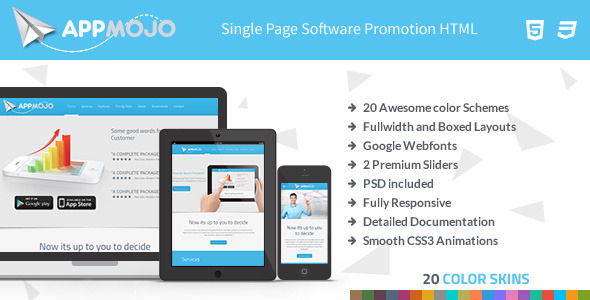
App Mojo is a one-page HTML5 landing template sold on ThemeForest for $10, aimed at developers and marketers who need a promotional site for a mobile or desktop application. It ships with 20 colour schemes, full-width and boxed layout options, two bundled slider plugins, a working contact form and MailChimp newsletter integration. Anyone launching an app who wants a polished single-scroll presence without building a theme from scratch is the core audience for these App Mojo Site Templates.
What the App Mojo Site Templates Actually Include
The package is a static HTML template rather than a WordPress theme, which shapes everything else about how it is used. There is no CMS layer, no database and no admin panel. Deployment means uploading files to a host and editing markup directly. For a freelancer comfortable in a code editor, that is a feature: nothing to configure, nothing to break on a server update, and page weight that stays low because nothing is generated at runtime.
The layout system is built around a single scrolling page with anchored sections, which is the standard structure for app promotion sites. The vendor supplies both full-width and boxed variants, so the same content can be presented edge-to-edge or constrained inside a fixed container without rewriting the grid. Twenty colour schemes and a set of light and dark background patterns are included, which means a reasonable amount of visual differentiation is possible before any custom CSS is written.
Sliders and motion
Two premium slider plugins are bundled: LayerSlider and Revolution Slider, which the listing values at $10 and $12 respectively. That matters because the template price is $10 — the bundled plugins alone nominally exceed the cost of the whole package. Both are well-known commercial products that support layered 2D and 3D transitions, and both can be driven from their own visual editors rather than hand-written markup. Smooth scroll animations and Font Awesome iconography round out the motion and icon layer.
Conversion elements
A pricing table, screenshot gallery and working contact form are included as ready-made sections. For an app landing page these are the three components that do the actual commercial work: the pricing table communicates tiers, the gallery shows the interface, and the form captures enquiries. The MailChimp integration handles newsletter signups, which is the standard mechanism for building a pre-launch list. None of this is unusual for the category, but having it pre-built removes the most tedious part of assembling a landing page.
Design source files and typography
A layered PSD file is included for customisation, alongside Google Webfonts. The PSD matters more than it first appears: it allows a designer to alter the visual language in Photoshop and re-export assets rather than reverse-engineering the CSS. The template is also described as HTML5 and CSS3 based and compatible with major browsers.
Where App Mojo Site Templates Fit, and Where They Do Not
The strongest fit is a pre-launch or early-stage app that needs a credible marketing page quickly. An independent developer shipping an iOS or Android product can take this template, swap the copy and screenshots, adjust the colour scheme, and have a live page in an afternoon. The same applies to agencies producing small promotional microsites where the budget does not justify custom design work, and to desktop software vendors who want a download-focused page rather than a full product website.
A second good fit is the freelancer who wants a starting point with the fiddly parts solved. The bundled sliders, the contact form handler and the MailChimp wiring are the components most likely to consume a day of setup on a blank build. Getting them pre-assembled at this price point is the practical argument for buying.
It is the wrong choice for anyone who needs a content-managed site. Because this is static HTML, every text change, new blog post or updated screenshot requires editing files and re-uploading. A marketing team that expects to publish without developer involvement will find the workflow obstructive, and a WordPress theme or a page builder would serve them far better. It is also a poor fit for multi-page product documentation, changelogs or support portals — the one-page structure is a constraint, not a foundation to build on.
There is a more specific mismatch worth flagging: the last vendor update was in March 2020. The bundled slider plugins in particular have had their own release histories since then, and a buyer should verify the shipped versions are current enough for their needs rather than assuming the package reflects present-day releases.
Strengths and Limitations of App Mojo Site Templates
Strengths
- Two commercial slider plugins are bundled at a total nominal value above the template price, which is unusual value at the $10 tier.
- Twenty colour schemes plus light and dark pattern sets give genuine visual range without custom CSS.
- Full-width and boxed layout variants are both included, so the same content suits different brand presentations.
- A layered PSD is provided, letting designers rework the visual system in an image editor rather than in code.
- The conversion essentials — pricing table, gallery, contact form, MailChimp signup — are pre-built rather than left as an exercise.
- Static HTML output keeps the page fast and removes server-side dependencies entirely.
- 639 sales and a strong marketplace rating indicate the template has been widely deployed and reviewed.
Limitations
- No CMS. Content updates require editing HTML files and redeploying, which rules out non-technical editors.
- The last vendor update was March 2020, so the bundled third-party slider versions may lag behind current releases.
- Demo images are not included. The listing states they are copyrighted and that the vendor can supply purchase links, which means a realistic budget must account for stock or custom photography.
- The one-page structure limits information architecture. Longer sales narratives, multi-product catalogues or documentation do not fit the format.
- There is no stated accessibility work — no mention of ARIA roles, keyboard navigation for the sliders, or WCAG conformance. Buyers with accessibility requirements should audit the markup themselves.
- Slider plugins add JavaScript weight, and two of them is more than a simple landing page strictly needs.
How App Mojo Site Templates Compare With the Wider Category
The realistic alternatives fall into three groups. The first is a WordPress theme or a hosted page builder. Those win decisively on content management: a marketer can change copy, swap screenshots and publish without touching code. They lose on weight and on setup time, and they introduce hosting, plugin and update maintenance that a static template never has. For a team that will iterate on the page weekly, the CMS route is the correct one regardless of template quality.
The second group is a hand-built static page. A competent front-end developer can produce something comparable in a day or two, with full control over markup and no third-party plugin dependencies. The trade-off is that the bundled sliders, the pattern library and the PSD would all have to be sourced or created separately, so the $10 price is really buying assembly time rather than code that could not be written.
The third group is other one-page app landing templates on the same marketplace. Here the differentiators are narrow and concrete: how many bundled plugins are included, whether a PSD ships with it, how many colour schemes and layout variants exist, and how recently the vendor updated the package. App Mojo is competitive on the first three and behind on the fourth. A buyer comparing options should weigh the freshness of competing templates carefully, because a template that has not been touched since 2020 will not have absorbed several years of browser and plugin changes.
The author, designthemes, is an established ThemeForest seller, which is a mild positive signal on support expectations but not a guarantee of ongoing maintenance on this particular item.
Frequently Asked Questions
Is App Mojo a WordPress theme or a static HTML template?
It is a static HTML5 template, not a WordPress theme. There is no CMS, database or admin dashboard involved. Deployment means uploading the files to any web host and editing the HTML directly to change content. That keeps the page fast and dependency-free, but it also means anyone updating the site needs access to the code and a basic understanding of markup.
Do the demo images come with the template download?
No. The vendor states explicitly that the images used in the demo are copyrighted and are not included in the download. They offer to provide links for purchasing licences. Any realistic budget for this template therefore needs to include stock photography or original screenshots, which is a cost the $10 price does not cover.
Which slider plugins are bundled with App Mojo?
LayerSlider and Revolution Slider are both included, which the listing values at $10 and $12. Both are commercial products with their own visual editing interfaces for building layered 2D and 3D transitions. Because the template was last updated in March 2020, buyers should check which plugin versions ship in the package before relying on them.
Can App Mojo be used for a multi-page website?
Not comfortably. The template is built as a single scrolling page with anchored sections, and the full-width and boxed layout options both assume that structure. Adding multiple pages would mean building the navigation and page scaffolding yourself, at which point a general-purpose HTML template or a CMS-based theme would be the more sensible starting point.
Verdict on App Mojo Site Templates
App Mojo Site Templates are worth buying for a developer or small agency that needs a single-page app promotion site live quickly and is comfortable working in HTML. The bundled sliders, the twenty colour schemes, the PSD source and the pre-built conversion sections represent solid value at $10, and the 639 sales with a strong rating suggest the package behaves as advertised. It is not the right purchase for a marketing team that needs to edit content without a developer, nor for anyone planning a multi-page product site. The March 2020 update date is the main caveat: the template is not abandoned, but it is not actively maintained either, and buyers should confirm the bundled plugin versions meet their requirements before committing.