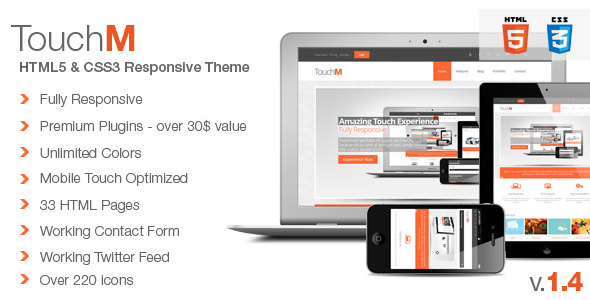
TouchM Premium HTML5 Multipurpose Responsive corporate is a static HTML5 and CSS3 website template sold on ThemeForest by the developer FourGraFx, priced at $18. It provides a complete set of pre-built pages, sliders, portfolio layouts and shortcodes for building a business or corporate site without a content management system, and it is aimed at freelancers and small studios who want a hand-coded front end rather than a WordPress theme.
The template has been purchased 804 times, which puts it in the modest-but-established bracket on the marketplace. That figure matters because it tells a buyer two things: the code has been in front of a reasonable number of people, and it is not a runaway bestseller with a large community behind it.
What the TouchM Premium HTML5 Multipurpose Responsive corporate template actually includes
The core of the package is a page library. The vendor lists 30 HTML pages, broken down as 25 content pages and 8 shortcode demonstration pages, all written to W3C-valid HTML5. In practice that means a buyer gets the usual corporate furniture — home, about, services, portfolio, blog, contact, pricing, plus a registration page, an under-construction page and a 404 — already styled and cross-linked. The shortcode pages are reference sheets rather than pages a visitor would ever see; they exist so the developer can copy markup for buttons, tabs, accordions, alerts and similar components without guessing at class names.
Layout is handled by Zurb’s Foundation 3 framework on a 960px grid. This is worth flagging early, because Foundation 3 is a legacy version of the framework. The grid works and the responsive breakpoints behave, but the underlying CSS conventions are not those of Foundation 5 or 6, and anyone expecting to drop in modern Foundation components will be disappointed.
Touch interaction is the theme’s stated speciality, and it is more than a tagline. Sliders, the lightbox and the portfolio grid all respond to swipe, tap and double-tap, which is the behaviour that separates a template genuinely built for phones and tablets from one that merely reflows. Three separate slider scripts ship with the package — Slider Revolution, Camera and FlexSlider — so a buyer can pick the one whose animation style suits the project rather than being locked into a single option. Slider Revolution and the Titan lightbox are bundled at no extra cost, which the vendor values at $12 and $14 respectively; that is marketing arithmetic, but the plugins are real and would otherwise be separate purchases.
Portfolio filtering runs on Isotope, giving the familiar animated re-sort when a visitor clicks a category. The grid supports multiple layouts, and a later update added a portfolio page with sidebar navigation. Colour management is handled through a small number of edits — the vendor says four colour values control the scheme — and a different accent colour can be applied to individual pages. There are also more than 20 background patterns, over 220 icons and access to the Google Fonts library, so typography is not restricted to the two or three families that ship in the download.
Two functional extras round out the list: a working contact form and a working Twitter feed. Both are worth verifying against a current hosting environment, since a feed implementation written in 2012 predates several rounds of API changes at Twitter.
Where this template fits, and where it does not
The strongest fit is a small corporate or agency brochure site — five to fifteen pages, a services section, a filterable case-study grid and a contact form. That is exactly the shape the page library assumes, and a developer can assemble it in a day or two by editing existing markup rather than building components from scratch. Freelancers producing fixed-scope marketing sites for local businesses are the natural audience, particularly when the client wants something that feels deliberate on a tablet.
It also suits anyone who needs a static prototype quickly: pitching a design direction, demonstrating a navigation concept, or producing a clickable mock-up for stakeholder sign-off before committing to a CMS build. The shortcode reference pages make it easy to hand a partially built site to a second developer.
The wrong choice is a project that needs a CMS. TouchM is a static template; there is no WordPress version, no admin panel and no database. A client who wants to publish blog posts without touching code will need something else entirely, and retrofitting a static template onto a CMS usually costs more than buying a CMS theme in the first place. It is also a poor fit for anyone who needs a modern build pipeline — there is no mention of Sass sources, a task runner, npm or a component framework, and Foundation 3 predates the tooling most teams now expect.
Strengths and limitations of TouchM Premium HTML5 Multipurpose Responsive corporate
Strengths
- Genuine touch support across sliders, lightbox and portfolio, not just a responsive grid that reflows.
- Three slider engines bundled, so the animation style can be matched to the project instead of accepted as-is.
- Slider Revolution and Titan Lightbox included, which would cost more than the template itself if bought separately.
- A broad page library with registration, 404 and under-construction pages already styled.
- Isotope-filtered portfolio with several layout options and a sidebar variant.
- Centralised colour control — a handful of edits changes the entire scheme, and per-page accent colours are supported.
- W3C-valid HTML5 markup, which reduces the chance of browser-specific rendering quirks.
- Documentation covers the bundled premium plugins, not just the template itself.
Limitations
- Foundation 3 is a discontinued framework version. Its grid and class naming differ from current Foundation, so knowledge of the modern framework does not transfer cleanly.
- The last vendor update was October 2014. Nothing in the listing indicates maintenance since then, so browser and plugin compatibility should be verified before purchase rather than assumed.
- The bundled Twitter feed was built against an older API and is the most likely component to have stopped working.
- Static HTML only. There is no CMS integration, no templating layer and no build tooling.
- Colour changes are described as code edits in four places, which is manageable but not a visual customiser or a settings panel.
- The vendor does not state a licence position on the bundled plugins beyond their inclusion, so redistribution terms for client work are worth confirming directly.
How it compares with other corporate templates in this category
The corporate template market splits roughly three ways: static HTML templates like this one, CMS themes, and site builders. TouchM competes in the first group, and within that group its differentiator is touch handling rather than page count or feature breadth. Plenty of static templates offer more pages or a newer framework; fewer have tested swipe behaviour across every interactive element.
Against CMS themes, the trade-off is straightforward. A CMS theme gives a client editing control and costs more in setup and hosting complexity. TouchM gives a faster, lighter front end with no database to maintain, but every content change goes through a developer. For one-off marketing sites with infrequent updates, that is often the better deal; for anything with a blog or a product catalogue, it is not.
Against modern static site generators, TouchM loses on tooling and wins on immediacy. There is no build step, no dependency install and no deploy pipeline to configure — the files upload and the site works. Teams already invested in a generator will find the template’s plain HTML approach limiting; teams without that investment will find it refreshingly simple. The price point of $18 sits at the low end of the marketplace, which lowers the cost of trying it, but it also means the buyer should not expect the support depth that comes with a $60 theme.
Frequently Asked Questions
Is TouchM Premium HTML5 Multipurpose Responsive a WordPress theme?
No. It is a static HTML5 and CSS3 template, not a WordPress theme, and the vendor does not offer a WordPress version. Content is edited directly in the HTML files and uploaded to a host. Anyone needing a CMS-managed site should look at WordPress or Joomla themes instead, since converting this template would require building a theme from scratch.
Does the template work properly on phones and tablets?
Yes, touch support is the template’s main selling point. Sliders, the lightbox and the portfolio grid all respond to swipe, tap and double-tap, and the layout is built on a responsive grid. Buyers should still test on current devices, because the template has not been updated since 2014 and mobile browsers have changed considerably since then.
What is included in the $18 price?
The download contains 30 HTML pages, three slider scripts, the Titan lightbox, an Isotope portfolio, over 220 icons, 20-plus background patterns, Google Fonts integration, a contact form, a Twitter feed and documentation. Slider Revolution and Titan Lightbox are bundled at no extra cost, which the vendor values at $12 and $14 separately.
Is the template still maintained and supported?
The last recorded update was October 2014, and the vendor’s listing does not indicate any maintenance since. Support was historically handled through a dedicated forum, and older buyer reviews describe fast response times, but that activity predates the final update. Prospective buyers should treat ongoing support as unlikely and plan accordingly.
Verdict on TouchM Premium HTML5 Multipurpose Responsive corporate
This template is worth buying for a developer who needs a static corporate brochure site finished quickly and who values tested touch behaviour over modern tooling. The bundled premium plugins alone justify the $18 for that use case, and the page library removes most of the repetitive setup work.
It is not the right purchase for a client who needs to edit their own content, for a team standardised on a current framework, or for anyone unwilling to audit legacy code before launch. The 2014 update date is the single biggest consideration — it does not make the template unusable, but it does shift responsibility for compatibility testing onto the buyer.
FourGraFx built a capable touch-first template for its era, and the 804 sales reflect that. Whether it still fits a given project depends almost entirely on how much legacy code that project can tolerate.