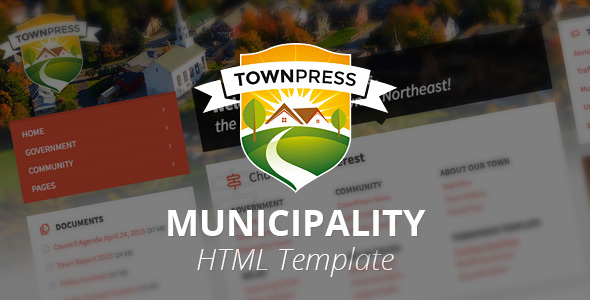
TownPress Nonprofit is a static HTML template built for small towns, villages and municipal bodies that need a public-facing website without the overhead of a CMS. It ships with purpose-built page types for events, official documents, galleries and community notices, and it is sold on ThemeForest by LSVRthemes for $18. Because it is plain HTML, CSS and JavaScript rather than a theme for a content management system, it suits developers and technically confident site owners rather than non-coders.
TownPress Nonprofit Capabilities That Go Beyond a Generic Template
The distinguishing feature of this template is that its page inventory was designed around the things a municipality actually publishes, rather than around generic blog and portfolio layouts that have been relabelled. That distinction matters in practice: a town clerk does not need a “latest posts” grid, but does need a place to list council meetings, publish minutes, and keep a document archive that residents can browse.
Event and Meeting Listings
Upcoming events are treated as a first-class content type rather than an afterthought. The template includes layouts for a chronological event index and for individual event detail pages, which is the pattern most councils need for meetings, public hearings, festivals and registration deadlines. Because the output is static markup, each event is a hand-authored file, so the workflow is closer to maintaining a small brochure site than running a calendar application.
Document and Records Pages
The template provides layouts intended for town documents — the kind of material that would otherwise be buried in a PDF folder. For a small municipality, having a styled, navigable index of agendas, budgets and bylaws is a genuine improvement over an unformatted file directory, and it gives residents a predictable place to look.
Galleries and Community Imagery
Gallery layouts are included, which is a reasonable fit for the way small towns present themselves: local landmarks, seasonal events, public works projects. The vendor explicitly states that the demo images are not included and that links to them appear in the documentation, so any budget for the project needs to account for licensing or commissioning photography separately.
Widgets and Reusable Components
A set of specialised widgets and reusable blocks is bundled, covering the sort of sidebar and footer content a civic site leans on — quick links, contact details, notice panels. A Google Maps element is also provided, and the changelog notes that as of version 1.0.1 it requires a Google API key supplied through a data-google-api-key attribute; without a key, that element will not render. This is a small but important operational detail, since a broken map on a municipal contact page is a visible failure.
Front-End Standards
The markup is valid HTML5, the layouts are mobile-friendly, and graphics are supplied at retina resolution. The template also ships its own icon set under a tp tp- prefix, which was swapped for a different icon family in version 1.0.2 — worth knowing if an older copy is already in use, because icon class names changed. FontAwesome was updated to 4.6.3 in the same release.
Where TownPress Nonprofit Fits and Where It Does Not
The strongest fit is a small town, parish, village or district with a modest web presence and no in-house CMS. A freelance developer or small agency quoting a fixed-scope brochure site for a municipality can use this as a starting point and deliver something that looks purpose-built in a fraction of the time a bespoke design would take. It also works for related civic organisations — a historical society, a rural community association, a local precinct committee — that publish events and documents but do not need editorial workflows.
It is the wrong choice for any municipality that needs residents to submit forms, pay fees, register for programmes, or have staff update content without touching code. Static HTML means every content change is a file edit and a redeploy; there is no admin interface, no user roles, no revision history, and no database. A town with a communications officer who is not comfortable in a text editor will find this template actively obstructive. The vendor is upfront about this, noting that basic HTML knowledge is required and pointing buyers toward a WordPress version for a more streamlined experience.
It is also a poor fit for larger cities. The design language is deliberately restrained and small-scale, and the content architecture assumes a handful of pages rather than hundreds of departments, services and translated sections.
Strengths and Limitations of the TownPress Nonprofit Template
Strengths
- The page types map to real municipal publishing needs — events, documents, galleries, notices — instead of generic blog layouts.
- Static output is fast to host and cheap to run; there is no database, no PHP, and no CMS attack surface to patch.
- Valid HTML5, mobile-friendly layouts and retina graphics mean the baseline technical quality is sound.
- At $18 the licence cost is trivial relative to the design and build time it can save on a small civic site.
- 506 sales on ThemeForest give a reasonable indication that other buyers have taken it into production.
Limitations
- The last vendor update was 13 January 2017, and that release only refreshed the documentation. The template has effectively been static for years, so buyers should assume no further browser-compatibility or accessibility work is coming.
- There is no content management layer at all. Every event, document entry and page update is a manual code edit.
- The Google Maps element requires a Google API key, and Google’s mapping terms and pricing have changed substantially since the template was last touched — the integration may need rework.
- Icon class names changed between versions, so upgrading an existing installation can break icons already in use.
- Demo images are not licensed with the template, adding an unbudgeted cost for photography.
- The vendor does not state any accessibility conformance level, which is a material gap for public-sector sites that are often subject to accessibility obligations.
- No mention of RTL support, translation tooling or a build pipeline is made in the listing.
How TownPress Nonprofit Compares With the Wider Category
The realistic alternatives fall into three groups, and the comparison is about fit rather than feature counts.
The first group is a general-purpose HTML template from any marketplace. Those are usually cheaper in effort to customise for a corporate site but require the buyer to invent municipal page structures from scratch. TownPress Nonprofit wins on domain fit: the events index, document pages and civic widgets already exist.
The second group is a CMS theme — WordPress, Joomla or similar — often from the same developer. These cost more in setup and hosting but hand day-to-day editing to non-technical staff, which for a public body is usually the deciding factor. If content changes weekly, a CMS theme is the better investment even at several times the price.
The third group is a custom build or a municipal SaaS platform. Those offer form handling, accessibility tooling and compliance features that a static template simply does not attempt. They also cost orders of magnitude more, which is precisely why a small town with a five-page site and a volunteer webmaster ends up looking at something like this instead.
Frequently Asked Questions
Is TownPress a WordPress theme or an HTML template?
It is a static HTML template, not a WordPress theme. The files are plain HTML, CSS and JavaScript, so there is no admin dashboard, database or plugin system. The vendor notes that basic HTML knowledge is required and directs buyers who want a CMS-driven experience to a separate WordPress version of the same design.
Can a non-technical town clerk update the site with TownPress?
No, not realistically. Every change — a new meeting, an updated document, a notice on the homepage — means editing markup and re-uploading files. Without a WYSIWYG editor or content management layer, the template assumes whoever maintains the site is comfortable working in code, which rules it out for most volunteer-run municipal sites.
Is TownPress Nonprofit still maintained and updated?
The last vendor update was released on 13 January 2017, and it only refreshed the documentation. Earlier releases in 2016 fixed icons and added a Google Maps API key requirement. Buyers should treat the template as feature-frozen and plan to handle any future browser or accessibility fixes themselves.
Does the template include the images shown in the live preview?
No. The vendor states plainly that the demo images are not included with the purchase. Links to the sources appear in the documentation, but licensing or commissioning that photography is a separate cost. Budget for it before quoting a project, since civic sites lean heavily on local imagery.
Verdict on TownPress Nonprofit
TownPress Nonprofit is worth buying for a developer or agency delivering a small, mostly static municipal website where the page structure is already known and content changes are infrequent. At $18 it removes a meaningful amount of design and markup work, and the civic-specific page types are the reason to choose it over a generic template. It is not the right purchase for a town that needs staff to publish content independently, for any organisation with accessibility obligations it cannot meet through manual testing, or for a project where ongoing vendor maintenance is a requirement — the 2017 update date makes that expectation unrealistic. Buyers should also budget for photography and for reworking the Google Maps integration. The 506 sales suggest it has served small civic projects adequately, but it should be treated as a starting point to be maintained in-house, not a supported product.