The Android WhatsApp Sticker app (Offline) with AdMob is a source-code package for building a sticker catalogue app that sends sticker packs into WhatsApp, bundled with Google AdMob monetisation and a GDPR consent flow. It is sold on ThemeForest for $24 as a ready-to-publish Android Studio project rather than a hosted service, so the buyer receives code, not a running product. It suits developers and small studios who want a short path to a Play Store sticker app with ads already wired in, and it is a poor fit for anyone who needs a managed backend or an app that works without code-level customisation.
What the Android WhatsApp Sticker app (Offline) with AdMob actually ships with
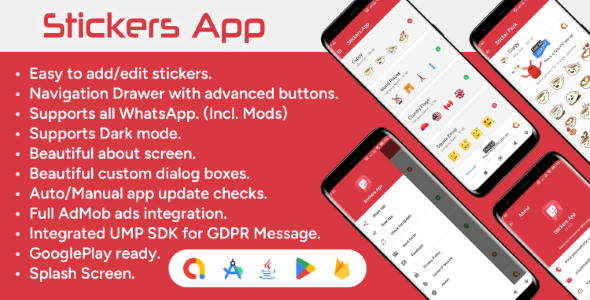
The package is built around a single core interaction: a user browses a sticker catalogue and taps to add a pack to WhatsApp. The vendor describes this as one-click sticker addition, and the surrounding screens exist to support that flow rather than to add unrelated functionality. The app is described as offline, which in this category means the sticker assets are bundled with the app rather than fetched from a remote server at runtime.
Several capabilities are worth separating out because they determine how much work remains after purchase.
Sticker management and WhatsApp compatibility
Users can add and edit stickers inside the app, and the integration is stated to work with all WhatsApp variants including modified builds. That last point matters more than it first appears: WhatsApp mods are widespread in exactly the markets where sticker apps get the most installs, and a sticker app that only hooks the official client loses a meaningful share of its potential audience. The trade-off is that modified clients change their internal behaviour without notice, so this compatibility claim is the part of the package most likely to need maintenance over time.
Ad monetisation and consent handling
AdMob is integrated across multiple ad formats rather than a single placement, which gives a buyer room to test banner, interstitial and rewarded inventory against retention. The inclusion of the UMP SDK for GDPR consent messaging is the more consequential detail. Consent management is a legal requirement for serving personalised ads to EU users, and it is the piece most commonly missing from budget source-code packages. Having it built in removes a compliance task that would otherwise require separate SDK work and a consent message configured in the AdMob console.
Platform currency and store readiness
The project targets Android 14 at API level 34, which is the relevant baseline for Play Store submission at the time of writing. It also includes a splash screen, a navigation drawer, custom dialog components, an about screen, and in-app privacy policy and terms pages. Those last two are not glamorous, but Google Play requires a privacy policy to be reachable from within the app, and shipping the screens pre-built saves a small but real amount of submission friction. The vendor also lists Firebase Crashlytics among the tags, which implies crash reporting is wired up, though the listing copy does not describe the implementation.
Interface and update behaviour
Dark mode support is included, which is now an expectation rather than a differentiator on Android. The app checks for updates both automatically and on manual request, a pattern that lets a publisher push users to a new version without relying solely on Play Store rollout timing. The vendor does not state whether this uses an in-app update API or a custom prompt.
Where this sticker app template fits, and where it does not
The clearest fit is a developer or small studio that wants to launch a niche sticker app quickly. Sticker packs are a content business, not a software business: the code is the easy part, and the differentiator is the artwork. A template like this lets a buyer spend their time on pack design and store listing rather than on rebuilding WhatsApp’s content provider integration and AdMob plumbing from scratch. It is equally reasonable for a freelancer delivering a sticker app to a client on a fixed budget, where a $24 starting point plus customisation hours is far cheaper than a from-scratch build.
It also works for publishers running a portfolio of small utility apps who want a proven, low-maintenance unit they can reskin. The offline model helps here, because there is no server bill and no backend to monitor.
The wrong choice is a project that needs dynamic content. Because the app is offline-first, adding new sticker packs means shipping an app update, not uploading to a CMS. Anyone planning a large, frequently refreshed catalogue, user-submitted stickers, or per-pack analytics will find the architecture working against them and should look at a server-backed sticker app instead. The same applies to buyers who cannot read or modify Java or Kotlin: the package is source code, and the vendor’s support is limited to contact by email, so any change beyond swapping assets and colours depends on the buyer’s own ability.
Strengths and limitations of this AdMob-ready sticker package
Strengths
- Consent handling via the UMP SDK is included, which is the single most commonly omitted compliance piece in low-cost AdMob templates.
- Multiple AdMob formats are wired in, allowing placement testing without additional SDK integration work.
- Compatibility is claimed for modified WhatsApp clients as well as the official app, widening the addressable audience.
- Privacy policy and terms screens ship inside the app, reducing Play Store submission friction.
- Targets API level 34, so the project is not starting from a deprecated baseline.
- Offline asset delivery means no hosting costs and no backend to maintain.
- At $24, the cost is negligible against the hours saved on WhatsApp integration and ad setup alone.
Limitations
- The offline architecture is also the biggest constraint: every new sticker pack requires a new app release and a review cycle.
- The listing discloses no sales figures, and no rating or review history is provided, so there is no independent evidence of how the code behaves in production or how responsive support is.
- No documentation is described in the listing. Buyers should assume they will be reading the source to understand structure and configuration.
- Support is an email address rather than a ticketing system, with no stated response window.
- The feature list is thin on specifics: ad format names, Crashlytics configuration and the update-check mechanism are named only as tags or passing mentions, not documented.
- Sticker apps depend on WhatsApp’s own content provider contract, which Meta can change; no template in this category can guarantee long-term compatibility.
How this compares with other routes to a sticker app
The realistic alternatives are a from-scratch build, a WordPress or web-to-app wrapper, and a more expensive native template with a backend.
Building from scratch gives full control and no licensing questions, but reproducing WhatsApp’s sticker content provider integration, AdMob mediation, consent flow and Play-ready screens is several days of work at minimum. Against that, a $24 package that already covers those pieces is straightforwardly better value for anyone whose goal is to ship rather than to learn.
Web-wrapper approaches are cheaper to produce but handle sticker pack registration poorly, because the WhatsApp integration needs native code. They also tend to perform worse on the ad side. This package’s native Android foundation is the correct shape for the job.
Higher-priced native templates typically add an admin panel or API so packs can be published remotely. That is a genuine capability difference, not a marketing one, and it is the upgrade path for anyone whose catalogue will change often. For a fixed set of packs, the offline model here is simpler and cheaper to run.
On compliance, this package sits above the typical budget template because of the UMP SDK integration. On documentation and track record, it sits below established alternatives, simply because the vendor discloses neither.
Frequently Asked Questions
Does this app work without an internet connection?
Yes. The Android WhatsApp Sticker app (Offline) with AdMob bundles sticker assets inside the app, so users can browse and add packs without a network request. Ads still require connectivity to load, and the update check needs a connection to function, but the core sticker flow does not depend on either.
Can stickers be added to the app without publishing an update?
No. Because the package is offline-first, sticker packs are compiled into the app, so adding or changing packs requires a new build and a Play Store release. Projects needing frequent catalogue changes should use a server-backed sticker app instead, where packs are fetched from an API or admin panel.
Is the app ready to publish on Google Play as delivered?
It is close. The vendor states the project is Google Play ready, targets API level 34, and includes in-app privacy policy and terms screens, which covers the most common submission blockers. Buyers still need their own signing key, store listing assets, and a privacy policy URL reflecting their own data practices.
Which ad formats does the AdMob integration support?
The listing states that multiple AdMob ad formats are integrated but does not enumerate them. Banner, interstitial and rewarded formats are the standard set for this kind of app, and the source code should be checked before purchase if a specific format is required for the planned monetisation strategy.
Verdict: who should buy the Android WhatsApp Sticker app (Offline) with AdMob
This is a sensible purchase for a developer or small studio with a set of sticker packs ready to ship and no appetite for rebuilding WhatsApp integration and AdMob consent handling from scratch. The inclusion of the UMP SDK and API 34 targeting makes it more submission-ready than most budget templates in this category, and the price is low enough that the decision turns almost entirely on whether the offline model suits the planned catalogue. Buyers who need remote pack updates, user submissions, or who cannot modify native Android code should choose a server-backed template or budget for a developer instead. The absence of disclosed sales, ratings and documentation means the purchase carries some unverified risk, and it is worth requesting a code sample or demo APK from the vendor before paying. For the right project, the Android WhatsApp Sticker app (Offline) with AdMob removes the tedious parts and leaves the work that actually differentiates a sticker app: the artwork and the store presence.