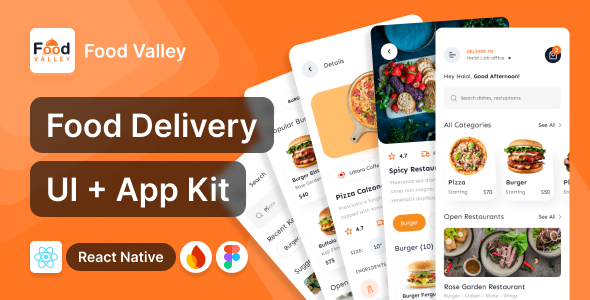
Food App: React Native Food App UI Mobile is a source-code package for building a multi-restaurant food ordering and delivery product on iOS and Android. It bundles a React Native customer app, a courier app, a restaurant-facing admin panel, a Firebase backend and an editable Figma design file, sold as a one-time purchase on ThemeForest for $15. It suits developers and agencies who want a working delivery-app foundation to customise rather than a hosted SaaS platform.
The listing is published under the Food Valley name by a vendor that describes itself as an expert React Native team; the marketplace page does not disclose a sales count or a rating, so there is no purchase history to weigh up yet. That absence matters for a buyer comparing a $15 code package against a subscription-based delivery platform, and it shapes how the rest of this review should be read.
What the Food App: React Native Food App UI Mobile Actually Ships With
The deliverable is not a single app but a small ecosystem. Understanding the split between the pieces is the most useful thing a prospective buyer can do before purchasing, because each component carries its own maintenance burden.
Three separate front ends and one backend
The package contains a customer-facing ordering app, a driver app with an earnings and delivery-history dashboard, and an admin panel for managing users, restaurants and orders. All three talk to a Firebase project that supplies the real-time database, authentication and push notification delivery. In practical terms, that means a buyer is taking on three codebases plus a backend configuration rather than one, and each will need its own store listing, signing certificate and release cycle if the product goes to market.
Ordering flow and scheduling
The customer app covers the standard delivery journey: browsing nearby restaurants, selecting from menus that span fast food, healthy meals and home-style cooking, adding to a cart, checking out and following the order. Scheduled ordering is included, which lets a customer place a meal order ahead of time rather than only on demand. That single feature changes the data model considerably, since orders need a future fulfilment window rather than an immediate dispatch, and it is worth checking how the admin panel surfaces those queued orders.
Live tracking and maps
Google Maps integration drives both restaurant location and courier routing, and the listing pairs this with live tracking and estimated arrival times. The vendor does not state which Google Maps APIs are used or what the expected billing exposure is, and that is a genuine cost consideration: Maps Platform usage is metered per request, so a delivery app with live tracking can generate meaningful API spend at volume even though the theme itself is a one-time $15.
Payments and pricing transparency
Cash on delivery, credit and debit cards, and digital wallets are all listed as supported. The listing does not name the payment gateway or gateways involved, so a buyer should confirm before purchase which provider the checkout code is wired to and how much rework a switch would require. The customer-facing side does at least present a full cost breakdown before confirmation, which is the right default for food ordering where delivery fees and small-order surcharges are common points of friction.
Design assets and code structure
A fully editable Figma UI kit ships alongside the code, which is more useful than it first appears: rebranding a delivery app usually means reworking colours, typography and component states across dozens of screens, and having the source design file shortens that loop. The vendor describes the codebase as modular and clean, and states that the purchase includes lifetime updates with no recurring fee. Both claims are reasonable to verify by inspecting the demo and asking support directly.
Where This Food App: React Native Food App UI Mobile Fits, and Where It Does Not
The strongest fit is a development team or freelance developer with an existing React Native and Firebase skill set who has been commissioned to build a delivery product and wants to skip several weeks of scaffolding. A small restaurant group launching its own branded ordering channel, a dark-kitchen operator, or an agency building a regional multi-vendor marketplace would all find the three-app structure close to what they need out of the box.
It also suits projects where the client expects a native app rather than a mobile web experience, and where the budget rules out a per-order SaaS commission model. Because the purchase is one-time and the code is owned outright, the long-run economics favour anyone expecting meaningful order volume.
The wrong choice is a non-technical restaurant owner with no developer on hand. This is a code package, not a managed service: someone has to configure Firebase, register the apps with Apple and Google, set up a payment gateway account, provision Maps API keys and handle store submission. Likewise, a team that has standardised on Flutter, or on a SQL backend with an existing order management system, will spend more time adapting this stack than starting fresh. Buyers who need multi-currency, multi-language or complex tax handling should also confirm coverage first, since the listing does not mention localisation or tax rules.
Strengths and Limitations of the Food Valley Package
Strengths
- Complete three-sided marketplace structure. Customer, courier and admin surfaces are all present, which is the part most templates skip.
- Firebase removes backend hosting work. Real-time sync, authentication and notifications come from a managed service, so there is no server to provision or patch.
- Figma source file included. Rebranding is a design-tool exercise as well as a code exercise, and having the kit saves real time.
- Genuinely low entry cost. At $15 with no recurring licence fee, the financial risk of evaluating the codebase is minimal.
- Cross-platform from one codebase. React Native covers iOS and Android together, which halves the platform-specific work compared with two native builds.
Limitations
- No disclosed sales or rating history. The listing shows no purchase volume or reviews, so there is no independent signal about code quality or support responsiveness.
- Firebase lock-in is structural. Authentication, database and notifications all route through Firebase. Migrating to another backend later means rewriting the data layer across three apps, not swapping a config file.
- Payment gateway unspecified. The listing claims card and wallet support without naming the provider, so integration effort for a specific processor is unknown until the code is inspected.
- Maps billing sits outside the purchase price. Google Maps usage is metered, and the vendor gives no guidance on expected request volume or cost controls.
- No stated localisation or tax handling. Multi-language, multi-currency and regional tax rules are not mentioned, which limits out-of-the-box suitability for markets outside the vendor’s assumed default.
- Support quality is unverifiable. A dedicated support team is promised, but with no review history there is no way to judge response times before buying.
How It Compares With Other Delivery App Templates and Platforms
The realistic alternatives fall into three groups. The first is other React Native delivery templates on marketplaces like ThemeForest and CodeCanyon, which typically cost a similar amount and vary mainly in how complete the courier and admin sides are. Many cheaper templates ship only the customer app and leave dispatch to a third party; this package’s inclusion of a driver dashboard and admin panel is its main differentiator within that group. The trade-off is that a three-app package carries more code to audit and more surface area for bugs.
The second group is managed delivery SaaS platforms, which charge monthly fees or per-order commissions but handle hosting, updates and support. Those are the better answer for operators without developers. This product wins on ownership and marginal cost per order, and loses on convenience and accountability.
The third group is building from scratch on React Native and Firebase. A competent team can reach a comparable feature set, but the effort is measured in weeks of scaffolding before the first order flows. The $15 price is effectively a shortcut past that stage, and whether it is worth it depends entirely on how much of the existing structure survives the customisation.
Frequently Asked Questions
Is Food App: React Native Food App UI Mobile a complete app or just a design?
It is a complete code package, not a design-only asset. The purchase includes full React Native source for iOS and Android, a Firebase backend configuration, an admin panel and a driver app, plus an editable Figma file for design work. The Figma kit is a companion to the code, not a substitute for it.
Do I need my own Firebase account and Google Maps API key?
Yes. The app is built to connect to a Firebase project and to Google Maps, and both are services the buyer provisions and pays for separately. Firebase has a free tier that suits development and low volume, while Maps Platform is metered per request. Neither is included in the purchase price.
Can this React Native food delivery app be rebranded for a client?
Yes, rebranding is the intended use. Colours, logos, screens and flows can be changed in the code, and the included Figma UI kit lets a designer rework the visual system before those changes are applied. The vendor describes the codebase as modular, though the practical ease of restructuring depends on how deeply the flows are customised.
Does the package include payment processing fees or a gateway account?
No. The listing states support for cash, cards and digital wallets but does not name the payment gateway, and no gateway account or processing is included. A buyer will need a merchant account with a supported provider, and should confirm which one the checkout code targets before committing to a build.
Verdict on the Food App: React Native Food App UI Mobile Package
This is a sensible purchase for React Native developers and agencies who already know Firebase and need a three-sided delivery product scaffolded quickly, particularly at a price that makes a full code audit low-risk. The inclusion of courier and admin surfaces alongside the customer app is the reason to pick it over cheaper single-app templates. Buyers without in-house development capacity should not buy it, because configuring Firebase, provisioning Maps keys, wiring a payment gateway and shipping to two app stores is real work. The undisclosed sales and rating history is the main caution: inspect the demo and ask support direct questions about gateway support and update cadence before paying. Teams committed to a non-Firebase backend or needing built-in localisation should treat the Food App: React Native Food App UI Mobile offering as a starting reference rather than a finished platform.