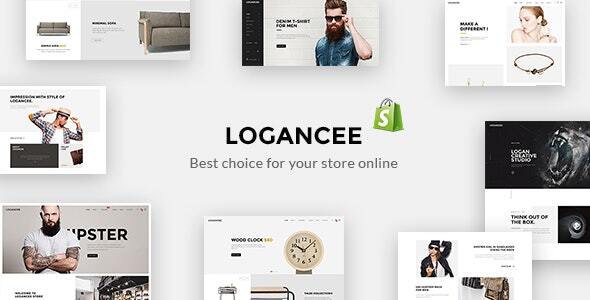
Logancee is a responsive ecommerce template built for the Shopify platform by the developer typostores, sold on ThemeForest for $39. It packages a set of pre-built storefront layouts, header variations and AJAX-driven shopping interactions into a single installable theme, aimed at store owners and freelancers who want a fashion, jewellery, interior or accessories shop live without commissioning custom design work. The Logancee Ecommerce template has accumulated 1,003 sales since its initial release in December 2015.
That sales figure matters less than the date attached to the most recent update: 11 May 2020. Anyone evaluating this theme in the present day needs to weigh a mature, well-documented codebase against a product that has not received vendor attention for several years. What follows is an assessment of what the template actually delivers, where it fits, and where it does not.
What the Logancee Ecommerce template actually gives a store owner
The core proposition is breadth of pre-built storefront design. The changelog records home layouts added one at a time across the first year — a jewellery store layout, a sidebar variant, a shoes store layout, a cosmetics home — reaching a dozen distinct homepage arrangements. For a store owner who needs a starting point that already looks like a finished shop rather than a blank canvas, that library is the main draw. Each layout ships with its own header treatment, so the theme effectively offers several visual identities rather than one design with colour swaps.
Underneath the layouts sits a fairly conventional Bootstrap 3 foundation, styled with HTML5, CSS3 and Sass. Sass matters for anyone who intends to customise: variables for colour, spacing and typography can be changed at the source rather than overridden with increasingly specific CSS. The theme also exposes unlimited colour options and Google Web Fonts integration through its own settings, which covers most of what a non-developer would want to change without touching stylesheets at all.
The shopping interactions are where the template earns its keep. Quick view lets a shopper inspect a product from a collection page without a full page load, and it is paired with hover states on product tiles. Ajax wishlist, Ajax cart and Ajax filtering all work without reloading the page, which is the behaviour modern shoppers expect from a storefront. Product sale labels, grid and list view switching, customer reviews and product variants are all present. None of this is unusual in 2020s ecommerce, but it is the baseline functionality a store cannot operate without, and it is included rather than sold as an add-on.
Navigation gets more attention than the average template. A mega menu is included, along with a canvas menu for mobile, and the changelog shows both were revised after launch. The theme also ships predefined pages for contact and about sections, a cookie popup, social networking integration and Font Awesome icons. Product pages are described as SEO optimised, though the vendor does not specify what that entails beyond standard markup, so it should be treated as a claim rather than a documented feature set.
Which projects suit this template, and which do not
The strongest fit is a small to mid-sized store in fashion, jewellery, sunglasses, interiors or accessories — the categories the vendor’s own demo layouts target. A freelancer building a first Shopify storefront for a client on a tight budget can use one of the twelve home layouts as a credible starting point and spend the remaining hours on product photography and merchandising rather than layout construction. Agencies producing several small stores in the same vertical could reuse the theme across projects and differentiate through colour, typography and header choice, which is exactly what the unlimited colour and font options are for.
It is the wrong choice for a store with unusual functional requirements. If the business model depends on subscriptions, complex bundle logic, multi-currency checkout with bespoke rules, or a headless front end, a template built around a fixed set of theme settings will fight those requirements rather than support them. It is also a poor fit for anyone who needs a vendor actively shipping compatibility fixes. Shopify changes its platform continuously, and a theme last touched in May 2020 has had no opportunity to absorb those changes. A store owner who is not comfortable debugging Liquid or hiring someone who is should look at a theme with current maintenance.
There is a third scenario worth naming: a merchant who wants a very specific, distinctive brand aesthetic. The template is competent and clean, but it is a template. Twelve home layouts still share a recognisable structural grammar, and shoppers who browse many Shopify stores will have seen variations on it before.
Strengths and limitations of the Logancee Ecommerce theme
Strengths
- Layout variety at a low price point. Twelve homepage layouts across distinct retail verticals, each with its own header treatment, for $39.
- Complete baseline commerce functionality. Ajax cart, wishlist, filtering, quick view, variants, reviews and sale labels are all included, so no essential shopping interaction needs to be built.
- Customisation without code. Colour, typography and header options are exposed in theme settings, with Sass available underneath for deeper changes.
- Mature, well-documented release history. The changelog spans more than four years and roughly twenty releases, which suggests the early bugs were found and fixed.
- Reasonable social proof. Over a thousand sales on ThemeForest indicates the theme has been used in production by a meaningful number of stores.
Limitations
- No updates since May 2020. This is the single most significant issue. Shopify’s platform, theme requirements and performance expectations have all moved on, and the vendor has published nothing since.
- Bootstrap 3 foundation. Bootstrap 3 is a legacy framework. Developers expecting a modern utility-class or flexbox-first codebase will find the markup dated and some patterns harder to extend.
- Vendor support status is unclear. The listing advertises long-term support and regular updates, but the changelog contradicts the “update regularly” claim. Buyers should assume support may be unresponsive.
- SEO claim is unsubstantiated. “Product SEO optimised” appears without detail. The vendor does not state what markup, structured data or performance work is included.
- Dated visual language in places. Parallax effects and some of the older home layouts reflect mid-2010s design conventions rather than current taste.
- No stated performance benchmarks. The changelog mentions an optimisation pass in version 1.2.0, but no measurable figures are published.
How the Logancee Ecommerce template compares with the wider category
The Shopify theme market splits roughly into three tiers: free themes from Shopify itself, mid-priced premium themes from established studios, and budget marketplace templates like this one. Free themes have the advantage of guaranteed platform compatibility and ongoing maintenance, but they offer far less layout variety and almost no design differentiation. Established premium themes typically cost several times more than $39 but come with active development, documented performance work and support channels that respond.
Logancee sits in the budget tier and competes on volume of included design rather than on maintenance or performance. Against other marketplace templates in the same price band, its advantages are the breadth of home layouts and the completeness of its Ajax commerce features. Its disadvantage is shared with much of that tier: the codebases tend to be older, and the vendors tend to move on to newer products. The relevant comparison is not feature against feature but risk against cost. A buyer saving perhaps $100 on the theme price should factor in the possibility of paying a developer to resolve a compatibility issue that a maintained theme would have handled.
For a store where the theme is a starting point that will be heavily customised anyway, the calculus shifts. The developer cost of fixing an old theme is small relative to a full custom build, and the $39 outlay is trivial. For a store owner who needs something that simply works and keeps working, the budget tier is the wrong place to be looking.
Frequently Asked Questions
Is the Logancee template still updated?
No. The most recent vendor update recorded on the product listing is 11 May 2020, and nothing has been published since. The listing still advertises regular updates and long-term support, but the changelog does not support that claim. Buyers should plan on maintaining the theme themselves or hiring a developer to do so.
What kinds of online stores is Logancee best suited to?
It fits small and mid-sized stores in fashion, jewellery, sunglasses, accessories and home interiors. The twelve included homepage layouts were built around those specific retail categories, so a store in one of them can launch with minimal design work. Stores with unusual functional requirements are a poorer match.
Does the Logancee Ecommerce theme require coding knowledge?
Basic setup does not. Colour, typography, header layout and menu configuration are handled through theme settings, and the predefined pages cover contact and about sections. Deeper changes to layout structure or styling require comfort with Liquid, HTML and Sass, and the Bootstrap 3 codebase is dated enough that some familiarity with older framework conventions helps.
How does Logancee handle product filtering and cart interactions?
Filtering, wishlist additions and cart updates all run over Ajax, so shoppers can refine a collection or add items without a page reload. Quick view opens product details from the collection page, and product tiles carry hover states. Sale labels, grid and list view switching, variants and customer reviews are also included as standard.
Verdict on the Logancee Ecommerce template
Buy this if the budget is genuinely tight, the store fits one of the fashion, jewellery or interiors categories the layouts target, and there is either developer resource available or a willingness to accept that the theme will not receive vendor fixes. The Logancee Ecommerce template delivers a lot of finished design and complete Ajax commerce functionality for $39, and its thousand-plus sales suggest it has worked in production for a real number of merchants.
Do not buy it if the store depends on current platform compatibility, if support responsiveness matters, or if nobody involved can read Liquid. The absence of updates since May 2020 is not a minor caveat — it is the deciding factor for most buyers, and it should be weighed before the price. A maintained theme costing several times more is often the cheaper decision once developer time is counted.