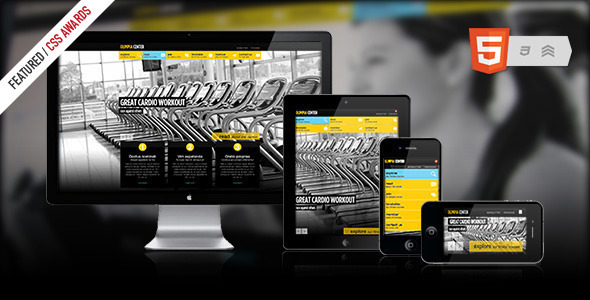
Olimpia Responsive Fullscreen Fitness Center health-beauty is a static HTML5 and CSS3 template sold on ThemeForest for $21, aimed at gyms, personal trainers, yoga studios and wellness businesses that need a marketing site rather than a content-managed one. It ships with a fullscreen image slider, a fullscreen gallery, AJAX-powered signup and contact forms, and a Skeleton-based responsive grid, all built by the theme studio Ansonika. It suits a freelancer or agency delivering a fast, single-purpose promotional site on a tight budget, and it is a poor fit for anyone who needs a blog, e-commerce or a non-technical client editing pages after launch.
What the Olimpia Responsive Fullscreen Fitness Center template actually includes
The defining characteristic of this template is its fullscreen presentation model. The FlexSlider component stretches imagery across the entire viewport rather than sitting inside a fixed-width content column, which is the layout most gym and studio sites use to lead with atmosphere — equipment, classes, instructors — before any text appears. A separate fullscreen gallery extends the same treatment to photo sets, and the vendor lists responsive video support alongside it, so a background or inline video can scale with the viewport instead of being cropped or letterboxed.
Underneath the visuals, the build is deliberately conventional. The markup is HTML5 with CSS3 for typography and effects, and the layout sits on the Skeleton grid, a lightweight responsive framework that predates the utility-class era. In practice that means a developer who already knows Skeleton can move quickly, and a developer who does not will still find the structure readable because it is a small, well-documented grid rather than a proprietary system. Fonts are loaded through CSS3 @font-face declarations, so custom typefaces can be swapped without touching a plugin layer.
The interactive pieces are where the template does more than a typical static download. The newsletter signup, the “join” form and the contact form are all handled over AJAX with PHP endpoints, which means submissions happen without a page reload and the visitor stays on the page they were reading. For a fitness business, that matters: a membership enquiry form that reloads the page loses a percentage of submissions to impatience, and keeping the interaction in place is a small but real conversion advantage. The PHP side is included, so the forms are functional out of the box provided the host runs PHP.
Supporting elements include accordion tabs and standard tabs for organising class schedules, pricing tiers or FAQ content; a PrettyPhoto lightbox for image viewing; and an embedded Google Map, which is the expected way to show a studio’s physical location. The vendor describes the template as very easy to edit, and the file structure supports that claim — there is no build step, no package manager and no compiled asset pipeline to reverse-engineer.
One detail worth stating plainly: the demo photography is not included. The listing points to stock sources for the images shown in the preview, so the visual impression the demo creates has to be rebuilt with licensed or original photography. Budget for that separately, because a fullscreen template lives or dies on the quality of the images placed into it.
Where this template fits and where it does not
The strongest use case is a single-location gym, CrossFit box, dance studio, physiotherapy practice or personal training business that needs a brochure site: who we are, what we offer, where we are, how to get in touch. These projects have a short content set that rarely changes, and a static template handles them with far less overhead than WordPress. Load times are better, there is no database to maintain, no plugin update cycle and no attack surface from a CMS. For an agency billing a fixed fee on a two-week turnaround, that is a meaningful margin improvement.
It also works well as a landing page for a specific campaign — a class launch, a membership drive, a single trainer’s personal brand — where the fullscreen slider and gallery do the persuasive work and the AJAX join form captures the lead. Freelancers building a portfolio piece or a first commercial site will find the price point low enough to experiment with.
Where it breaks down is any project that expects the client to edit content themselves. There is no admin panel, no WYSIWYG editor and no content API. Every text change, new class, price update or staff photo goes through a developer editing HTML files and re-uploading them. A gym owner who wants to post a schedule change on a Friday afternoon cannot do it without help. If ongoing self-service editing is a requirement, a WordPress or other CMS-based theme is the correct category, not this one.
Multi-location businesses, sites needing member login areas, booking systems, e-commerce for merchandise or class packages, and anything requiring a blog with archives and categories are also outside what this template provides. Those needs require a platform with server-side application logic, and bolting them onto a static template produces a fragile result.
Strengths and limitations of the Olimpia Responsive Fullscreen Fitness Center theme
Strengths
- The fullscreen slider and gallery are the template’s core competency, and they are executed as a coherent visual system rather than a single hero image with ordinary pages behind it.
- AJAX form handling for newsletter, join and contact submissions keeps visitors on-page and removes the reload penalty that costs conversions on static sites.
- No build tooling, no dependency chain and no CMS to maintain, which keeps hosting cheap and the security surface small.
- Responsive behaviour is baked into the Skeleton grid rather than patched on, so the layout adapts from phone to tablet to desktop without a separate mobile theme.
- At $21 with 315 sales and a long-standing author in Ansonika, the commercial risk is low and the codebase is likely to be encountered by other developers.
- Semantic HTML5 structure and CSS3 typography give a clean starting point for customisation without fighting a framework.
Limitations
- No content management layer at all. Clients cannot update text, images or schedules without developer involvement, which makes the total cost of ownership higher than the sticker price suggests over a multi-year engagement.
- The last vendor update was September 2021. The template is not abandoned in any dramatic sense, but it has not tracked recent browser behaviour, accessibility expectations or modern CSS practices, and the vendor does not state a support or update commitment going forward.
- Demo images are licensed separately and not bundled. A fullscreen template with weak photography looks considerably worse than the preview, so the real budget is $21 plus a stock or shoot cost.
- The AJAX forms depend on PHP being available on the host. On static hosting platforms, or where PHP mail is restricted, the forms will need reworking or replacing with a third-party form service.
- Accessibility provisions are not documented. A fullscreen slider with autoplay and a lightbox gallery typically needs manual work on keyboard navigation, focus management and reduced-motion handling, and the listing gives no indication that any of this is addressed.
- Skeleton is a legacy grid. Developers accustomed to Flexbox and CSS Grid utility frameworks will find the layout system dated, even if it remains perfectly functional.
How this compares with other fitness and health-beauty templates
The health and beauty template category splits roughly into two halves: CMS-driven themes, overwhelmingly for WordPress, and static HTML templates like this one. The CMS half wins on editability, extensibility and the ecosystem of booking, membership and e-commerce plugins that can be attached. It loses on performance overhead, maintenance burden and the fact that a $59 WordPress theme often requires several paid plugins to reach the same functional state.
Within the static half, differentiation comes down to layout ambition and form handling. Many HTML templates in this category are conventional multi-page brochure sites with a modest hero image. Olimpia’s fullscreen treatment is a more opinionated design decision, and it is the reason to choose it over a generic alternative — the template is making an argument that the photography should carry the page. Templates that instead emphasise pricing tables, class timetables or trainer bios are solving a different problem and may suit a studio whose selling proposition is scheduling rather than atmosphere.
Compared with page-builder-based approaches, the trade-off is control versus convenience. A builder lets a non-technical owner assemble pages visually at the cost of heavier markup and slower loads. This template produces leaner output but requires someone comfortable in a code editor. Neither is universally better; the deciding factor is who will maintain the site in month six, not who builds it in week one.
Frequently Asked Questions
Do I need to know how to code to use this template?
Yes, for any content change. Olimpia is a static HTML5 and CSS3 template with no admin panel, so editing text, swapping images or adding a class requires working directly in the HTML files and re-uploading them. A developer or someone comfortable with basic markup is required; a gym owner with no technical background cannot maintain it independently.
Are the images shown in the demo included with the purchase?
No. The vendor states explicitly that images are not included and links to the stock sources used in the preview. Buyers must license their own photography or shoot original images. Because the layout is fullscreen and image-led, the quality of the replacement photography has a larger effect on the finished result than with a conventional template.
Does this template work for a WordPress site?
No. It is a standalone HTML template, not a WordPress theme, and it cannot be installed through the WordPress dashboard. Converting it would mean rebuilding the design as a custom theme, which is usually more work than starting from an existing WordPress fitness theme. Choose this only if a static site is the intended outcome.
Is the template still maintained and updated?
The vendor’s most recent update is dated September 2021, and the listing does not state a future update or support commitment. The template remains functional as a static build, but buyers should assume no further feature development and verify current browser compatibility themselves rather than relying on ongoing vendor maintenance.
Verdict on the Olimpia Responsive Fullscreen Fitness Center health-beauty template
Buy this if the project is a single-location gym, studio or trainer site with a stable content set, the budget is tight, and either the buyer or the delivering freelancer is comfortable editing HTML. The fullscreen slider, gallery and AJAX forms give it a clear visual and functional identity that justifies the $21 against a generic brochure template, and the 315 sales and Ansonika’s track record make it a low-risk purchase.
Do not buy it if the client expects to update the site themselves, if the project needs booking, membership accounts, e-commerce or a blog, or if long-term vendor support and modern accessibility standards are hard requirements. In those cases a CMS-based theme is the correct choice, and the money saved here would be spent several times over on developer hours for routine edits.