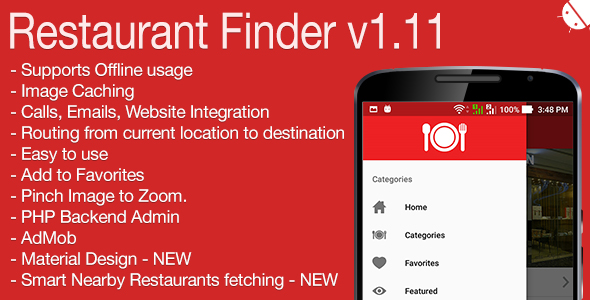
Restaurant Finder Full Android Application v1.11 is a native Android source code package that builds a restaurant locator app, complete with map routing, distance calculation, categories, favourites and photo galleries. It ships as an Android Studio project plus a PHP backend for managing restaurant data, and it is aimed at developers and agencies who want a working locator app they can rebrand rather than build from scratch. The listing is published on ThemeForest under the Android category by developer Mangasaur Games at $24.
The product has been maintained across a long version history, from an initial release through to v1.11 in September 2020, which is unusual for a low-priced CodeCanyon-style item. That history is also the most important thing to understand about it: the codebase matured through the Eclipse-to-Android-Studio migration era, and the later updates are largely maintenance rather than new features.
What the Restaurant Finder Full Android Application v1.11 actually does
The core of the app is a nearby-restaurant locator. Restaurants are stored in a local database, which means the app keeps working when the device loses connectivity — a meaningful advantage over locator apps that query a live API on every screen. The vendor describes this as “supports offline usage” and pairs it with image caching, so gallery and slider images are not re-downloaded each time a user opens a listing.
Location features are the strongest part of the package. Users can view restaurants on a map, request a route to one, and see the calculated distance between their position and the venue. The distance logic was refined in v1.6 with an auto-adjust behaviour, which suggests the developer addressed the common problem of stale distances when a user moves. Categories let the operator classify venues by type, and a favourites system gives users a shortlist they can return to without searching again.
Contact and conversion actions are built in. Each listing can trigger a phone call, open an email composer, or hand off to a web page, which covers the three ways a diner typically acts on a restaurant they have just found. Photo galleries support zoom and panning, and featured restaurants get their own image slider — the kind of presentation detail that separates a usable listing screen from a bare text entry.
The backend is PHP and manages the restaurant data. The listing notes PHP 7 support was added in v1.9, and that the Google Maps API key was moved out of inline code into constants and then into the Gradle build file, which is the correct place for it. A GDPR consent flow was added in the same release, and v1.10 removed call log and SMS permissions — a sensible cleanup given how aggressively Google Play now scrutinises permission requests.
Where this fits, and where it does not
The obvious fit is a freelancer or small agency delivering a restaurant directory, food guide or city dining app on a fixed budget and a short timeline. Because the source is included, the buyer can rebrand colours, typography and copy, then populate the backend with their own venues. A tourism board, a local food magazine, or a chain wanting its own branded locator app are all plausible buyers.
It also suits developers who want a reference implementation. The project demonstrates a workable pattern for offline-first data with a remote PHP source, map integration, and permission handling across API levels — useful if the goal is to learn the structure and then extend it.
It is the wrong choice for anyone who needs a multi-platform release. There is no iOS counterpart, no web app and no cross-platform layer here; the deliverable is an Android Studio project. It is also a poor fit for a business that wants a hosted, no-code solution. Running this app means owning a PHP host, a Google Maps API key with billing attached, and the responsibility for keeping the backend patched. Buyers who want to publish on Google Play should also note the vendor does not state a target SDK level for v1.11, so the build’s compliance with current Play requirements needs to be verified before purchase rather than assumed.
Strengths and limitations
Strengths
- Offline-capable local database with image caching, so the app degrades gracefully on weak connections.
- Genuinely complete locator feature set: map routing, distance calculation, categories, favourites, galleries and featured sliders.
- Call, email and web integrations cover the standard diner actions without custom work.
- Long, documented version history showing the developer has shipped fixes rather than abandoning the item.
- GDPR consent flow and removal of call log and SMS permissions show attention to store policy and privacy expectations.
- Maps API key externalised into build constants, which is the right pattern and saves a common configuration mistake.
- Low entry price relative to the amount of working functionality included.
Limitations
- The most recent release is v1.11 from September 2020. The update notes for that version mention a settings page, network security and a build version bump — no new user-facing features. Buyers should expect to modernise dependencies themselves.
- The vendor does not state the target SDK, minimum SDK or the Android Studio version required, so compatibility with current tooling is unverified from the listing alone.
- A PHP backend must be hosted and maintained separately. The listing gives no detail on the backend’s framework, database schema or authentication model.
- Support is explicitly scoped to bug fixes and lightweight changes. Functionality additions or removals are excluded, so anyone planning to substantially reshape the app is on their own.
- No sales count is disclosed on the listing, so there is no public signal about how many buyers have deployed it or how active the user community is.
- Google Maps usage carries its own API billing, which is an ongoing cost the $24 price does not cover.
- The listing includes a notice about impersonation and legal action against a third party. It is worth reading before purchase so the official contact address is clear.
How it compares with the wider category of locator app scripts
Restaurant and directory locator scripts generally fall into three groups: hosted SaaS builders where the operator never touches code, WordPress plugins that bolt a directory onto an existing site, and native source packages like this one. The first group is faster to launch but locks the operator into a subscription and rarely allows deep customisation. The second is cheap and familiar but constrained by the host platform and usually weaker on offline behaviour and native map performance.
The Restaurant Finder Full Android Application v1.11 sits firmly in the native source group, and that is where its trade-off lies. It offers full control and a real offline data layer, which hosted and plugin options typically cannot match, in exchange for requiring Android and PHP skills plus hosting. Within that group it is competitively featured — routing, distance, categories, favourites and galleries are all present rather than sold as add-ons — but it is not the most recently maintained option, and a buyer comparing against newer native templates should weigh update recency and documentation quality, not just the feature list.
Frequently Asked Questions
Do I need coding skills to use Restaurant Finder Full Android Application v1.11?
Yes, some. The package is an Android Studio project plus a PHP backend, so publishing it requires the ability to open, build and configure an Android project, deploy PHP to a host, and generate a Google Maps API key. Buyers without those skills would need to hire a developer, which adds to the effective cost.
Does the app work without an internet connection?
Partly. Restaurant data is held in a local database and images are cached, so previously loaded listings and photos remain viewable offline. Map tiles, routing and distance calculation depend on Google Maps services and will not function without connectivity, so the offline experience covers browsing rather than navigation.
Can the app be rebranded and published under my own name?
Yes. The purchase includes the full source, so colours, typography, copy and assets can be changed and the result published under the buyer’s own developer account. The vendor’s support terms cover bug fixes and light changes only, so substantial redesigns fall outside what support will assist with.
Is the app compatible with current Android versions?
The vendor does not state a target or minimum SDK for v1.11, and the last release was September 2020. That means compatibility with the latest Android releases and current Google Play submission rules cannot be confirmed from the listing. Buyers should plan to update Gradle, dependencies and the target SDK as part of their project.
Verdict on Restaurant Finder Full Android Application v1.11
This is a sensible purchase for a developer or agency that needs a working Android restaurant locator with offline data, maps, routing and contact actions, and is comfortable bringing the project up to current Android standards. The feature coverage is broad for the price, and the documented version history suggests the code has been maintained rather than dumped.
It is not the right buy for someone wanting a no-code launch, a cross-platform release, or a package that is current out of the box. The 2020 release date, the unstated SDK targets and the narrow support scope are the three things to weigh before paying. Anyone whose project depends on iOS, on a hosted dashboard, or on the vendor handling substantial customisation should look elsewhere.