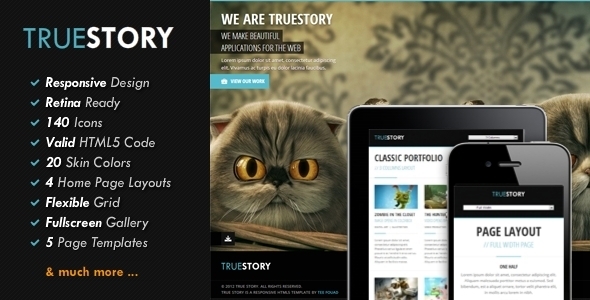
TrueStory is a fullscreen HTML5 template built for creative portfolios, photography showcases and image-led marketing pages, sold on ThemeForest for $25. It ships with four home page layouts, three fullscreen gallery styles, a filterable portfolio and a CSS3 animation layer, and it targets freelancers and small studios that want a visually loud site without building a custom theme. Buyers should weigh its age carefully: the last vendor update landed in July 2014, so TrueStory creative projects work best when the template is treated as a static front end rather than a maintained platform.
What TrueStory creative actually delivers out of the box
The template’s organising idea is that the browser window is the canvas. Layouts stretch to fill the viewport rather than sitting inside a fixed container, which suits photography, motion work, architecture and any portfolio where the images are the argument. Three fullscreen gallery layouts are included, and a ColorBox-powered fullscreen image viewer handles the lightbox duty. Ajax portfolio items are linked together so the next and previous navigation carries across from one project to the next without a page reload, which is a small detail that makes browsing a body of work feel continuous rather than fragmented.
Under the surface there is more structure than the fullscreen presentation suggests. A six-column grid with nestable columns underpins the page builder, so a two-thirds/one-third split or a stacked editorial layout is a matter of nesting rather than hand-written CSS. Twenty pre-defined skin colours ship with the template, and each page can carry its own background image, which means a site can shift mood between sections without a second stylesheet. Five page templates and three page layouts cover the usual suspects: home, portfolio, gallery, standard content and contact.
Typography is handled through web fonts, and the vendor states that any custom font can be loaded, so the template is not locked to a single typeface family. The icon set is unusually generous for the price point: 140 vector icons that can be recoloured and resized, with a reference page listing the icon-to-code mapping so the right glyph can be found without guessing. The contact form submits over Ajax, which keeps the fullscreen illusion intact instead of dumping visitors onto a bare confirmation page.
Two implementation details are worth flagging because they affect how the template behaves on real hosting. A configuration parameter in the main JavaScript file converts relative URLs in the main menu to absolute URLs, which addresses the classic problem of a template breaking when it is installed in a subdirectory or virtual directory rather than at the domain root. Separately, the home slider accepts a per-slide duration attribute, including a value that halts autoplay on a chosen slide — useful when one image deserves to sit still while the rest cycle.
Responsiveness and high-density displays are both covered. The layout adapts as the browser window resizes, and the assets are prepared for Retina and comparable high-resolution screens. The markup is valid HTML5, and the CSS3 animation layer includes fallback handling for browsers that do not support the newer properties, so the site degrades rather than collapsing on older engines.
Where a fullscreen HTML5 portfolio template fits, and where it does not
The clearest fit is a photographer, illustrator or small design studio that needs a portfolio site live quickly and has a defined set of images ready to go. The fullscreen galleries and the filterable portfolio do the heavy lifting, and the twenty skin colours mean a reasonable brand match can be found without commissioning design work. A freelancer building a personal site on a $25 budget is squarely in scope, as is an agency producing a one-off campaign or microsite where the visual treatment matters more than a content management workflow.
It also suits anyone who wants to hand a finished static site to a client who will rarely touch it. Because the template is HTML, CSS and JavaScript rather than a CMS theme, there is no admin panel to secure, no database to maintain and no plugin update treadmill. For a brochure-style presence with a contact form, that is a feature rather than a limitation.
The wrong choice is a content-heavy site. A blog, a news outlet, a documentation portal or anything with a large and growing body of text will fight the template’s fullscreen premise at every turn — the layouts are built around images occupying the viewport, not around long-form reading. The same applies to any project that requires multiple editors, scheduled publishing, e-commerce, membership or structured content types. TrueStory has no CMS integration, so those needs would have to be met by rebuilding the front end on top of WordPress or another platform, at which point the template’s value is mostly its design reference. Buyers who need a client to update galleries weekly through a dashboard should look at a theme rather than a static template.
Strengths and limitations of this ThemeForest template
Strengths
- Fullscreen presentation is the default rather than an add-on, which is exactly what image-led portfolios need.
- Four home page layouts, five page templates and three gallery layouts give genuine variety within one purchase.
- The nestable six-column grid supports editorial layouts without custom CSS work.
- 140 recolourable vector icons plus a reference page remove a common source of friction.
- Per-page background images and twenty skin colours allow visual differentiation across a single site.
- Ajax portfolio navigation links items together, so browsing a body of work feels continuous.
- Absolute-URL conversion for the main menu addresses subdirectory installs directly.
- Valid HTML5 with CSS3 fallbacks, and Retina-ready assets.
- At $25 with 767 sales, the price-to-capability ratio is difficult to argue with.
Limitations
- The last vendor update is dated July 2014. That is more than a decade without maintenance, so compatibility with current browsers and any modern build tooling is not assured and would need testing before purchase.
- There is no CMS layer. Every gallery item, portfolio entry and text change is a manual edit to markup.
- No page builder, block editor or visual editing interface is provided.
- Customisation runs through the main JavaScript configuration file and hand-edited CSS, which assumes comfort with code.
- The vendor does not state a support policy, documentation depth or browser support matrix beyond the fallback claim.
- Ajax-driven navigation can complicate analytics tracking and deep linking unless handled deliberately.
- Nothing in the listing indicates accessibility work such as keyboard navigation for the lightbox or ARIA labelling for the galleries.
How TrueStory compares with the wider creative template category
The creative template market splits roughly three ways: static HTML5 templates like this one, CMS themes that wrap a design around WordPress or a similar platform, and site builders where the design is assembled from components rather than shipped as a finished file. TrueStory sits firmly in the first group, and that placement explains most of its trade-offs.
Against CMS themes, the static approach wins on speed, hosting simplicity and the absence of a plugin dependency chain. A static template loads fast because there is no database query behind each page, and it cannot be broken by a plugin update. It loses on everything an editor needs: no dashboard, no revision history, no roles, no scheduled publishing. For a portfolio that changes twice a year, the static model is fine. For one that changes weekly, it is a liability.
Against site builders, the comparison is about control versus convenience. A builder lets a non-technical owner restructure a page by dragging elements, at the cost of heavier markup and a subscription. TrueStory hands over clean, hand-written HTML5 that a developer can extend freely, but every change requires that developer. The relevant question is not which is better in the abstract but who will be maintaining the site after launch.
Within the static HTML5 group itself, the differentiators are the fullscreen gallery implementation, the depth of the grid system and the icon set. TrueStory is competitive on all three at $25, and its 767 sales and established rating on ThemeForest indicate a reasonable number of buyers have found it workable. What it cannot claim is currency — templates in this category that receive ongoing updates hold an advantage purely on browser compatibility.
Frequently Asked Questions
Is TrueStory – Fullscreen HTML5 Template still usable in 2025?
Yes, with caveats. The HTML5, CSS3 and jQuery foundations still render in modern browsers, and the fallback handling helps on older engines. However, the vendor’s last update was July 2014, so there is no guarantee that every script behaves correctly against current browser versions. Testing the demo and a local install before purchase is the sensible approach.
Does TrueStory creative require WordPress or any CMS?
No. It is a standalone HTML5 template, so it runs on any static web host with no database, no PHP requirement and no plugin stack. That makes hosting cheap and setup fast, but it also means every content change is a manual edit to the HTML files rather than something done through an admin dashboard.
Can the galleries and portfolio be customised without coding?
Partly. Skin colours, background images and slider behaviour are configurable, and the slider accepts per-slide duration and fade attributes in the markup. Deeper changes — layout structure, grid nesting, new page templates — require editing the HTML and CSS directly, and the main configuration options live in a JavaScript file.
How many images or portfolio items can the template handle?
The vendor does not state a limit. Because items are plain markup rather than database records, the practical ceiling is page weight and load time rather than a hard cap. A filterable portfolio with a few dozen items should be manageable; very large galleries would benefit from pagination or lazy loading added by the developer.
Verdict on TrueStory creative
TrueStory is a well-equipped fullscreen HTML5 template for its era, and the feature list still reads generously: four home layouts, three gallery styles, a nestable grid, 140 icons and per-page backgrounds for $25. The 767 sales and established ThemeForest rating suggest buyers have generally got what they paid for. It is the right purchase for a developer or designer building a static, image-first portfolio or campaign site where the visuals carry the page and content changes are infrequent. It is the wrong purchase for anyone who needs a CMS, multiple editors, e-commerce or a template that receives ongoing maintenance — the 2014 update date is the single fact that should decide the question. Buyers who accept the trade-off get a fast, clean front end at a very low price; buyers who need a living platform should keep looking.