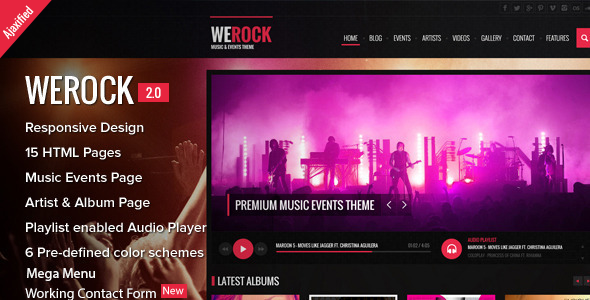
WeRock Entertainment is a static HTML template sold on ThemeForest for $24, built on Bootstrap 3 and aimed at musicians, radio stations, bands and event promoters who need a promotional website without a CMS behind it. It ships with 15 pages, an Ajax-driven version, a playlist-capable audio player and a mega menu, and it was last updated by its developer, xvelopers, in June 2015. Buyers get a front-end codebase to customise, not a hosted service or a WordPress theme.
The listing has accumulated 618 sales, which for a template in the entertainment category is a reasonable signal that the layout choices resonate with people building music and event sites. That said, anyone evaluating it now needs to weigh a decade-old codebase against modern expectations for accessibility, performance and mobile behaviour.
What WeRock Entertainment actually delivers in the box
The core of the package is a set of 15 hand-built HTML pages covering the usual territory for a music or event brand: a landing page, band or artist profiles, a discography or release listing, a schedule or tour page, gallery layouts, a blog-style news section, and contact. Because the pages are static markup rather than CMS templates, the buyer edits them directly in a code editor and uploads them to any host. That makes deployment trivial and removes the database and PHP requirements entirely.
The audio player is the headline feature, and it is the one element that separates WeRock Entertainment from a generic Bootstrap template. It supports playlists defined in HTML, so a station or band can list tracks in the markup and have the player advance through them without a backend. The vendor added an Ajax version in the 2.0 release, which means page content can be swapped in without a full reload — useful for keeping audio playing while a visitor browses between sections of the site. The same update addressed audio playback on mobile devices, a common failure point for HTML5 audio implementations of that era.
Navigation is handled through a mega menu, which suits the content density of an entertainment site: genres, artists, schedules and archive links can all sit under a single parent item without forcing a deep hierarchy. The template is built on Bootstrap 3’s grid, so the responsive behaviour follows that framework’s breakpoints and class conventions. Font Awesome is bundled for iconography, and the markup is described as HTML5-validated with semantic structure — worth checking yourself with a validator, but the intent is a clean document outline rather than a wall of divs.
Beyond the layout, there is a tweet plugin and Ajax-validated contact form, both added in the 1.2 release. Those are conveniences rather than differentiators, and the Twitter integration in particular is the kind of thing that ages badly as platform APIs change.
Where WeRock Entertainment fits, and where it does not
The strongest fit is a small radio station, podcast network or independent label that wants a lightweight promotional site and already has hosting. Because there is no database or server-side runtime, the site can live on cheap static hosting or even a CDN bucket, and there is nothing to patch beyond the front-end dependencies. A band preparing a single-album campaign, or an event promoter running a one-off festival site, can take the existing pages, swap the imagery and copy, and be live quickly.
Freelancers and small agencies may also find it useful as a starting point when a client wants a music-flavoured site and the budget does not stretch to a custom build. The Bootstrap foundation means anyone comfortable with that framework can restyle it without fighting unfamiliar conventions.
It is the wrong choice in several common scenarios. If the client needs to publish gig dates, upload tracks or write news posts without touching code, a static template is a poor fit — a WordPress theme or a headless CMS setup would serve them far better. If the project requires e-commerce for merchandise or ticketing with inventory management, WeRock Entertainment provides none of that. And if the site must meet current WCAG conformance targets or pass modern Core Web Vitals thresholds out of the box, a 2015 Bootstrap 3 build will need substantial remediation work before it is close.
Strengths and limitations of the WeRock template
Strengths
- The playlist-enabled audio player is genuinely useful for radio and music sites, and the Ajax mode lets playback continue while visitors navigate.
- Static HTML output means no database, no PHP, no plugin updates and no server-side attack surface.
- Fifteen pages cover the standard content needs of a band, station or event brand without requiring the buyer to invent layouts.
- Bootstrap 3 is widely documented, so restyling and extending the grid is straightforward for anyone with front-end experience.
- The mega menu handles dense navigation well, which matters when a site has many artists, genres or event categories.
- At $24 with 618 sales behind it, the price-to-effort ratio is favourable for a quick promotional build.
Limitations
- The last vendor update was June 2015. Bootstrap 3 itself reached end of life years ago, and the bundled Font Awesome and jQuery-era dependencies are well behind current releases.
- There is no content management layer. Every gig date, track listing and news item is a manual HTML edit, which becomes unmanageable for anyone publishing frequently.
- The Twitter integration depends on an API surface that has changed substantially since the template was maintained, so that feature should be treated as non-functional until verified.
- Accessibility is not addressed in the vendor’s feature list. Audio players, mega menus and carousels are exactly the components that need careful ARIA and keyboard handling, and there is no indication that was done.
- Mobile audio fixes were applied in 2015, but browser autoplay policies and iOS audio behaviour have changed considerably since; testing on current devices is essential.
- Documentation and support scope are not stated in the listing, so buyers should assume self-sufficiency is required.
How WeRock Entertainment compares to the wider template category
Static HTML entertainment templates occupy a specific niche. Compared with a WordPress music theme, WeRock Entertainment trades flexibility for simplicity: no admin panel, no plugins, no hosting requirements beyond a web server, but also no way for a non-technical client to update anything. Compared with a general-purpose Bootstrap template, it wins on domain-specific layouts — the audio player and playlist structure are the parts that would take real effort to build from scratch — but loses on breadth of page variety and on maintenance currency.
Against modern page-builder-driven themes, the gap is wider. Tools that generate markup from a visual editor offer responsive controls, accessibility options and ongoing updates as part of the subscription. WeRock Entertainment offers a fixed, hand-editable codebase. For a developer who wants full control and no vendor lock-in, that is an advantage. For an agency handing a site to a client, it is usually a liability.
The honest framing is that this is a well-executed 2015 template that still works as a starting point, provided the buyer budgets time for modernisation. It is not a turnkey solution in 2024 terms, and anyone expecting current best practices out of the box will be disappointed.
Frequently Asked Questions
Is WeRock Entertainment a WordPress theme?
No. WeRock Entertainment is a static HTML template built on Bootstrap 3, not a WordPress theme or plugin. It consists of 15 hand-coded pages that are edited directly and uploaded to any web host. There is no admin dashboard, no database and no theme customiser, so all content changes happen in the source files.
Can the audio player stream a live radio feed?
The player is designed around playlists defined in HTML rather than live streaming endpoints. It can play a sequence of audio files and, in the Ajax version, keep playing while visitors move between pages. Pointing it at a continuous live stream URL is not something the vendor documents, so that use case would require custom work.
Does WeRock Entertainment still work with current browsers?
The core HTML, CSS and Bootstrap 3 layout will render in modern browsers, but several bundled components are dated. The Twitter plugin relies on an API that has changed since 2015, and mobile audio behaviour has shifted with autoplay restrictions on iOS and Android. Testing and likely patching are required before launch.
What support and updates come with the purchase?
The listing does not specify a support period or update commitment, and the most recent vendor update is dated June 2015. Buyers should assume the template is sold as-is with no ongoing maintenance. Any framework upgrades, accessibility fixes or browser compatibility work after purchase are the buyer’s responsibility.
Verdict on the WeRock Entertainment template
WeRock Entertainment suits developers and small studios who need a music, radio or event site live quickly and are comfortable editing HTML directly. The playlist audio player and the mega menu navigation are the parts that justify the $24 price, and the static architecture keeps hosting simple and cheap. It is not the right purchase for anyone who needs a client-editable CMS, e-commerce, or a site that meets current accessibility and performance standards without additional work. The 618 sales and the fact that xvelopers shipped three update rounds between 2014 and 2015 suggest a solid original build, but the long silence since then means the buyer is effectively adopting a legacy codebase. Treat it as a head start on a custom project rather than a finished product.