Key Features
The Car Make/Model DB – 9900+ Models – jQuery plugin delivers a robust data-driven solution for websites requiring vehicle search functionality. Built with a comprehensive database spanning over a century of automotive history, this tool eliminates the need for manual data entry or third-party API subscriptions. Below are the standout features that make this product a go-to choice for developers and site owners.
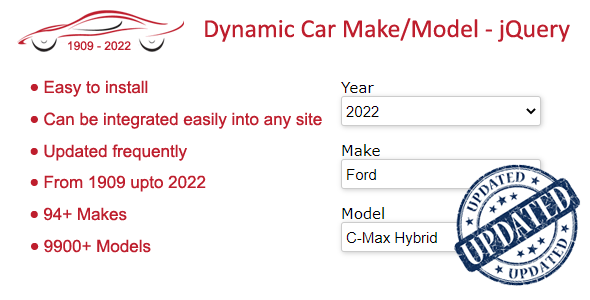
- Extensive Vehicle Coverage (1909–2022): The database includes models from 1909 through the 2022 model year, making it one of the most complete offline-ready vehicle databases available. Whether you need classic cars from the 1920s or the latest 2022 releases, this dataset covers the full timeline.
- 94+ Car Makes and 9,900+ Models: With support for over 94 vehicle manufacturers (including luxury, domestic, import, and discontinued brands) and nearly 10,000 distinct model variations, the script provides granular selection options. This reduces user frustration caused by missing or outdated entries.
- jQuery-Powered Interactive Forms: The front-end uses lightweight jQuery to create cascading dropdown menus. When a user selects a year, the make dropdown updates automatically; selecting a make then populates the model list. This logic is handled client-side without page reloads, ensuring fast interaction.
- Frequent Database Updates: The developer commits to regular updates, ensuring new model years and emerging car brands are added. This is critical for automotive sites where outdated data can cost credibility and sales.
- Quick Installation and Integration: The script is designed to be embedded into any existing website with minimal effort. You do not need to restructure your site or migrate to a specific CMS—just include the necessary files and connect the HTML.
- Seamless Year/Make/Model Flow: The three-step selection process is intuitive and follows industry-standard automotive search patterns. This reduces cognitive load for users and increases the likelihood of completing a search or form submission.
These features collectively solve the common problem of maintaining an accurate, large-scale vehicle database while keeping the user interface simple and responsive.
Who Is This For? Use Cases
The Car Make/Model DB is not a niche plugin—it serves a wide range of web projects. Its versatility makes it suitable for commercial, informational, and service-oriented platforms. Below are the primary use cases where this tool delivers maximum value.
Automotive E-Commerce and Parts Stores
If you run an online store selling car parts, accessories, or tires, you need customers to identify their exact vehicle quickly. Integrating this jQuery form allows visitors to select their year, make, and model before browsing compatible products. This reduces returns and support inquiries because the user can self-qualify their vehicle. For example, a WooCommerce-based parts seller can use the script to pre-filter the product catalog, improving conversion rates by guiding users to the right items immediately.
Car Dealerships and Classifieds
Dealerships and private car listing platforms benefit from this tool by enabling advanced search filters. Instead of forcing users to browse thousands of listings manually, the Year/Make/Model dropdown narrows results instantly. This is particularly useful for used car websites where inventory changes daily. The script saves development time because you do not have to build a custom vehicle database from scratch—just plug in the pre-built solution and style it to match your brand.
Auto Repair Shops and Service Providers
Auto mechanics, detailing centers, and insurance estimators often need quick vehicle identification. A repair shop can embed the form on their booking page, allowing customers to specify their car model before scheduling an appointment. This automates the data collection process and ensures the mechanic knows exactly what vehicle is arriving. The database accuracy reduces the risk of ordering wrong parts or misdiagnosing issues.
Car Enthusiast Blogs and Community Sites
Blogs focused on classic cars, reviews, or automotive history can use the database to create interactive features. For instance, a site reviewing every Chevrolet model could let readers filter articles by year and model. This increases engagement and time on site, which are positive signals for SEO. The regular updates ensure that even niche or low-volume models remain in the dataset.
Technical Details & Compatibility
Before purchasing, understanding the technical requirements and compatibility landscape is essential. The 2022 Car Make/Model DB – jQuery is built for simplicity, but it does have specific dependencies.
- Core Technology: The script relies on jQuery (version 1.7 or higher recommended). It does not use any modern frameworks like React or Vue, which actually simplifies integration on legacy websites or platforms with specific jQuery versions.
- Data Format: The car database is provided as a JavaScript object or JSON, making it easy to modify, filter, or extend. You can update the data without touching the form logic.
- Browser Support: Compatible with all modern browsers (Chrome, Firefox, Safari, Edge) as well as older versions of Internet Explorer (IE9+) due to jQuery’s backward compatibility.
- Platform Agnostic: Works on any HTML website, including WordPress, Joomla, Drupal, static sites, or custom PHP frameworks. No CMS-specific hooks are required.
- Mobile Responsiveness: The dropdowns are responsive and work on touch devices, though you may need to adjust CSS for very small screens if your theme uses custom breakpoints.
- No API Dependencies: All data is stored locally on your server. This means zero ongoing costs for data access, no API rate limits, and full control over updates.
The script is also optimized for performance. Since the data is loaded once into memory, subsequent interactions do not trigger server requests. This makes it suitable for high-traffic sites where database round-trips could become a bottleneck.
Pros and Cons
Every product has strengths and limitations. Below is an honest assessment that helps you make an informed purchase decision.
Pros
- Massive dataset, one-time purchase: You get access to 9,900+ models covering a century of vehicles without recurring license fees or subscription costs.
- Simple integration: Adding the form to any website takes less than 30 minutes for a developer, and even non-technical users can follow the documentation.
- No external API calls: Your site remains independent—no service interruptions due to third-party outages or API changes.
- Regular updates: The developer actively maintains the database, so you do not have to manually scrape or compile vehicle data.
- Lightweight front-end: Because the logic runs on jQuery, page load times remain fast, and the script does not bloat your site.
Cons
- Requires jQuery: If your site uses vanilla JavaScript or a modern framework that does not include jQuery, you will need to load it separately. This can add around 30KB to your page weight.
- Static data structure: The dataset is provided as-is. Adding new makes or models that are not in the database requires manual editing of the JavaScript file. There is no admin panel to add entries via the front-end.
- Design limitations: The default styling is basic. You will need to write custom CSS to match your site’s branding, which may be a minor hurdle for beginners.
- Not a full CMS plugin: This is a standalone script, not a WordPress plugin with a settings page. If you prefer a GUI-based solution, you may need to wrap it in your own plugin or code.
Weighing these pros and cons, the product is ideal for users who value data completeness and independence over a polished admin interface. If you are comfortable editing JavaScript files and writing CSS, the trade-offs are minimal.
Frequently Asked Questions
Is the Car Make/Model DB compatible with WooCommerce?
Yes, it is fully compatible with WooCommerce. Because the script outputs standard HTML elements (select dropdowns), you can embed it on any WooCommerce product page or custom search template. Many developers use it to filter variable products by vehicle compatibility. You will need to configure the product attributes manually in WooCommerce to match the database values, but the script itself will not conflict with WooCommerce’s JavaScript.
Does the product include support or updates?
Yes, the purchase on CodeCanyon typically includes six months of support from the author, which can be extended. Updates to the database (including new model years) are included for the duration of the support period. After the support period ends, you can still use the script indefinitely, but you will need to purchase an extension to continue receiving updates. Check the specific license terms on your purchase page for exact details.
Can I add custom makes or models not in the current database?
Absolutely. The database is stored in a plain JavaScript object (usually in a data.js or database.js file). You can edit this file directly with any text editor to add new makes or models. For example, if a new brand like “Rivian” is introduced, you can manually insert the entry following the existing syntax. No special tools or programming experience beyond basic JavaScript is required.
Final Verdict
The Car Make/Model DB – 9900+ Models – jQuery stands out as a practical, offline-ready automotive database solution for developers and site owners who need reliable vehicle search functionality. Its extensive coverage from 1909 to 2022, combined with 94+ makes and nearly 10,000 models, rivals many paid API services. The jQuery-based form ensures a smooth user experience, while the one-time cost eliminates recurring licensing fees.
With hundreds of active sales on CodeCanyon and a track record of frequent updates, this script has earned trust within the developer community. It is particularly valuable for automotive e-commerce, dealership platforms, repair shop systems, and enthusiast sites that prioritize speed and independence from external services.
If your website requires visitors to select a vehicle accurately, do not waste time building your own database or paying for ongoing API access. This tool gives you immediate access to a century of vehicle data with minimal implementation effort. Buy it now and get it running on your site in no time—your users will appreciate the smooth search experience, and you will save countless hours of development work.