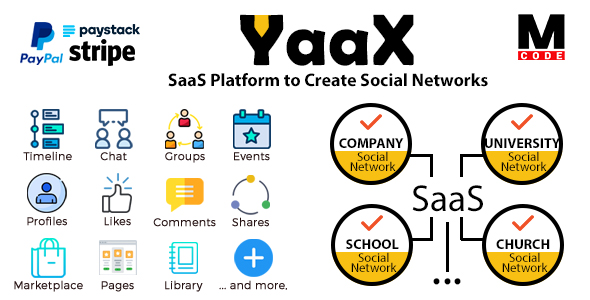
YaaX php-scripts is a multi-tenant social networking platform sold on ThemeForest for $121. It lets a single installation host unlimited independent social network spaces, each with its own users, branding and custom domain, and it includes subscription billing so the operator can charge companies for access. It is aimed at developers and agencies who want to run social communities as a service rather than build one network for themselves.
The product comes from developer mCodeDeveloper and has been maintained through several update cycles, the most recent listed as version 1.4.0 in March 2023. That release added PHP 8+ compatibility, which matters because the earlier builds were written for PHP 7-era hosting. Buyers evaluating it today should weigh that update history carefully: the feature set is broad, but the maintenance cadence has slowed.
What the YaaX SaaS platform actually does
The defining characteristic of this script is tenancy. A super administrator creates and manages multiple networks from one control panel, and each network behaves as a separate site with its own user base. That is a meaningfully different architecture from a standard social network script, where one install equals one community. It means a single licence and a single hosting environment can serve several client organisations.
Custom domains are part of that picture. Each network can be mapped to its own address rather than living on a subfolder of the operator’s main site, which is what makes the multi-tenant model commercially usable. A client paying for a branded community generally expects it to sit on their own domain, and YaaX supports that without separate installations.
Monetisation is built in at two levels. The operator charges companies monthly or annual fees for platform access, and the update log shows Stripe and Paystack payment gateways were added in version 1.3.0. Stripe covers most Western markets; Paystack covers Nigeria, Ghana, Kenya and South Africa, which suggests the developer was targeting African and international resellers rather than only US or European customers. The super administrator can also define which currencies the system accepts, so pricing is not locked to a single currency.
On the community side, the script ships with the modules a social product normally needs: pages, groups, events, marketplace, library and games. Each of these can be switched on or off globally from the administration panel, which is useful when a client only wants a lightweight feed and groups rather than the full suite. Hashtags are supported in posts, and the dashboard includes a trend viewer showing popular tags. The administrator controls whether that viewer appears, how many tags it displays and over what period.
Advertising is handled at the platform level. The super administrator can place ads on the dashboards and user profiles of every network created under the installation, and can also decide whether individual network administrators are allowed to place their own announcements. That gives the platform owner a second revenue channel independent of subscription fees.
User registration is configurable. External registration can be enabled or disabled, and when enabled the administrator chooses between automatic approval and a queue where new accounts wait for review. That is a practical control for communities that need to keep spam or unverified accounts out.
Communication features include a chat system and threaded comments. Both were reworked in version 1.4.0 to load in batches — comments in blocks of three, chat messages in blocks of ten — with a manual reload for older content. That is a performance-oriented change, and it is worth understanding as a trade-off rather than a pure upgrade: pagination reduces initial load weight but changes how the feed feels compared with infinite scroll.
Who the YaaX php-scripts platform suits, and where it does not fit
The clearest fit is an agency or freelance developer building social communities for multiple clients. Instead of buying a separate script per project and maintaining separate codebases, one YaaX installation can host several client networks, each on its own domain, each billed through the built-in subscription system. The same logic applies to a niche network operator who wants to launch vertical communities — one for a professional association, one for a university alumni group, one for a local business directory — under a shared administrative roof.
It also suits organisations that already have a client base and want to sell community as a service. The subscription billing, currency configuration and advertising controls together form a plausible small SaaS operation without custom development.
Where it does not fit is the single-community project. A site owner who wants one social network for one audience is paying for tenancy infrastructure they will never use, and the vendor explicitly points buyers toward a non-SaaS version of the same platform for that case. Anyone wanting a community that plugs into an existing WordPress site should also look elsewhere, since YaaX is a standalone PHP application rather than a plugin. And buyers who need guaranteed long-term support should note the update timeline: the gap between the July 2020 and March 2023 releases is substantial, and the vendor does not publish a roadmap.
Strengths and limitations of the YaaX social network script
Strengths
- Genuine multi-tenancy: one installation, unlimited networks, separate user bases and separate custom domains.
- Subscription billing is native rather than bolted on, with Stripe and Paystack gateways already implemented.
- Module-level control lets each network enable only pages, groups, events, marketplace, library or games as needed.
- Two-tier administration separates platform-owner concerns from individual network management.
- Platform-level advertising on dashboards and profiles creates revenue beyond subscriptions.
- An installer was added in version 1.2.1, which reduces the setup friction typical of standalone PHP scripts.
- PHP 8+ support in version 1.4.0 keeps it viable on current hosting stacks.
Limitations
- The last documented release is March 2023. Buyers cannot assume active development, and the vendor publishes no forward roadmap.
- Sales figures are not disclosed on the listing, so there is no public signal about how widely the script has been deployed or how large the user community is.
- Comments and chat now load in fixed batches with manual reloads. That is lighter on the server but less fluid than the infinite-scroll behaviour users expect from mainstream platforms.
- Because it is a standalone PHP application, integration with an existing CMS, CRM or membership system would require custom work the vendor does not document.
- The demo credentials published on the listing use real company names and personas as sample tenants. It is a presentation choice that says nothing about the software’s security, but it also means the demos are not representative of a real client configuration.
- Multi-tenant hosting brings operational overhead: one database and one codebase serving several client networks means a single point of failure for every tenant.
How YaaX php-scripts compares with the wider category
Social network scripts on marketplaces generally fall into two groups. The first is single-install community software: one licence, one network, one domain. These are simpler to deploy and cheaper to host, and for most small projects they are the right answer. The second group is multi-tenant SaaS platforms, which is where YaaX sits. The distinction is not cosmetic — it changes the business model the software supports.
Against single-install alternatives, YaaX costs more upfront and demands more from the host, but it removes the need to buy and maintain a separate licence per client. For an agency running three or four client communities, that arithmetic can favour YaaX quickly. For an operator running one community, it never does.
Against other multi-tenant options, the differentiators to check are payment gateway coverage, whether custom domains are supported per tenant, and how granular the module controls are. YaaX does reasonably well on all three: Stripe and Paystack, per-network domains, and six toggleable modules. Where it is weaker than the category ideal is extensibility. There is no documented plugin or hook system, so extending behaviour means editing core code, which complicates future updates. Buyers comparing on long-term maintainability should weigh that heavily.
Frequently Asked Questions
Can YaaX host multiple social networks from one installation?
Yes. Multi-tenancy is the core design of the product. A super administrator creates and manages unlimited networks from a single control panel, and each network has its own users, settings and administration. Each can also be mapped to a custom domain, so tenants appear as independent sites rather than subfolders of the operator’s main installation.
Which payment gateways does YaaX support for subscriptions?
Stripe and Paystack. Both were added in version 1.3.0, according to the vendor’s update log. Stripe covers most international markets while Paystack handles payments in several African countries. The super administrator can also configure which currencies the system accepts, so subscription pricing is not restricted to a single currency out of the box.
Does YaaX require PHP 8?
It supports PHP 8 and above. Version 1.4.0 updated the codebase specifically to add PHP 8+ compatibility, which means the script can run on current hosting stacks. Earlier versions were written for PHP 7-era environments. The vendor does not state a minimum PHP version in the listing, so confirming requirements with them before purchase is sensible.
Is YaaX still actively maintained?
The vendor does not state that it is. The most recent documented release is version 1.4.0 from March 2023, following a gap of roughly two and a half years from version 1.3.0 in July 2020. No roadmap or future release schedule is published. Buyers should treat the script as stable but not necessarily under active development.
Verdict on the YaaX php-scripts platform
YaaX php-scripts is worth buying for agencies, resellers and developers who intend to run social communities for multiple clients and want subscription billing, custom domains and advertising built in rather than assembled from parts. The multi-tenant architecture is the whole point, and at $121 it undercuts the cost of licensing several single-install scripts. It is not the right purchase for someone building one community, who should look at the vendor’s non-SaaS edition or a simpler script instead.
The reservations are about longevity rather than capability. The feature list is solid, the payment integrations are practical, and the module toggles give real flexibility. But the update history shows a long quiet period, sales figures are not published, and there is no documented extension system. Buyers who need active vendor support or plan to customise heavily should factor that risk into the decision before purchasing.