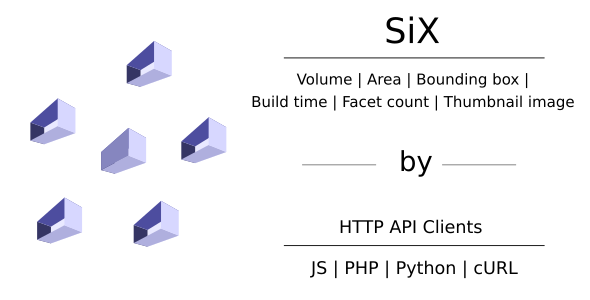
Server-side 3D processing has long been a bottleneck for developers, e-commerce platforms, and design studios. The Manifold 3D API Clients package, including its accompanying WordPress plugin, directly addresses this by providing a robust HTTP API for computing critical mesh properties. Whether you are building a custom STL to image converter for a marketplace or need to calculate build time for a 3D printing cost calculator, this service offers a scalable, language-agnostic solution. It eliminates the need for heavy desktop software, shifting complex geometric calculations to the cloud. For teams using ThemeForest or CodeCanyon assets, this API is a powerful backend engine that can power front-end tools, automating volume, surface area, bounding box, and print time calculations with a simple HTTP request.
Key Features
The Manifold API ecosystem is designed to streamline the entire pre-print workflow. It moves beyond simple file storage to offer actionable data critical for quoting and production planning. Here are the core features that make it a standout tool for developers and businesses:
- Comprehensive Geometric Calculations: Instantly retrieve the Volume, Surface Area, and Bounding Box dimensions of any 3D mesh. This is essential for generating accurate cost estimates and material usage reports.
- Build Time Estimation: The API provides a crucial Build Time estimate (provided in min/max ranges) based on the model’s geometry. This allows you to set accurate expectations for SLA or FDM printing processes without manual slicing.
- Multi-Format Support: It natively handles the most common file types in the industry: STL (Binary & ASCII), 3DS, and OBJ. This ensures compatibility with software like AutoCAD, Blender, and SolidWorks.
- Server-Side Thumbnail Generation: The newer versions include the ability to auto-generate 3D thumbnail images. You can turn your STL, 3DS, or OBJ files into visual previews directly on the server, perfect for galleries or listing pages.
- WordPress Plugin Integration: A dedicated WordPress Plugin is included, allowing you to make API calls directly from your PHP environment without writing complex cURL requests. This bridges the gap between the API and your content management system.
- Multi-Language Client Kits: To speed up development, the package includes client-side implementations in PHP, JavaScript/HTML, Python, and cURL commands.
Who Is This For? Use Cases
This tool is not a single-purpose utility; it is a backend infrastructure component that serves a wide range of digital creators and businesses. If you work with 3D assets in any capacity, this API can likely save you hours of coding and processing time.
E-commerce and 3D Printing Marketplaces
If you run a platform where users upload models for printing, you need instant quotes. Instead of downloading files and processing them locally, your server can use the Manifold 3D API to compute build time and volume instantly. This allows you to dynamically price orders based on material usage and machine time. The ability to generate thumbnail images on the fly also enhances the user experience, allowing customers to preview their uploads before confirming an order.
Web Developers and SaaS Builders
Creators using CodeCanyon scripts often need to add a “3D calculator” feature to their applications. Rather than relying on slow client-side WebGL libraries to parse geometry, you can offload this to the cloud. The WordPress Plugin is particularly useful here. It allows you to build a plugin that sends the file path to the API and returns the surface area or bounding box data to be displayed in a custom dashboard, all without consuming your local server’s CPU.
Engineering and CAD Verification Teams
For quality assurance, engineers often need to verify that exported models match design specifications. The API provides a quick, automated way to check facet counts and physical dimensions. By integrating the Python client into your CI/CD pipeline, you can automatically validate every build file, ensuring they fall within the required size limits before they are sent to manufacturing partners.
Technical Details & Compatibility
Understanding the underlying technical framework is crucial for integration planning. The service operates on a simple REST architecture, requiring HTTP POST and HTTP GET requests. You authenticate via an API key that is passed as a form parameter.
The API returns data in a structured JSON format, making it trivial to parse in any modern programming language. The response includes the numerical values alongside the Unit of Measure (UOM), which defaults to millimeters and cubic millimeters. This consistency prevents unit conversion errors in your application logic.
Regarding updates, the recent addition of the Thumbnail Generation endpoint and the WordPress Plugin signals active development. The service is hosted on the Manifold cloud platform, meaning there are no specific server requirements for your own infrastructure; you only need an environment capable of making standard HTTPS requests. The provided client libraries wrap the API endpoints, abstracting away the authentication handshake and request formatting.
Pros and Cons
No tool is perfect for every scenario. Here is a balanced look at the strengths and potential drawbacks of this solution to help you make an informed decision.
Pros
- Highly Scalable: Offloads heavy computational tasks to a dedicated server, ensuring your local environment remains fast and responsive, even during traffic spikes.
- Time-to-Market: With ready-to-use clients for PHP and Python, you can integrate the 3D printing cost calculation feature within hours, not weeks.
- Cost-Effective for Startups: You avoid the initial capital expenditure of purchasing high-end rendering workstations; you only pay for the compute time you use via a monthly plan.
- Accurate Data: The API returns precise values up to several decimal places, which is critical for financial quotes regarding material usage.
- Versatile Output: The ability to generate images server-side means you can create dynamic previews for users without forcing them to download the original file.
Cons
- Requires Internet Connection: The service is cloud-based, so it will not work in fully air-gapped environments or offline desktop applications.
- API Key Purchase: You must purchase an API key from the provider to make live calls, which adds a variable cost depending on your usage volume.
- File Size Limitations: While not explicitly stated, cloud API services often have payload limits. Very large, high-poly meshes might need to be decimated before uploading.
- Dependency on Third-Party Uptime: Your application’s functionality depends on the uptime of the Manifold servers; a service outage would temporarily halt your calculation features.
Frequently Asked Questions
Is the Manifold 3D API Clients package fully compatible with WooCommerce?
Yes, the package is highly compatible with WooCommerce environments. If you are using the standard WordPress plugin, you can write a simple PHP function that hooks into the WooCommerce order completion action. This function would send the uploaded STL file to the API using the provided client, retrieve the build time, and then update a custom order meta field. This allows you to display printing quotes directly on the product page or in the admin panel without any JavaScript conflicts.
Does the API support auto-formatting for different measurement systems?
The API primarily returns metric units (mm, mm², mm³) as these are the standard for 3D printing. The JSON structure includes an “UOM” (Unit of Measure) field for each value, making it straightforward for your client-side code to convert these to imperial units if necessary. For instance, you can easily multiply the volume by a conversion factor to display it in cubic inches for clients in the United States.
Is there a free trial or sandbox environment to test the API before purchasing a plan?
Yes, the developers provide a free trial hosted on GitHub. This trial allows you to experiment with the API endpoints and see the JSON response structure. However, to make full production calls—especially the compute endpoint for the bounding box and area—you will need the API key from the official site. The free trial is an excellent way to verify that the returned data meets your requirements before committing to a subscription.
Final Verdict
The Manifold 3D API Clients is a well-engineered solution that bridges the gap between web development and computational geometry. Its primary strength lies in the simplicity of the “Upload, Compute, Visualize, Quote” flow. The inclusion of four different client languages demonstrates a commitment to developer experience, while the new WordPress plugin lowers the barrier for non-expert programmers. If you are building a 3D printing service, a CAD file viewer, or an e-commerce platform that sells custom parts, this API provides the backend muscle you need to generate precise metrics instantly.
Considering the value of automated build time estimation and thumbnail generation, this service can significantly reduce server load and bandwidth costs.
Don’t let manual calculations slow down your workflow. Implement the Manifold 3D API today. Visit the official site, select a plan that fits your scale, and let the cloud handle the heavy lifting. Your future self—and your server—will thank you.