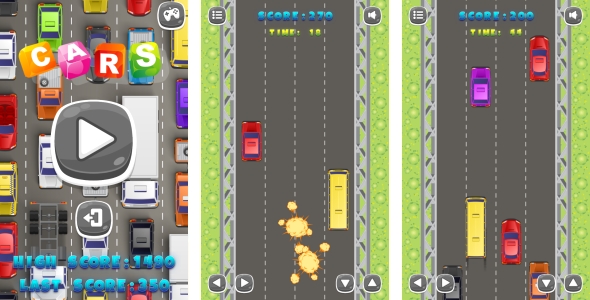
Tap Tap Boy Games is a casual HTML5 title built in Construct 2 and sold as an editable source package on ThemeForest for $19. It ships with the .capx project file, documentation, and a touch-or-mouse control scheme, which means a buyer can publish it as-is or reskin it into something else entirely. It is aimed at developers, small studios and resellers who want a finished, working game skeleton rather than a from-scratch build.
What Tap Tap Boy Games Actually Gives You
The core of the package is the Construct 2 source file. That single fact shapes everything else about the product. Because the project is opened in Scirra’s Construct 2 editor rather than a text-based engine, the game logic arrives as event sheets and object behaviours instead of code files. A buyer who has never written a line of JavaScript can still open the project, change values, swap sprites and export a build. That is the central promise here, and the vendor’s “no required coding” claim is accurate in the narrow sense that Construct 2’s visual event system replaces scripting.
The control model is the one implied by the title: tapping. Input is handled through touch and mouse, so the same build responds to a finger on a phone and a click on a desktop browser. This matters more than it sounds. Many casual templates ship with keyboard bindings that have to be stripped out or remapped before a mobile release, and that work is already done here.
Responsiveness is handled at the layout level. The vendor states the game adapts across platforms, which in Construct 2 terms usually means scaled or letterboxed layouts rather than separate builds per device. The practical result is one exported project that can be wrapped for iOS and Android through a service such as Cordova or published directly to the web. The vendor does not specify which export targets have been tested, so that claim should be verified against the actual project before committing to a store submission.
Reskinning is the other headline capability. The listing describes the artwork as easy to replace and the source as easy to modify, and the tag list includes the usual 2D casual vocabulary. In practice this means a buyer can substitute character sprites, background layers and UI elements without touching the event logic, provided the replacement assets match the existing dimensions and animation frame counts. That is a real constraint worth understanding: Construct 2 animations are frame-based, so dropping in art with a different number of frames requires editing the animation definitions, not just the image files.
What ships in the download is deliberately thin. The vendor lists documentation and the Construct 2 source, and nothing else. There is no PSD, no vector source, no audio project files and no marketing assets. Buyers expecting layered artwork to recolour will be disappointed; the graphics are delivered as they appear in the game.
Where Tap Tap Boy Games Fits and Where It Does Not
The strongest use case is a quick store presence. A solo developer or small studio that needs a finished casual title on Google Play, the App Store or a web portal within days rather than months can take this project, apply a new art pass, and ship. The $19 price sits well below the cost of commissioning even a simple game, so the economics work for anyone treating it as a starting point rather than a finished product.
A second fit is learning. Construct 2 event sheets are readable in a way that compiled code is not, and a working game with clean, organised logic is a better tutorial than most documentation. Someone moving from tutorials into their own first project can study how input, scoring and scene transitions are wired together here.
A third fit is client work with a tight budget. Agencies that occasionally need a small browser game for a campaign landing page can reskin this and hand it over without a full development cycle.
Where it is the wrong choice: any project that needs original mechanics. This is a finished game with a fixed loop, not a framework. If the requirement is a physics puzzler, a match-three board or anything with progression systems, the event logic has to be rebuilt from the ground up, and at that point the template is contributing artwork and not much else. Teams already working in Unity, Godot or Phaser should also look elsewhere, because adopting Construct 2 purely to edit one template means maintaining a second toolchain for a single asset.
Strengths and Limitations of This Construct 2 Template
Strengths
- The full Construct 2 project file is included, so the game can be modified at the logic level rather than only reskinned superficially.
- Touch and mouse input are both supported out of the box, removing the most common porting task for mobile releases.
- No coding is required to make changes, which opens the product to designers and marketers without a programming background.
- Documentation is bundled, which is not guaranteed at this price point on ThemeForest.
- At $19 the entry cost is low enough that the package only needs to save a few hours of work to pay for itself.
- Responsive layouts mean a single export can target desktop browsers and mobile devices.
Limitations
- Construct 2 is a legacy editor. Scirra has moved development to Construct 3, which is subscription-based and browser-hosted. The vendor does not state whether the .capx file imports cleanly into Construct 3, and that compatibility question is the single biggest risk in the purchase.
- Only the Construct 2 source and documentation are provided. There are no layered art files, so recolouring or restyling the graphics means working from flattened images.
- No audio source files are listed, which limits how far the sound design can be adapted.
- Reskinning is constrained by the existing animation frame counts and sprite dimensions, so replacement art must be prepared to match.
- The listing does not name the author, does not disclose a sales count, and carries no rating history, so there is no track record to assess support responsiveness or update frequency.
- There is no stated support period or update policy, which matters for a product tied to an editor that is no longer receiving feature development.
How Tap Tap Boy Games Compares to Other HTML5 Game Templates
The HTML5 game template market on ThemeForest splits roughly into two groups. One group ships raw JavaScript or TypeScript alongside a framework such as Phaser, and appeals to developers who want to own the code and integrate it with an existing build pipeline. The other group ships visual-editor projects like this one, and appeals to buyers who want to avoid code entirely.
Against the code-first group, Tap Tap Boy Games trades flexibility for accessibility. A Phaser template can be refactored, unit tested and merged into a larger application; a Construct 2 project is edited in a proprietary tool and exported as a bundle. For a standalone casual game that difference rarely matters. For anything that needs to live inside a larger web application, it is a significant limitation.
Against other visual-editor templates, the differentiator is the editor choice. Construct 2 templates are cheaper and more numerous, but they inherit the platform’s uncertain future. Construct 3 templates cost more and lock the buyer into a subscription, but they are actively maintained. Unity templates sit at a higher price again and assume a steeper learning curve. The right pick depends less on the game itself and more on which tool the buyer is willing to keep installed for the next two years.
On raw value, a $19 package with source and documentation is competitive with anything in its bracket. The absence of art source files is normal at this price, not an outlier.
Frequently Asked Questions
Do I need to know how to code to use Tap Tap Boy Games?
No. The game is built in Construct 2, which uses visual event sheets instead of written code, so changes are made by editing conditions and actions in a graphical interface. Basic familiarity with the editor helps considerably, but a buyer with no programming background can still reskin the game and export a build.
Can I publish Tap Tap Boy Games on the App Store and Google Play?
Yes, in principle. Construct 2 projects can be exported to HTML5 and wrapped for iOS and Android using a Cordova-based build service. The vendor states the game is playable across mobile, desktop and web, but does not confirm which export paths have been tested, so a buyer should verify the build before submitting to a store.
Does the package include the original artwork and audio files?
No. The download contains the Construct 2 source file and documentation only. Graphics are delivered as they appear in the game rather than as layered source files, and no audio project files are listed. Buyers who want to restyle the visuals substantially will need to produce replacement assets that match the existing sprite dimensions and animation frame counts.
Is Tap Tap Boy Games compatible with Construct 3?
The vendor does not state this. The listing names Construct 2 and supplies a .capx file, which is the older project format. Construct 3 can import many .capx projects, but compatibility depends on which features the project uses, so the safe assumption is that Construct 2 is required unless the buyer confirms otherwise before purchasing.
Verdict on Tap Tap Boy Games
Tap Tap Boy Games is worth buying for a developer, designer or small studio that wants a finished casual HTML5 game to reskin and publish quickly, and who is comfortable working inside Construct 2. The combination of full source, bundled documentation, touch and mouse input, and a $19 price makes the maths straightforward for anyone who values their time at more than a few dollars an hour. It is not the right purchase for teams needing original mechanics, for projects that must integrate with an existing JavaScript codebase, or for anyone unwilling to keep a legacy editor installed. The absence of a disclosed sales count, a named author and any stated Construct 3 compatibility means the buyer is taking on some unquantified risk, and that risk should be weighed against the low price rather than ignored. Treat it as a cheap head start on a small casual game, not as a foundation for a larger product.