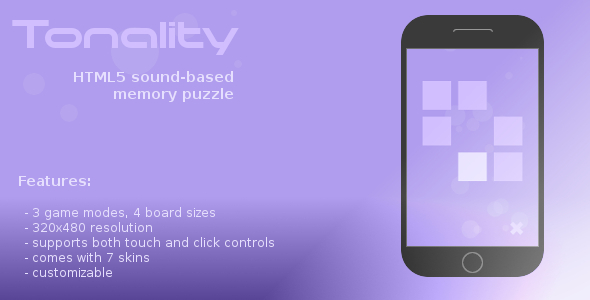
Tonality – Sound Memory Game is an HTML5 browser game in which players match pairs of tones rather than pairs of pictures, turning the familiar memory grid into an ear-training exercise. It ships with three play modes, four board sizes, seven visual skins and a mobile-first layout, and it is sold as a one-off purchase on ThemeForest for $16. It suits web publishers, casual game portals and anyone who wants an audio-based puzzle they can drop onto an existing site without building a game from scratch.
The developer is credited on the listing as the author behind the Tonality Games release, and the build leans on howler.js for audio playback alongside two open fonts, Moonhouse and Titillium Web. The vendor does not disclose a sales figure, so there is no meaningful purchase history to weigh up yet. That makes the product itself, rather than its track record, the only thing worth judging.
What Tonality Games actually does differently from a picture-matching puzzle
The core loop will be familiar to anyone who has played a concentration game: a grid of face-down tiles, two flipped at a time, matched pairs removed. The twist is that each tile plays a short tone instead of showing an image, and the tones are close enough in pitch that a careless match fails. That single change alters how the game is played. Players cannot scan the board visually for a remembered shape; they have to hold a pitch in working memory, compare it against a second tone, and decide whether the two are identical. The listing is explicit that the tones must be exact, and that the differences between them are subtle, which is the whole difficulty curve.
Three modes change the pressure rather than the rules. Practice mode removes the clock and lets a player learn the tone set. Timed mode starts with a fixed budget of seconds and adds ten seconds for every pair found, so early mistakes compound and a clean run extends itself. Active mode is the most interesting of the three: when a pair is matched, two remaining pieces may swap positions at random, signalled by a blink. That mechanic attacks the memorisation strategy directly, because a board state a player has carefully mapped can be invalidated mid-round. It is the mode that gives Tonality Games a reason to exist beyond novelty.
Board sizes, skins and the practical side of embedding it
Four grid sizes are available: 3×3, 4×4, 5×5 and 6×6. The smaller boards are quick and forgiving, and the 6×6 grid is where the pitch-matching becomes genuinely demanding, since the number of distinct tones scales with the tile count. Offering four sizes is a sensible way to let the same build serve a two-minute coffee-break player and someone who wants a longer session.
Seven skins are included, which matters more than it sounds for a game that will sit inside somebody else’s site design. A single fixed palette would make the product hard to place next to an existing brand; seven gives at least a chance of finding something that does not clash. The listing describes the game as customizable but does not itemise what a buyer can change, so anyone needing to alter tone frequencies, timing values or the skin system itself should treat that as unverified until they inspect the code.
Technically, the build is canvas-based and designed mobile-first, with a 320×480 reference resolution that scales. Both touch and click input are supported, which is the correct decision for a product that will be played on phones and desktops from the same codebase. Audio is handled through howler.js, a well-established web audio library that deals with the browser autoplay restrictions and format inconsistencies that would otherwise make a sound-dependent game unreliable. That choice suggests the developer understood where an audio game typically breaks.
Where a sound-based memory game fits, and where it does not
The obvious home for this is a casual game portal or an arcade section of a larger site, where a lightweight, self-contained title adds dwell time without requiring a backend. It also works as a lead magnet or interstitial — something a visitor can play in a browser tab while waiting. Music education sites, ear-training resources and language-learning products have a more specific use for it, because matching pitches by ear is a real skill and the game is a palatable way to drill it.
It is the wrong purchase for anyone who needs a game with progression systems, accounts, leaderboards or monetisation hooks. Nothing in the listing suggests saved scores, user profiles or analytics, and there is no indication of a backend component at all. A studio looking for a game framework to extend into a larger product will also find this too narrow: it is a finished single-mechanic game, not a toolkit. And any project where audio cannot be relied upon — a kiosk with muted speakers, a context where autoplay policies will block sound until a user gesture — should avoid a game whose entire premise is sound.
Strengths and limitations of the Tonality Games build
Strengths
- The pitch-matching mechanic is a genuine variation on the memory genre rather than a reskin, and Active mode’s random tile swaps add a layer of unpredictability that most casual puzzlers lack.
- Three modes and four board sizes give a reasonable spread of difficulty without bloat.
- Mobile-first design with scaling from a 320×480 base, plus both touch and click input, means one build covers phones, tablets and desktops.
- howler.js handles the audio layer, which is the part of a sound game most likely to fail across browsers.
- Seven skins reduce the friction of matching the game to an existing site palette.
- At $16 it is a low-risk purchase for a single self-contained asset.
Limitations
- No sales figure is published, so there is no user base, no review history and no way to gauge how the game performs in the wild.
- The listing claims the game is customizable but does not document what is configurable, which is a real gap for buyers who need to change tone sets, timing or layout.
- There is no evidence of score persistence, leaderboards or any server-side feature, so it cannot support competitive or return-visit mechanics on its own.
- An audio-dependent game is inaccessible to deaf and hard-of-hearing players by design; the listing mentions no visual fallback or accessibility option.
- Two third-party fonts and a third-party audio library are bundled, which means a buyer inherits those licensing terms and should check them before commercial deployment.
- The vendor does not state browser support, file size, or whether a build tool or source files are included.
How Tonality Games compares with other casual HTML5 puzzle games
The casual HTML5 category on marketplaces like ThemeForest is crowded with match-three clones, endless runners and physics tappers, most of which compete on visual polish and are functionally interchangeable. Tonality Games competes on a mechanic instead. That is a meaningful distinction: a buyer choosing between this and a generic tile-matcher is really choosing between a game that looks different from everything else on the page and one that looks like everything else.
The trade-off is scope. A generic casual game template often bundles level editors, score systems and ad hooks because those are the features buyers ask for. This product does one thing and does not pretend otherwise. Against free alternatives — an open-source memory game on a code repository, for instance — the argument for paying $16 is the audio handling, the mobile-first layout and the fact that it is finished. Against a full game framework, it is clearly the smaller purchase and should be evaluated as such. Buyers should also weigh the audio dependency: a picture-matching game works anywhere, while this one needs working sound, which narrows the contexts where it can be deployed.
Frequently Asked Questions
What is Tonality – Sound Memory Game?
It is an HTML5 browser game where players flip tiles to match pairs of tones instead of images. The tones are deliberately close in pitch, so success depends on careful listening rather than quick visual recall. It includes three play modes, four board sizes and seven visual skins, and it is sold as a single-purchase download for $16.
Does Tonality Games work on mobile phones?
Yes. The game is built mobile-first, scales from a 320×480 reference resolution, and accepts both touch and click input. That means the same build runs on phones, tablets and desktop browsers without a separate mobile version. The vendor does not publish a specific list of supported browsers or minimum operating system versions.
Can the tones, difficulty or appearance be changed?
The listing states the game is customizable and includes seven skins, but it does not document which elements can be edited. Tone frequencies, timer values, swap behaviour in Active mode and the skin system are all plausible candidates, yet none are confirmed. Buyers needing specific changes should inspect the source files before purchasing.
Is Tonality Games suitable for children or classroom use?
It can be, since the rules are simple and Practice mode removes time pressure. However, the game depends entirely on hearing, so it excludes deaf and hard-of-hearing players, and the listing mentions no visual alternative. For a classroom or therapy setting, that limitation needs to be weighed against the ear-training benefit before adopting it.
Verdict on Tonality Games
Tonality Games is worth buying for anyone who wants a small, finished, audio-driven puzzle to drop into a website, particularly a casual game portal, a music education resource or an ear-training product where pitch matching has actual value. The $16 price is low enough that the risk is minimal, and the mobile-first build with howler.js audio handling removes the two technical problems that most often sink a browser sound game. It is not the right choice for projects needing accounts, leaderboards, saved progress or monetisation, and it should be avoided wherever audio cannot be guaranteed, including kiosks and muted environments. The absence of any published sales data, combined with undocumented customization and no stated accessibility fallback, means buyers should treat this as a niche single-purpose asset rather than a platform to build on.