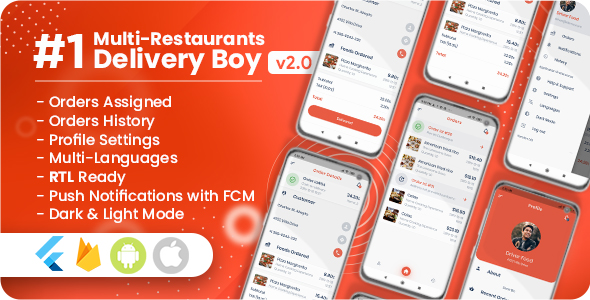
Delivery Boy For Multi-Restaurants Flutter App is a mobile application source code package for Android and iOS that gives a courier or driver a dedicated app for picking up and delivering orders placed across multiple restaurants. It is built with Flutter and ships as full Dart source, and it suits development agencies and restaurant-platform operators who already run (or plan to build) a multi-vendor ordering backend and need the driver-side client rather than a complete end-to-end system. The item sells for $19 on ThemeForest and, per the vendor, includes only the driver app — the admin panel, customer app, vendor app and customer website are separate products.
What the driver app actually delivers
The package is narrower than its title might suggest, and understanding the boundary is the single most important thing before buying. What is included is the Flutter project for the delivery driver role: login and registration, an orders list, order details, order history, notifications, a user profile, account settings, app settings and a help/support screen. Everything a courier needs to see an assigned job, read the delivery address and move it through to completion is present in the driver flow.
Several capabilities are worth calling out because they affect real deployment decisions:
- Multi-restaurant directory with Google Maps. The app can present a directory of restaurants on a map and provide directions, which matters when a driver is collecting from several vendors in one shift rather than a single kitchen.
- Cash on delivery and payment on pickup. These two settlement methods are supported natively. Card processing, wallets and in-app gateways are not listed by the vendor, so any online payment flow has to be handled elsewhere in the stack.
- Firebase Cloud Messaging push notifications. New order assignments and status changes can reach the driver without the app being open, which is essential for a job-based courier workflow.
- RTL language support and translation files. The changelog shows translation strings moved into a dedicated lib/l10n/ folder, so Arabic, Farsi and other right-to-left locales are a first-class concern rather than an afterthought.
- Light and dark theming plus animation work. Hero, parallax and swipe animations are included, and the vendor states the app holds 60fps on both platforms. Theming is described as restylable for branding.
- MVC-structured Dart code. The project is organised on an MVC pattern with entities and models provided, which shortens the time spent wiring data classes to an existing API.
The current release is version 2.0.0, dated 16 March 2023 in the listing, built against Flutter 3.3.10 and Android SDK 33. That date is a meaningful data point: Flutter moves quickly, and a project pinned to a 2023 toolchain will need dependency upgrades before it compiles cleanly on a current stable channel.
Where this app fits — and where it does not
The clearest fit is a team that already has, or is commissioning, a Laravel-based multi-restaurant ordering platform with its own admin panel and customer-facing apps. The vendor explicitly frames the backend as Laravel/PHP, and the demo credentials reference admin, market manager, client and driver roles — evidence of a multi-role ecosystem the driver app plugs into. If that backend exists, this package supplies the courier client at a fraction of the cost of building one from scratch.
It also suits agencies delivering a branded driver app to a restaurant group or delivery marketplace, particularly in markets where cash on delivery dominates and where an Arabic or Farsi interface is required. Freelancers prototyping a delivery product can use it to demonstrate the driver experience quickly.
The wrong choice is anyone expecting a turnkey delivery business. A buyer who has no backend, no admin panel and no customer app will find this is one piece of a puzzle whose other pieces are sold separately and priced separately. Likewise, a project that needs integrated card payments, live driver tracking on a map for customers, route optimisation or earnings/wallet management will not find those features documented here. And a team unwilling to maintain a Flutter codebase through framework upgrades should look at a hosted delivery SaaS instead of source code.
Strengths and limitations in plain terms
Strengths
- Full Flutter source for both Android and iOS, so the app can be rebranded and extended rather than locked to a vendor.
- Genuinely low entry price at $19 for a complete driver-role application.
- Multi-restaurant and map/directions support is built in, matching the multi-vendor model the name promises.
- RTL and translation handling is present in the codebase, which is rare at this price point.
- Clean MVC structure with ready-made entities and models reduces integration effort against an existing API.
- Documented update history stretching back to the initial release, showing the developer has maintained the item over multiple Flutter versions.
Limitations
- The admin panel is not included, and the listing states so plainly. The customer app, vendor/manager app and customer website are also separate items. The $19 buys one role, not a platform.
- The last recorded update is March 2023 against Flutter 3.3.10. Expect to resolve deprecated widgets and dependency conflicts before a modern build succeeds.
- No online payment gateway integration is listed; only cash on delivery and payment on pickup are named.
- The vendor does not state sales figures or a rating, so there is no public purchase history to weigh.
- Support quality and response times are not documented in the listing beyond a pointer to the support section.
How it compares with the wider category
Delivery and courier app scripts generally fall into three groups: all-in-one platforms that bundle admin, customer, vendor and driver apps; single-role apps like this one; and SaaS products where the operator rents the software monthly. All-in-one bundles cost more but remove integration guesswork. SaaS removes maintenance entirely but gives no source code and no resale or white-label freedom. This item sits firmly in the single-role, source-code camp, and that is its honest positioning: it competes on price and on the freedom to own and modify the driver client, not on completeness.
Against other single-role Flutter driver apps, the differentiators are the multi-restaurant directory with Google Maps, RTL support and the Laravel-oriented backend assumption. Where a competing script might target a single-restaurant model, this one is designed for a marketplace of vendors. The trade-off is that the surrounding ecosystem must match — a buyer with a non-Laravel backend will spend more time adapting endpoints than someone already on that stack.
Frequently Asked Questions
Is the admin panel included with Delivery Boy For Multi-Restaurants Flutter App?
No. The listing states clearly that the admin panel is not included and must be obtained from the separate item. The same applies to the customer app, the manager/vendor app and the customer website. Buyers should budget for those additional purchases or plan to build their own backend before committing.
Which Flutter version does this app require?
The current 2.0.0 release targets Flutter 3.3.10 stable with Android SDK 33, per the changelog. Because that toolchain dates from early 2023, a fresh build on a newer Flutter channel will likely need dependency upgrades and fixes for deprecated widgets. The vendor does not state compatibility with later Flutter releases.
Does the app support online card payments?
Not according to the listing. Only cash on delivery and payment on pickup are named as supported methods. Any card, wallet or gateway integration would need to be added by the buyer or handled by the backend system the app connects to. The vendor does not document a payment gateway module.
Can the driver app be rebranded and published under my own name?
Yes, in practical terms. The package includes full Flutter source for Android and iOS, and the vendor describes theming as restylable for branding. That means colours, logos and interface text can be changed and the app published under the buyer’s own developer accounts, subject to the standard ThemeForest licence terms.
Verdict: who should buy it and who should not
Delivery Boy For Multi-Restaurants Flutter App is a sensible purchase for a developer or agency that already operates a Laravel-based multi-restaurant ordering platform and needs a working driver client without building one from scratch. At $19 the risk is low, and the full source, RTL support and map-based restaurant directory make it a credible starting point for a branded courier app. It is not suitable for someone hoping to launch a complete delivery business from this single item, nor for teams that need integrated card payments or a current, upgrade-free Flutter build. The realistic buyer treats this as one component in a larger system and budgets time for framework upgrades and backend integration. Those constraints understood, it represents fair value for the driver-side piece of a multi-vendor delivery stack.