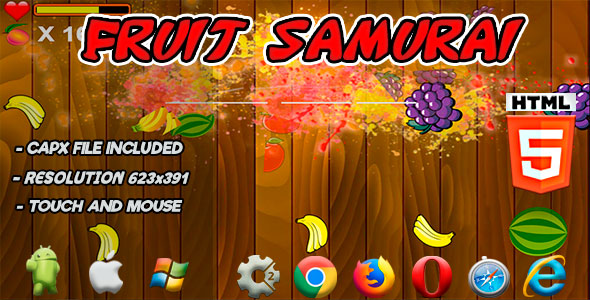
Fruit Samurai – HTML5 Game is a slice-and-dice arcade title built in Scirra Construct 2 and sold on ThemeForest for $16. It ships as a complete HTML5 package plus the editable .capx source project, and it is aimed at developers and small studios who want a ready-made mobile game they can rebrand, wrap in Cordova or PhoneGap, and publish to app stores without writing gameplay code. Buyers researching Fruit Samurai Games are usually weighing whether a $16 source-available template is a faster route than commissioning a build.
What the Fruit Samurai package actually contains and what each part enables
The purchase is best understood as two products in one archive: a playable build and the project files that produced it. The distinction matters, because the value sits almost entirely in the second half.
Construct 2 source with commented event sheets
The .capx file is the working project, not a compiled export. That means the slicing logic, spawn timers, scoring rules and menu flow can all be opened, read and altered in Construct 2. The vendor states the code is commented, which is the difference between a template a programmer can extend and a black box that only accepts cosmetic swaps. Anyone without a Construct 2 licence should note that the editor is a separate purchase from Scirra, so the true entry cost is higher than the sticker price.
Touch and mouse input across desktop and mobile browsers
Swipe gestures on phones and tablets are handled alongside pointer input on desktop, so the same build runs in a browser on either. For a swipe-based slicing game this is the core interaction, and getting it to feel consistent across iOS Safari, Android Chrome and a mouse-driven laptop is normally where hand-rolled HTML5 builds fall down. Having that already resolved is a meaningful head start.
Wrapper-ready export for app stores
The package is prepared for PhoneGap and Intel XDK, with Cordova noted as the route to iOS and Android binaries. In practice this means the HTML5 output can be dropped into a WebView container and submitted, rather than requiring a native rewrite. The vendor does not state which Cordova version or which store requirements the wrapper configuration has been tested against, and store policies around WebView-only apps change regularly, so that compatibility needs verifying before committing to a release date.
Monetisation and platform service hooks
Advertising support, in-app purchase buttons, and integration points for Game Center and Google Play Games Services are all listed. For a free-to-play or ad-supported release, those are the three plumbing jobs that usually consume the most integration time, so having scaffolding in place shortens the path to a shippable product. The listing does not specify which ad networks are wired in, so the assumption should be that an SDK swap or addition is likely.
Reskinning by asset replacement
Art can be changed by swapping image files, which is the workflow the vendor promotes. Combined with the editable source, that supports a full thematic overhaul — different fruit, different blade, different palette — without touching logic. It is a genuine convenience for anyone producing multiple variants of the same mechanic.
Where a Fruit Samurai template fits, and where it does not
The clearest fit is a developer or small team that needs a finished, store-ready arcade game on a short timeline and a small budget. Typical scenarios include a first app store release to test the publishing pipeline end to end, a portfolio or agency demo that needs a working mobile game rather than a mockup, or a reskin exercise where a client wants a branded casual game and the mechanic is incidental to the brief.
It also suits publishers running a portfolio strategy: buy one solid mechanic, produce several themed variants, and test which theme converts. The low unit cost and asset-swap workflow make that economically sensible in a way that bespoke development does not.
The wrong choice is a project where the game itself is the differentiator. A slicing mechanic with fruit and a blade is one of the most imitated casual formats in existence, and a template build will read as a template build to players who have seen the genre. Anyone hoping for App Store featuring, a competitive multiplayer hook, or a distinctive art direction will need to invest heavily in original art and additional systems — at which point the $16 saving is irrelevant against the cost of the redesign. It is equally unsuitable for teams without a Construct 2 licence who have no intention of buying one, since the HTML5 export alone offers little beyond what the demo shows.
Strengths and limitations of this HTML5 game template
Strengths
- Editable Construct 2 source is included, so the game can be extended rather than only reskinned.
- Input handling covers touch and mouse, reducing cross-device testing work at the start of a project.
- Ad, in-app purchase and game service hooks are already scaffolded, which removes the most tedious integration tasks.
- Asset replacement is the documented customisation path, keeping reskins accessible to non-programmers.
- The price is low enough that the template functions as a cheap way to learn a Construct 2 production workflow.
- The developer offers direct email support, which is more than many low-cost template sellers commit to.
Limitations
- Construct 2 is a legacy editor; Scirra’s current product line is Construct 3, so buyers are adopting a toolchain that is no longer the vendor’s active generation. The listing does not address migration.
- No sales figures or ratings are disclosed on the listing, so there is no public signal of how many buyers have shipped with it.
- The vendor does not name the ad networks, Cordova version, or store submission targets that have been tested, leaving integration risk to the buyer.
- A fruit-slicing mechanic is highly familiar; differentiation depends almost entirely on art and additional content the buyer supplies.
- Support is offered by email on a best-effort basis with no stated response time or support period.
- No documentation beyond the Construct 2 manual is referenced, so the buyer is expected to already understand the editor.
How this compares with other routes to a casual mobile game
Against the broad category of HTML5 game templates on marketplaces, the differentiator here is source access at a very low price point. Many competing listings sell a compiled build with limited or no project files, which caps customisation at surface-level asset swaps. Fruit Samurai Games sits at the more permissive end: the .capx is included, which puts it closer to a starter kit than a finished product.
Compared with commissioning a developer, the trade-off is control versus cost. A commissioned build delivers original mechanics and art but costs orders of magnitude more and takes weeks. A template delivers neither originality nor exclusivity, but it delivers speed. Compared with building from scratch in a framework such as Phaser or PixiJS, the template wins on time-to-first-build and loses on architectural freedom — the buyer inherits Construct 2’s event-sheet model rather than a codebase they fully own and understand.
Against no-code game builders, the comparison is about ownership. A hosted builder gives a similar drag-and-drop experience but typically ties distribution to the platform. Here the export is genuinely portable HTML5, which matters for anyone selling the finished game to a client.
Frequently Asked Questions
Do I need Construct 2 to use Fruit Samurai?
No, not to publish the game as-is. The included HTML5 files can be wrapped and shipped without opening the editor. Construct 2 is required only to modify gameplay logic, add levels, or change anything beyond swapping image assets, and that editor is a separate purchase from Scirra.
Can Fruit Samurai Games be published to the App Store and Google Play?
Yes, that is the intended workflow. The package is prepared for Cordova, PhoneGap and Intel XDK wrappers, which package the HTML5 build as a native container. The vendor does not state which store policies or wrapper versions have been verified, so a test submission before a committed launch date is advisable.
How hard is it to reskin the game with my own artwork?
Straightforward for a straight asset swap. The documented method is replacing the image files, which changes fruit, blade and background without touching code. Deeper changes — new scoring rules, different spawn behaviour, extra game modes — require working in the Construct 2 event sheets, so difficulty scales with ambition.
Does the template include ads and in-app purchases?
Support for both is listed. Advertising is supported, in-app purchase buttons are included, and Game Center and Google Play Games Services integration points are present. The specific ad networks are not named in the listing, so buyers should expect to configure or replace the SDK before going live.
Verdict: who should buy Fruit Samurai Games and who should walk away
This is a sensible purchase for a developer who already owns or intends to buy Construct 2, wants a working swipe-arcade game quickly, and plans to reskin it for a client, a portfolio, or a first app store submission. The combination of editable source, pre-wired monetisation hooks and a $16 price makes the risk small. Buyers wanting an original mechanic, a modern toolchain, or a game that stands out on its own merits should look elsewhere — the template solves speed and cost, not differentiation. Anyone without Construct 2 should factor that licence into the decision before treating this as a cheap route to a finished product.