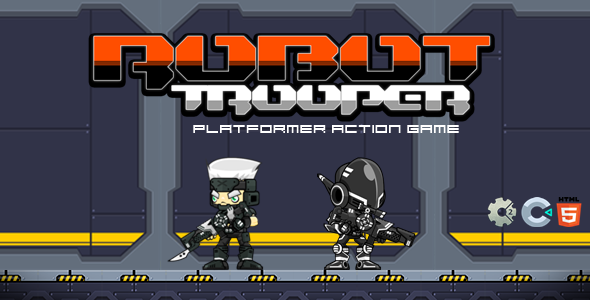
Robot Trooper – Construct Game is a $33 HTML5 action platformer sold on ThemeForest, built in Construct 2 and 3 and shipped with editable source files. It is aimed at developers and small studios who want a finished side-scrolling shooter they can rebrand, reskin and publish under their own name rather than build from scratch. Buyers receive a playable browser game, the CAPX and C3P project files, and documentation covering the basics of getting it live.
The core loop is deliberately simple: move a robot hero through side-scrolling levels, destroy enemy robots, and collect three diamonds per stage to unlock the next one. Input works through touch controls or keyboard arrow keys, and the whole package runs at 1280×720. For anyone researching Robot Trooper Games as a starting point for a commercial release, the appeal is speed of deployment rather than depth of design.
What Robot Trooper Games Actually Deliver in the Package
The most consequential thing here is the source file situation. Buyers get both a CAPX file for Construct 2 and a C3P file for Construct 3, which means the project can be opened in either generation of Scirra’s engine. That matters because Construct 2 is legacy software; a developer already working in Construct 3 does not have to migrate anything, and someone still on the older toolchain is not locked out. The trade-off, stated plainly in the listing, is that editing the project logic requires a paid Construct licence. The game itself is not gated that way — only the ability to modify it is.
Reskinning is the headline capability and it is handled at two levels. Replacing artwork is a straight asset swap, so a developer can drop in new sprites without touching a single event sheet. Changing behaviour, level layout, enemy placement or the win condition requires opening the project file, which is where the Construct licence becomes necessary. The vendor explicitly notes that no programming knowledge is needed, and for a Construct project that is broadly fair — the engine is event-sheet driven rather than code-driven — but it is worth being precise about what that means. A non-programmer can absolutely reskin and republish this. A non-programmer who wants to redesign the level structure will be learning Construct’s event system first.
Platform coverage is broad by default. Because the output is HTML5, the game runs in a browser on desktop and mobile without a separate build, and touch input is implemented natively rather than bolted on. That gives a single artefact that can be embedded on a website, wrapped for Android distribution, or hosted on a web game portal. The 1280×720 canvas is a 16:9 resolution, which scales predictably to most modern displays, though it is not a responsive layout in the web-design sense.
Audio and sprite assets are drawn from OpenGameArt and GameArt2D respectively, and the listing credits both sources. That is a meaningful detail for commercial buyers: the provenance of third-party assets is disclosed rather than hidden, and the documentation is included in the download. Sound effects are present, though the listing does not specify how many tracks or whether music is included alongside effects — a gap worth checking before purchase if audio matters to the project.
Where Robot Trooper Games Fit and Where They Do Not
The clearest fit is a developer or agency that needs a finished, working HTML5 action game quickly — for a client microsite, a promotional campaign, a branded arcade section, or a portfolio piece that demonstrates game delivery capability without a multi-month build. It also suits a solo creator testing whether a game concept has traction before investing in original design work, since the reskin path is short and the underlying systems already function.
It fits reasonably well as a learning artefact too. A Construct beginner who wants to see how a complete platformer is structured — how movement, collision, enemy spawning and level gating are wired together — gets a working reference project rather than a tutorial fragment. That is a different use case from publishing, and it is a legitimate one at this price point.
Where it is the wrong choice is any project that needs original mechanics. The design is a conventional collect-and-progress platformer; there is no procedural generation, no physics novelty, no multiplayer, no save system described, and no meta-progression beyond level unlocking. A studio building a game where the mechanics themselves are the selling point will spend more time tearing this apart than building fresh. Similarly, anyone who needs a game that works offline as a native app without a web wrapper, or who needs a fully responsive canvas that reflows to arbitrary aspect ratios, should look elsewhere — this is a fixed-resolution HTML5 build.
Strengths and Limitations of the Robot Trooper Construct Game
Strengths
- Both CAPX and C3P source files are included, covering Construct 2 and Construct 3 users without forcing an upgrade or downgrade.
- Artwork can be replaced without opening the project logic, which keeps reskinning accessible to non-developers.
- HTML5 output with touch and keyboard input means one build serves desktop browsers, mobile browsers and wrapped app packages.
- Documentation ships with the download, and asset sources are credited transparently rather than left ambiguous.
- At $33 the entry cost is low relative to commissioning even a simple custom platformer.
Limitations
- Modifying game logic requires a paid Construct licence, so the true cost of a customised build is higher than the sticker price for anyone who does not already own one.
- The fixed 1280×720 canvas does not adapt to unusual screen ratios, which limits how cleanly it embeds in variable-width page layouts.
- The game design is generic — three diamonds per level to unlock the next — so the finished product competes in a crowded browser-game space on presentation rather than mechanics.
- The listing does not state how many levels are included, how long the game runs, or whether background music is part of the audio package.
- No sales figures or ratings are disclosed on the marketplace listing, so there is no independent signal of how the template has performed for other buyers.
How This Compares to Other HTML5 Game Templates
The HTML5 game template category splits roughly into three groups: engine-agnostic JavaScript builds that require coding to modify, single-engine Construct or GameMaker projects, and full custom commissions. Robot Trooper Games sit firmly in the middle group, and the dual CAPX/C3P delivery puts it at the more flexible end of that group — many Construct templates ship in one format only.
Against JavaScript-based templates, the trade-off is control versus accessibility. A hand-coded Phaser or PixiJS game gives unlimited freedom to restructure, but demands programming skill to touch anything. This package gives less structural freedom in exchange for a visual editor and a reskin path that does not require reading code. For a buyer whose priority is shipping something branded quickly, that is the right side of the trade. For a buyer whose priority is a bespoke mechanic, it is the wrong one.
Against a custom commission, the comparison is simply cost and time versus originality. A commissioned platformer with original art and mechanics will cost multiples of $33 and take weeks. This delivers a working game today that looks like other games built from the same template. The decision hinges on whether distinctiveness or speed matters more to the project.
Frequently Asked Questions
Do I need to know how to code to use Robot Trooper?
No coding is required for reskinning or publishing. Replacing sprites is a direct asset swap, and the game runs as shipped without any edits at all. Changing game logic does require working inside Construct’s event sheet system, which is visual rather than textual, but it is still a skill that has to be learned. The vendor states no programming knowledge is needed, which holds for cosmetic changes.
Can I sell a game I make with this template?
The listing does not spell out the licence terms for redistribution, so buyers should confirm them on the marketplace product page before publishing commercially. What the listing does confirm is that editing the project files requires a valid Construct licence, purchased separately from Scirra. That licence requirement applies to modification, not to running or reskinning the shipped build. Check both before committing to a commercial release.
Does Robot Trooper work on Android and iOS?
It runs on mobile because the output is HTML5 with touch input implemented, so it plays in mobile browsers on both platforms. The vendor tags the product as Android-compatible and states it is playable across mobile and PC. Turning it into a native app store build requires an additional wrapping step, which the listing does not cover.
How many levels are included in the game?
The listing does not state a level count, and that information is not available from the supplied product data. What is described is the progression rule: collect three diamonds in a level to unlock the next one. Buyers who need to know the total playtime or number of stages should request that detail from the vendor before purchasing, since it materially affects value.
Verdict on Robot Trooper Games
This is a sensible purchase for a developer, freelancer or agency that needs a working HTML5 action platformer it can rebrand quickly — particularly if Construct 3 is already part of the toolkit, since the C3P file removes any migration friction. It also works as a low-cost reference project for someone learning how a complete Construct platformer is assembled. It is a poor fit for anyone who needs original mechanics, a variable-resolution canvas, or a game whose design itself is the differentiator. The $33 price is genuinely low for a finished, documented, dual-format source package, but the real cost of a customised build includes a Construct licence that many buyers will not already hold. Buy it for speed and reskinning; do not buy it expecting a distinctive game design underneath the artwork.