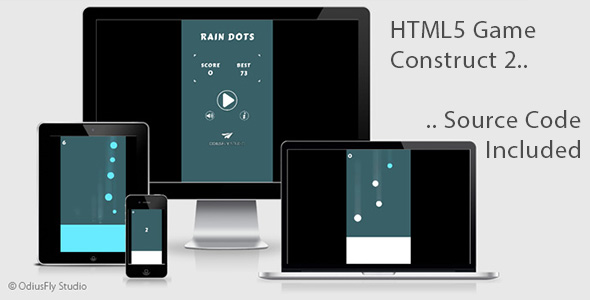
Rain Dots Games is a small, single-mechanic browser game sold on ThemeForest for $29, built in Construct 2 and delivered as both an HTML5 build and an editable .capx source project. The player taps or clicks to cycle the colour of a bar at the bottom of the screen and must match it to the colour of each falling dot, which makes it a reflex-based endless score-chaser rather than a level-based or narrative title. It suits developers and site owners who want a cheap, self-hosted arcade distraction for a portal, a promotional microsite or a mobile wrapper, and it is a poor fit for anyone expecting a content-rich game with progression, monetisation plumbing or a modern engine.
What Rain Dots Games actually delivers under the hood
The core loop is deliberately thin, and that is the point. A single input — tap on touch, click or keypress on desktop — rotates the active colour, and the difficulty curve comes entirely from the speed and density of the falling dots. There is no menu tree, no upgrade system and no tutorial sequence beyond the help text files bundled in the download. That simplicity is what makes the game readable in a few seconds on a phone, and it is also the reason the product lives or dies on how well it is re-skinned and where it is placed.
Two deliverables ship together, and the distinction matters commercially. The HTML5 folder can be uploaded to any host as-is and embedded with a standard iframe, so a site owner with no game development experience can have it live in an afternoon. The Construct 2 source file is the more interesting half: it opens in Scirra’s editor, which the vendor notes can be downloaded and used to modify and export the project without buying a Construct 2 licence. Graphics, audio and media can all be swapped, and the vendor states that .html and .js files can be edited directly by anyone with the skills.
Input handling covers both mouse and touch, and the vendor lists Android and iOS among the tags, which reflects the fact that the HTML5 build can be wrapped for app stores rather than that a native binary is included. The vendor explicitly offers to build Android and iOS versions, add advertising, or handle other customisation on request, and offers a one-time free reskin to buyers of the extended licence who supply their own graphics, logo, links and media. Those are services, not features, and they depend on the developer remaining responsive — worth weighing if the project has a deadline.
Licensing is the least glamorous part of the listing and the part most likely to catch a buyer out. A single licence covers one website portal or store, so an agency rolling the same game across several client sites needs a licence per deployment. Using a customised build as a paid app on Google Play or the App Store requires the extended licence; running ads is permitted under the regular licence. Reselling the game on Envato or comparable marketplaces is prohibited outright. None of this is unusual for the category, but it is stricter than the “buy once, use anywhere” assumption many buyers bring to cheap code purchases.
Where Rain Dots Games fits, and where it does not
The most natural home for this product is a casual gaming portal or an arcade section of a larger site that needs filler content between bigger titles. Because it loads as a self-contained folder and can be iframed, it slots into an existing page template without touching the host site’s theme or build pipeline. The same property makes it useful as an engagement device on a campaign page — a branded time-killer with a sponsor’s colours and logo, which is roughly what the free reskin offer is designed to enable.
Freelancers building small apps for clients are the second obvious audience. A hyper-casual reflex game with one mechanic is a realistic scope for a wrapped Android or iOS build, and starting from a working Construct 2 project is faster than starting from an empty canvas. Educational or event-based projects that need a quick, universally understandable interaction — a booth screen, a kiosk, a conference microsite — also fit, since the input model works with a mouse, a touchscreen or a keyboard.
It is the wrong purchase for anyone who wants a game to carry a site on its own. There is no meta-game, no unlock structure, no leaderboard, no analytics and no monetisation layer built in; all of that is custom work. Studios working in Unity, Godot or a JavaScript framework will find the Construct 2 dependency more of an obstacle than an asset, because the source format does not port cleanly into those pipelines. And anyone who needs guaranteed, tested compatibility across a long list of devices and OS versions should read the vendor’s own caveat carefully: the listing states plainly that full compatibility across every device and operating system update cannot be ensured. That is an honest disclosure, and it should be treated as a real constraint rather than boilerplate.
Strengths and limitations of this HTML5 arcade template
Strengths
- Genuinely low barrier to deployment. The HTML5 build runs from a folder on any host and embeds with a single iframe tag, so no build tooling or framework knowledge is required.
- Editable source included at a low price. A working Construct 2 project for $29 gives a solo developer a functional starting point rather than a locked binary.
- Input model that travels. Mouse, touch and keyboard support means one build can serve a desktop portal, a tablet kiosk and a wrapped mobile app.
- Straightforward art replacement. Graphics and audio are swappable, which is what makes the reskin and branding use case viable.
- Clear, if restrictive, licensing terms. The rules on portals, paid apps and advertising are spelled out rather than left ambiguous.
- Direct developer contact. The author, OdiusFly Studio, publishes a support address and invites pre-purchase questions, which is more than many small marketplace items offer.
Limitations
- Construct 2 is legacy software. Scirra has since moved on to Construct 3, a browser-based subscription product, so the included project format ties customisation to an older, no-longer-developed editor. The vendor’s note that Construct 2 can be used for free to modify and export softens this, but it does not make the toolchain current.
- One mechanic, no depth. There is nothing to unlock, no difficulty selection and no persistence layer described. Retention beyond a few sessions depends entirely on the wrapper site.
- No monetisation or analytics built in. Ads and store builds are explicitly handled as custom work rather than shipped features.
- Per-deployment licensing. Agencies and multi-site operators must budget for one licence per portal or store, which changes the effective cost considerably.
- Compatibility is not guaranteed. The vendor says so directly; there is no published device test matrix to check against.
- No sales or rating history to reference. The listing discloses no sales figures, so there is no community track record to weigh when assessing support responsiveness or long-term maintenance.
How Rain Dots Games compares with the wider HTML5 game template category
The marketplace category this belongs to splits roughly three ways. At one end are pure HTML5/JavaScript templates with no editor dependency, usually priced similarly, which suit web developers who want to read and modify the code directly but offer little visual tooling. At the other are Unity or Godot-based projects, which are far more capable and portable but carry a much steeper learning curve and a heavier runtime. Rain Dots Games sits in the middle: it depends on a specific visual editor, but that editor is approachable for non-programmers and free to use for this purpose.
Against the no-editor JavaScript templates, the Construct 2 route wins on ease of art and audio replacement and loses on longevity and code transparency. Against engine-based projects, it wins decisively on price and time-to-deploy and loses on everything to do with depth, performance tuning and platform reach. The relevant question is not which is better in the abstract but whether the buyer’s team can work in Construct 2 — or is willing to pay the author to do it. Where the answer is yes, the value proposition is reasonable for a single-site deployment. Where the answer is no, a plain JavaScript template or a more capable engine project will cost more upfront and less in friction.
Frequently Asked Questions
Do I need to buy Construct 2 to edit Rain Dots Games?
No. The vendor states that Construct 2 can be downloaded and used to modify and export the included project without purchasing a licence. That covers editing the .capx source and producing your own HTML5 build. Buyers should note, however, that Construct 2 is the older generation of Scirra’s tool, and the vendor will also export an HTML5 build on request if the editor proves troublesome.
Can I use this game in a paid app on the App Store or Google Play?
Only with the extended licence. The regular licence permits use on one website portal or store and allows advertising, but publishing a customised version as a paid app requires the extended tier. The extended licence also includes a one-time free reskin using supplied graphics, logo, links and media, and the vendor offers to handle Android and iOS builds on request.
How many websites can one licence cover?
One. Each licence is tied to a single website portal or store, so running the same game across several client sites or app listings requires a separate licence for each deployment. Reselling, copying or redistributing the game on Envato or any similar marketplace is prohibited under both licence tiers, regardless of how heavily it has been modified.
Is Rain Dots Games suitable for mobile browsers?
It is designed to be. The game supports touch input alongside mouse and keyboard, and the vendor tags Android and iOS and offers to wrap the HTML5 build for app stores. The listing does not publish a device test matrix, and the author cautions that full compatibility across every device and operating system update cannot be guaranteed, so testing on target hardware is advisable.
Verdict: who should buy Rain Dots Games and who should walk away
Buyers who should consider Rain Dots Games are site owners and freelancers who need a working, self-hostable arcade game for a single portal or campaign page and who are comfortable either editing a Construct 2 project or paying the author to reskin it. At $29 with source files included and a free one-time reskin on the extended licence, the economics work for a one-off deployment where speed matters more than depth. It is a sensible starting point for a hyper-casual mobile wrapper project with a small scope.
Buyers who should not buy it are teams needing a current toolchain, multi-site deployments that would multiply the licence cost, projects requiring built-in analytics or ad mediation, and anyone expecting a game with progression or long-term retention mechanics. The absence of any published sales or rating history also means there is no community evidence to lean on, so the decision rests on the demo and a direct conversation with the developer.