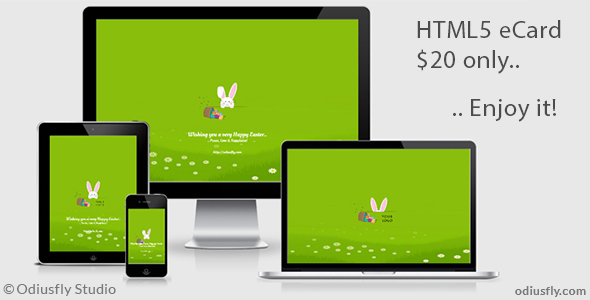
Happy Easter Card v2 Canvas is a small, self-contained HTML5 greeting card sold on ThemeForest for $20. It is an interactive Easter ecard built with web technologies that responds to mouse movement and touch input, and it is intended for anyone who wants to host a seasonal greeting on their own website rather than send a static image or a link to a third-party card service. The package is produced by Odiusfly Studio, a developer who publishes a range of similar interactive cards and games.
The product is best understood as a single-purpose digital asset: a folder of HTML, JavaScript and media files that gets uploaded to a web host and either linked directly or embedded in an existing page. It is not a WordPress plugin, not a theme, and not a service. That distinction matters because it shapes almost every practical question about how the card is deployed, licensed and maintained.
What the Happy Easter Card v2 Canvas package actually contains and does
The delivered files are plain HTML5 with accompanying JavaScript and media assets. There is no build step, no framework dependency and no server-side component, which means the card can be dropped onto almost any hosting environment that serves static files. The vendor describes the package as including the HTML5 files, a single version of the card, mouse and touch interaction, replaceable content, and a help document.
Input handling across desktop and mobile
The card responds to both pointer movement and touch. In practice this means the same file works on a desktop browser where the cursor drives the animation, and on a phone or tablet where a finger does the same job. For a greeting card this is the difference between something that feels alive on a laptop and something that simply sits there on a handset, so the dual input support is the most consequential technical detail in the listing.
Embedding options: direct link or iframe
Because the card is a standalone folder, it can be served from its own URL or embedded inside an existing page using an iframe. The vendor supplies an example iframe snippet with fixed width and height attributes. That flexibility is genuinely useful: a business can add an Easter greeting to a campaign landing page without rebuilding the page template, and a personal site owner can simply link to the card folder. The trade-off is that iframe sizing is manual, so responsive behaviour depends on how the embedding page handles the frame rather than on the card itself.
Reskinning and content replacement
The listing states that all graphics and media can be replaced with the buyer’s own, and that anyone with the relevant skills can edit the HTML and JavaScript files directly. This turns the card from a fixed greeting into a template: a studio could swap in a client’s branding, a photographer could substitute their own imagery, and a developer could adjust timing or interaction behaviour in the script. The help document is included to support that process, though the vendor does not state how extensive it is.
Where this Easter ecard fits, and where it does not
The clearest fit is a business or individual with an existing website who wants a seasonal touch without commissioning custom development. A bakery, a florist, a church group or a small agency running an Easter campaign could upload the folder, embed it on a seasonal landing page, and remove it once the holiday passes. The low price relative to bespoke animation work is the core argument in its favour.
It also suits developers and freelancers who want a starting point. Because the source files are editable and the media is replaceable, a freelancer could reskin the card for a client project and charge for the customisation rather than the asset. The single-licence-per-site rule means each client deployment needs its own licence, which is a cost to factor into a quote but not an unusual arrangement for marketplace assets.
Where the product is the wrong choice is equally clear. Anyone wanting to publish the card inside a mobile app store listing, or distribute it through Google Play, the Apple App Store or comparable platforms, is explicitly excluded by the vendor’s terms. Buyers who need a WordPress plugin that installs through the dashboard and inherits the site’s theme styling will also find this awkward, since it is a standalone folder rather than an integrated component. And anyone expecting guaranteed rendering across every browser and device generation should read the vendor’s own caveat: the listing states plainly that full compatibility across all devices and operating system updates cannot be assured.
Strengths and limitations of Happy Easter Card v2 Canvas
Strengths
- Zero infrastructure requirements. Static HTML5 files run on any standard host, including cheap shared hosting, with no database, PHP version or plugin dependency to manage.
- Dual input support. Mouse and touch handling in the same build means one purchase covers desktop and mobile visitors without a separate mobile version.
- Genuinely editable source. Graphics, media, HTML and JavaScript can all be replaced, so the card functions as a template rather than a locked artefact.
- Low entry price. At $20 the cost is trivial against the time required to build comparable interaction from scratch.
- Simple deployment paths. Direct hosting or iframe embedding covers most realistic use cases without touching a theme or CMS.
Limitations
- Restrictive licensing scope. Each licence covers one website or portal only. Agencies deploying across multiple client sites must buy multiple licences, and the card cannot be resold or redistributed on Envato or similar marketplaces.
- Excluded from app stores. The vendor’s terms prohibit use on Google, Apple and comparable storefronts, which rules out in-app seasonal greetings.
- No compatibility guarantee. The listing itself acknowledges that full compatibility across every device and OS update is not assured, so testing on the target audience’s actual browsers is essential.
- Manual iframe sizing. The supplied embed example uses fixed pixel dimensions, so responsive embedding is the buyer’s responsibility.
- Single version only. The package contains one card design. Buyers wanting variety across a campaign need to look at the developer’s other releases.
- No stated sales or rating history. The listing does not disclose sales figures, so there is no marketplace track record to weigh.
How it compares with the broader Easter ecard category
The alternatives fall into three rough groups: hosted ecard services, WordPress seasonal plugins, and custom-built animation. Hosted services handle delivery and tracking but keep the greeting on someone else’s domain, often with branding attached, and rarely allow deep customisation. Seasonal plugins integrate neatly with a WordPress site but are tied to that CMS and typically offer less visual ambition than a purpose-built interactive card. Custom animation delivers exactly what a brand wants but costs orders of magnitude more than $20.
Happy Easter Card v2 Canvas sits between the plugin and custom-build options. It offers more visual interactivity than a typical seasonal plugin and far more control than a hosted service, at a price close to a plugin licence. The trade-off is that it requires the buyer to handle hosting, embedding and any responsive tuning personally. For a team with basic front-end comfort, that is a reasonable exchange. For a non-technical site owner who wants a dashboard toggle, a plugin remains the easier path despite offering less.
Frequently Asked Questions
Do I need coding skills to use Happy Easter Card v2 Canvas?
No coding is required to deploy the card as supplied. The folder is uploaded to a host and either linked directly or embedded with an iframe snippet the vendor provides. Editing graphics, text or animation behaviour does require comfort with HTML, JavaScript and media files, so customisation is a separate skill from installation.
Can I use this Easter card on more than one website?
No, each licence covers one website or portal only. The vendor’s terms state that a single regular or extended licence cannot be used across unlimited sites or stores. Agencies deploying the card for several clients must purchase a separate licence for each deployment, which should be built into project pricing.
Does the card work on phones and tablets?
Yes, the package supports both mouse and touch input, so it responds to finger interaction on mobile devices. The vendor does, however, state that full compatibility across every device and operating system update cannot be guaranteed. Testing on the browsers and handsets the intended audience actually uses is advisable before a campaign goes live.
Can I change the images and content to match my brand?
Yes, the listing confirms that all graphics and media can be replaced with the buyer’s own assets, and that the HTML and JavaScript files can be modified by anyone with the relevant skills. That makes the card usable as a branded template rather than a fixed design, though the vendor does not specify how detailed the included help document is.
Verdict: who should buy Happy Easter Card v2 Canvas
Buyers with a hosted website, a modest Easter campaign and either front-end confidence or a developer on hand will get fair value from Happy Easter Card v2 Canvas at $20. Freelancers and small studios looking for an editable base to reskin for client work are the strongest fit, provided they account for per-site licensing. Site owners who want a one-click seasonal element inside WordPress, or who need the greeting inside a mobile app, should look elsewhere. The absence of a disclosed sales history means there is no marketplace track record to lean on, so the vendor’s caveat about device compatibility deserves attention before purchase. It is a small, honest utility rather than a polished campaign platform, and it should be judged on that basis.