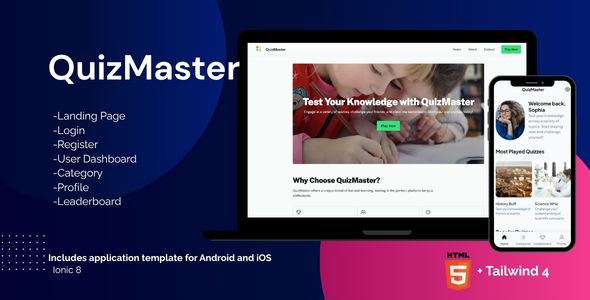
QuizMaster Mobile is a source-code package for building a quiz platform that runs in a browser and as a hybrid app on Android and iOS. It bundles a responsive HTML5/CSS/JavaScript web front end with an Ionic 8 and Angular mobile build, plus user accounts, a dashboard, leaderboards and quiz authoring tools. It suits developers and small teams who want a working quiz foundation to customise rather than a hosted quiz service.
The product is sold on ThemeForest for $32 under the Mobile category. The vendor does not disclose a sales figure, so there is no purchase history to weigh up, and buyers are effectively assessing the code and the feature list on their own merits. That makes the specifics of what is included, and what is left for the buyer to build, the most important thing to establish before paying.
What QuizMaster Mobile actually gives you to work with
The package contains two separate codebases rather than one codebase exported twice. The web version is plain HTML5, CSS and JavaScript styled with TailwindCSS, which means it can be dropped onto almost any static host or folded into an existing PHP, Node or Python site without a build pipeline getting in the way. The mobile version is a hybrid app built on Ionic 8 and Angular, structured for submission to Google Play and the App Store. Keeping the two apart is a sensible decision for customisation, though it also means styling and logic changes generally have to be made twice.
On the functional side, the application covers the loop a quiz product needs: registration and login, a user profile that displays statistics, a leaderboard, quiz creation and management, and custom categories. The presence of quiz authoring inside the app is the most consequential feature. It means the product is not just a player for questions stored in a file; it is a small platform where content can be created and organised. For an educator or a membership business, that changes the amount of backend work required before launch.
Two further details matter more than they might appear. First, the vendor states that both online and offline gameplay modes are supported, which is unusual in a template at this price and is directly useful for events, classrooms and venues with unreliable connectivity. Second, the listing explicitly says there are no mandatory subscriptions or external dependencies. In practice that means the buyer is not tied to a vendor’s API or a paid question bank, but it also means the buyer supplies whatever persistence layer the quizzes need.
The vendor describes the code as structured and commented, with documentation covering installation, configuration and publishing, plus basic startup support. Those claims are common in marketplace listings and can only be verified by reading the files. What can be said is that the stated scope of the documentation — installation through to store publishing — is the right scope for a hybrid app product, since the publishing step is where most buyers of Ionic templates get stuck.
Where a cross-platform quiz app template fits, and where it does not
The clearest fit is an educational or training context where someone already has questions and needs a presentable way to deliver them. A tutor building a revision product, a company running internal compliance or onboarding quizzes, or a membership site adding a knowledge-testing feature could all take this codebase and reach a working prototype quickly. The offline mode makes it viable for classrooms, conferences and exhibition stands where Wi-Fi cannot be relied on.
It also suits freelancers and small agencies who are asked for a quiz or trivia app and would rather start from an existing Ionic and Angular structure than scaffold authentication, profiles and a leaderboard from scratch. At $32, the economics of buying versus building are straightforward even if only part of the code is reused.
Where it is the wrong choice is any project that needs a managed backend out of the box. The listing does not name a database, an API layer or an admin panel for content moderation, and the vendor’s own wording about integrating “your own backend systems” confirms that persistence and server logic are the buyer’s responsibility. Anyone without development resource who expects to upload questions through a web console and have them appear in the app will be disappointed. The same applies to organisations that need multi-tenant accounts, payment processing for quiz access, or detailed reporting and analytics: none of those are listed, and each would be a substantial addition.
Strengths and limitations of QuizMaster Mobile
Strengths
- Two genuine codebases — a dependency-light HTML/CSS/JS web app and an Ionic/Angular mobile app — rather than a single responsive layout presented as cross-platform.
- Quiz creation and custom categories are built in, so the product supports content authoring and not only playback.
- Offline gameplay is explicitly supported, which is rare at this price point and valuable for events and classrooms.
- No subscription or third-party service lock-in, leaving the buyer free to choose hosting and infrastructure.
- TailwindCSS on the web side and Angular Material-style UI on mobile give a modern starting appearance that does not need to be rebuilt from zero.
- Documentation is stated to cover store publishing, which is the step most likely to block a first-time app publisher.
Limitations
- No backend, database schema or admin interface is included or described. Authentication, leaderboard storage and question persistence all require the buyer’s own server work, and the leaderboard in particular is meaningless without one.
- Because the web and mobile versions are separate stacks, every design or logic change is duplicated effort; there is no shared component layer between them.
- The vendor discloses no sales history, no live demo link in the supplied data and no version or update log, so there is no evidence of ongoing maintenance.
- Question types are mentioned only as something the buyer can adapt, which suggests a limited default set rather than a rich matrix of multiple-choice, true/false, image and timed formats.
- Basic startup support is undefined in scope; buyers should assume it does not extend to custom development.
- Store submission still requires the buyer’s own Apple and Google developer accounts and the associated fees, which are not part of the $32 price.
How QuizMaster Mobile compares with the wider quiz app category
Buyers researching this space generally face three options: a hosted quiz platform on a monthly plan, a WordPress quiz plugin, or a source-code template like this one. Hosted platforms win on speed to launch and include the backend, hosting and analytics, but they charge recurring fees and control the branding and data. A quiz plugin is cheaper to run on an existing WordPress site but is confined to the browser and offers no native app path.
QuizMaster Mobile sits in the third category and competes on ownership and reach. It is the only one of the three that hands over readable source for both a web app and a store-ready mobile build, and the only one where offline play and native distribution are part of the deal. The trade-off is that it is a starting point, not a finished service: the backend, the content and the store accounts are all on the buyer. Compared with other marketplace app templates, its distinguishing features are the dual-stack delivery and the built-in authoring tools; compared with a hosted platform, it offers control at the cost of convenience. Neither is better in the abstract — the decision turns on whether the buyer has development capacity.
Frequently Asked Questions
Does QuizMaster Mobile include a backend or database?
No. The package contains front-end source for the web and mobile apps only, and the vendor states that buyers can integrate their own backend systems or databases. User accounts, leaderboard scores and quiz storage therefore need a server the buyer supplies, which is the largest piece of work beyond the purchase price.
Can the app be published to Google Play and the App Store?
Yes. The mobile build uses Ionic 8 and Angular and is described as ready to publish on both stores, with documentation covering the publishing process. The buyer still needs their own Apple and Google developer accounts, must meet each store’s review requirements, and pays the respective developer fees separately.
Does QuizMaster Mobile work without an internet connection?
Yes, offline gameplay is one of the listed features. Both online and offline modes are supported, which makes the app usable in classrooms, at events and in venues with weak connectivity. How much content is available offline, and how results synchronise once a connection returns, depends on the backend integration the buyer builds.
What technology stack does QuizMaster Mobile use?
The web version is built with HTML5, CSS and JavaScript using TailwindCSS, and the mobile version uses Ionic 8 with Angular. The two are separate codebases, so changes to design or logic usually need to be applied to each. Buyers should be comfortable with Angular and modern JavaScript before purchasing.
Verdict: who should buy QuizMaster Mobile and who should walk away
QuizMaster Mobile is a reasonable purchase for a developer, freelancer or small agency that needs a head start on a quiz product and is comfortable wiring up its own backend. The combination of a lightweight web front end, an Ionic/Angular mobile app, built-in quiz authoring and offline play is a credible foundation for $32, and the absence of subscription lock-in keeps long-term costs predictable.
It is a poor fit for anyone without development resource, for projects that need a managed admin panel and analytics on day one, and for buyers who expect the leaderboard and user accounts to work without a server. The undisclosed sales figure and lack of a stated update history also argue for checking the vendor’s support responsiveness before committing to a commercial launch.
Treat the purchase as buying a starting codebase rather than a finished platform, budget accordingly for backend work and store fees, and the value proposition holds up.