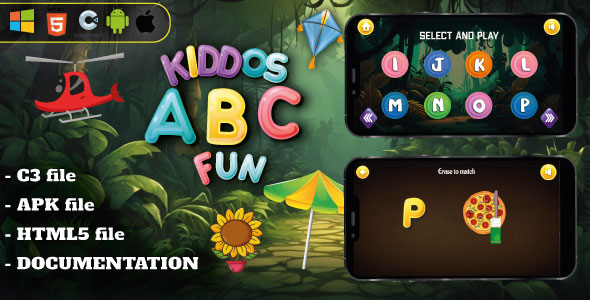
Kiddos ABC Fun Games is a browser-based alphabet learning game for toddlers and preschoolers, built in Construct 3 and delivered as an HTML5 package with source files. It presents 26 letter-themed levels in which a child drags a finger or mouse across blocks to wipe them away and uncover an object beginning with that letter, with voice narration naming the letter and the object. It is aimed at developers, freelance web builders and small agencies who want a ready-made educational mini-game to publish on a children’s site, inside a learning app, or as a white-labelled product for a client.
The listing sits in ThemeForest’s Games category at $29, which places it in the budget tier of ready-made HTML5 games. The vendor, who publishes under the Kiddos ABC Fun name and offers support through a Gmail address, does not disclose a sales figure, so there is no purchase history to weigh. That absence matters for a buyer comparing this against established code marketplaces, and it shapes much of what follows.
What Kiddos ABC Fun Games actually delivers
The core loop is deliberately narrow, and that is the point. Each level shows a letter, the child drags across a grid of blocks, and the blocks disappear to reveal a picture of something starting with that letter. The level ends when the object is fully uncovered. There is no scoring, no timer, no failure state and no progression gate — a child can jump to any letter from A to Z at will. For the target age group this is sensible design: frustration is the main reason toddlers abandon an app, and removing lose conditions removes most of it.
Voice narration is the feature that carries the educational weight. A letter-and-object game without audio is essentially a picture-matching exercise; the spoken prompt is what ties the visual to the phoneme. The vendor lists narration for both the letter and the object, which is the minimum needed for the format to work as an English-learning tool rather than pure entertainment.
On the technical side, the package includes four things: the Construct 3 project file, an exported HTML5 build for the web, an APK for Android, and documentation. That combination is more useful than it first appears. The HTML5 build can be dropped onto a static host or embedded in an iframe without touching the source; the APK gives a route to Google Play or a direct sideload distribution; and the C3 file means the game can be edited rather than merely rebranded. The vendor explicitly notes that the reskinning process is simple, and because the art is a set of letter-object pairs rather than a complex animated character rig, that claim is plausible — swapping images and re-recording narration is a contained job.
Graphics are described as Full HD and the gameplay as smooth, with no external plugins required. The plugin point is worth flagging: Construct 3 projects that depend on third-party addons can break when the runtime updates, so a plugin-free export is a genuine maintenance advantage for anyone hosting the game long-term. Controls are touch-and-drag on both mobile and desktop, which means a single input model across platforms and no separate build for mouse users.
Where this game fits, and where it does not
The clearest fit is a children’s education site or app that needs a lightweight alphabet activity to sit alongside stories, songs or printable worksheets. Because the whole thing is HTML5, it can be embedded in a WordPress page, a learning management system, or a native app wrapper without a rebuild. A freelance developer quoting on a nursery or primary-school website could use it as a low-cost interactive extra that lifts a quote without adding weeks of work.
A second fit is the reseller or white-label scenario. An agency building a branded kids’ portal can take the C3 file, replace the object art with its own illustrations, re-record the narration in a different language or accent, and ship it as a client-owned product. The $29 price makes that economically trivial compared with commissioning a custom game, and the presence of the source file is what makes the reskin legitimate rather than a hack.
The wrong choice is any project that needs measurable learning outcomes or progress tracking. There is no reporting, no score history, no difficulty curve and no assessment layer, so a school or edtech buyer looking for data on what a child has learned will find nothing here. It is equally unsuitable for older children — the mechanic is a reveal-and-name exercise with no challenge beyond the drag gesture, and a seven- or eight-year-old will exhaust it in minutes. Buyers wanting a multi-mechanic suite (matching, tracing, spelling, quizzes) should look at broader educational bundles rather than a single-activity game.
Strengths and limitations of Kiddos ABC Fun Games
Strengths
- Source file included. The Construct 3 project ships with the game, so it can be edited, extended or fully rebranded rather than used as a black box.
- Three delivery formats in one purchase. Web HTML5, Android APK and the editable C3 file cover the most common distribution routes without extra cost.
- No external plugins. Fewer dependencies means fewer breakages when the Construct runtime updates, and simpler hosting.
- Open level selection. Letting a child pick any letter suits real classroom and home use, where a lesson may focus on one letter rather than starting at A.
- Single input model. Touch and drag works identically on phone, tablet and desktop, so there is no separate control scheme to test.
- Low price relative to custom work. At $29 the game undercuts even a few hours of bespoke development.
Limitations
- No disclosed sales history. The vendor does not publish a sales count, so there is no track record to judge reliability or update frequency against.
- Single mechanic. Every one of the 26 levels uses the same erase-to-reveal interaction; there is no variety in play, which limits replay value.
- No progress or assessment features. Nothing records which letters a child has completed, and there is no score, so it cannot support reporting to parents or teachers.
- Support is an individual email address. Buyers should expect peer-level support rather than a staffed help desk, and should not assume a guaranteed response time.
- Narration language is not specified. The listing does not state which language or accent the voice files use, which is a material gap for anyone planning an English-learning product.
- No stated minimum browser or OS versions. Compatibility is described only as cross-platform, with no detail on which Android versions the APK targets.
How it compares with the wider ready-made HTML5 game market
Code marketplaces are full of HTML5 games, and the educational subcategory splits roughly into two groups: single-mechanic games like this one, and larger bundles that package several activities behind a menu. Bundles usually cost more and are heavier to integrate, but they offer variety that a one-mechanic game cannot. Kiddos ABC Fun Games competes on simplicity and on the inclusion of the editable Construct 3 source, which many cheaper arcade-style listings omit — plenty of budget games ship only a minified HTML5 build, leaving the buyer unable to change anything beyond a logo.
Against custom development, the trade-off is control versus cost. A commissioned alphabet game would be tailored to a specific curriculum, brand and language, and would come with a developer on the hook for fixes. This product offers none of that, but it costs a fraction and can be live the same day. Against free open-source educational games, the advantage is polish and completeness — free alternatives often lack narration, documentation or a mobile build — while the disadvantage is that free code can be inspected before commitment, whereas here the buyer sees only screenshots and a feature list.
The honest positioning is a cheap, tidy starting point rather than a finished educational platform. Buyers who treat it as a base to reskin and extend will get good value; buyers expecting a complete learning product with tracking and curriculum alignment will be disappointed.
Frequently Asked Questions
What is Kiddos ABC Fun Games?
It is an HTML5 alphabet game for young children, built in Construct 3, in which players drag across blocks to reveal objects starting with each of the 26 letters. The package includes the editable Construct 3 project, a web build, an Android APK and documentation, and it is sold on ThemeForest for $29.
Can Kiddos ABC Fun Games be reskinned and sold as my own product?
Yes, reskinning is the intended use of the included Construct 3 file. The vendor describes the reskinning process as simple, and because the art consists of discrete letter-object images plus narration audio, replacing them is a contained task. Buyers should still check the marketplace licence terms before redistributing the game commercially.
Does Kiddos ABC Fun Games work on phones and tablets?
Yes, it runs on mobile and desktop through the same touch-and-drag control scheme. The package includes a dedicated Android APK alongside the HTML5 web build, so it can be installed on Android devices directly or hosted online and played in a mobile browser. The vendor does not state which Android versions the APK supports.
Is Kiddos ABC Fun Games suitable for a school or classroom setting?
It works as a casual classroom activity but not as a tracked learning tool. There is no score, no progress saving and no reporting on which letters a child has completed, so teachers cannot assess outcomes from it. It suits short, supervised play on a tablet or interactive whiteboard rather than structured assessment.
Verdict on Kiddos ABC Fun Games
Kiddos ABC Fun Games is worth buying for developers and small agencies who need a presentable, narrated alphabet activity quickly and want the freedom to edit it. The combination of HTML5 build, Android APK and the Construct 3 source at $29 is the strongest argument in its favour, and the plugin-free export keeps long-term hosting simple. It is not the right purchase for anyone needing progress tracking, curriculum alignment, multiple game mechanics or documented support guarantees, nor for products aimed at children past early primary age. The undisclosed sales history and the unspecified narration language are the two details a cautious buyer should clarify with the vendor before committing, since neither is answered in the listing itself.