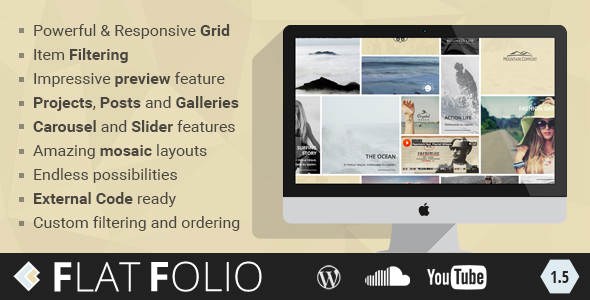
FlatFolio is a WordPress portfolio and gallery plugin sold on ThemeForest for $27, built by the developer unCommons. It generates grid, carousel, slider and mosaic layouts from three content sources — projects, posts and galleries — and adds filtering, hover overlays, lightbox previews and audio embeds on top. FlatFolio Galleries suit freelancers and small studios that want a controlled visual showcase without rebuilding their site around a new theme.
The plugin has accumulated 846 sales since launch, which puts it in the modest but established tier of ThemeForest gallery add-ons. Its last vendor update landed in May 2020, so buyers should weigh the feature set against the fact that active development appears to have stopped.
What FlatFolio Galleries Actually Builds
The core of the product is a responsive grid engine. Items are pulled from three separate WordPress content types — portfolio projects, standard posts and image galleries — and rendered through a layout builder that supports grids, carousels, sliders and mosaic arrangements. That range matters because most competing gallery plugins commit to one presentation model. A photographer can run a masonry grid on the homepage and a slider on a project page from the same content pool.
Filtering is the second pillar. Visitors can narrow a grid by category, skill or custom taxonomy, and the vendor exposes ordering controls so the default sort can be overridden per instance. For a studio with a large back catalogue, client-side filtering is often the difference between a browsable archive and a wall of thumbnails nobody scrolls past.
Presentation options are unusually granular for the price point. FlatFolio Galleries support four item shapes, unlimited custom item formats, captions, title and subtitle fields, coloured overlay layers, hover shadows and curtain-style reveal effects. Logos can be placed as grid items, which extends the plugin beyond portfolio work into client lists and sponsorship walls. An expand panel opens additional detail with body overflow handled correctly, so long descriptions do not break the page scroll.
Media handling covers more than stills. YouTube and SoundCloud items get dedicated layouts, and the changelog notes a custom URL field for gallery images, which allows each item to link somewhere other than its own attachment page. ImagesLoaded is bundled to prevent the classic masonry gap problem where items stack incorrectly before thumbnails finish loading, and the Aqua-Resizer library is included for on-the-fly image resizing — a meaningful performance decision, since serving full-size uploads into small grid cells is one of the most common causes of slow portfolio pages.
On the administrative side, the plugin is localization-ready and described as external-code ready, meaning shortcodes or template tags can be placed outside the main content area. Layouts, projects, categories and skills are all managed from the WordPress dashboard rather than through file edits.
Where FlatFolio Galleries Fit — and Where They Do Not
The strongest fit is a freelancer or small agency running a content-heavy portfolio on an existing theme. Because FlatFolio works as a plugin rather than a theme, it can be dropped into a site that already has its typography, navigation and page structure settled. Photographers, illustrators, motion designers and architecture practices all map cleanly onto the project-plus-gallery model.
A second good fit is the site that needs mixed media in one grid. A musician or podcast producer can place SoundCloud embeds beside press photos and YouTube videos in a single filtered layout, which is awkward to achieve with a pure image gallery plugin.
The wrong choice is a storefront. FlatFolio Galleries have no cart, no pricing fields, no variation logic and no checkout integration. Anyone who needs to sell prints or licences directly should be looking at WooCommerce-compatible portfolio themes instead. It is also a poor fit for teams that require a maintained, actively patched dependency — the plugin has not received a vendor update since 2020, and there is no published roadmap. Finally, sites built entirely around the block editor and full site editing will find the shortcode-driven workflow dated, since the plugin predates that editorial model.
Strengths and Limitations
Strengths
- Three content sources in one layout engine — projects, posts and galleries — so a single plugin can drive several different page types without duplication.
- Genuinely broad layout coverage: grid, carousel, slider and mosaic from the same item pool.
- Filtering by category, skill and custom taxonomy, with ordering controls exposed per instance.
- Bundled ImagesLoaded and Aqua-Resizer address the two most common real-world gallery failures: broken masonry stacking and oversized image payloads.
- Audio and video layouts for YouTube and SoundCloud give the plugin reach beyond photography portfolios.
- Custom URL support per gallery image, useful for campaign landing pages and affiliate-style outbound links.
- Localization-ready, with a documented translation path.
- At $27 with 846 sales, the price-to-capability ratio is favourable for a one-off project.
Limitations
- No vendor update since May 2020. Compatibility with current WordPress and PHP releases is not guaranteed by the listing, and buyers should test on a staging site before committing.
- No e-commerce functionality of any kind. Selling work requires a separate commerce layer.
- The interface is shortcode and settings based rather than block based, which feels like a step backwards on modern editorial workflows.
- Documentation is hosted online rather than shipped in-product, so offline or air-gapped installations have no reference material.
- Support responsiveness is not documented in the listing, and a five-year gap in releases makes the practical support picture unclear.
- No stated accessibility provisions — keyboard navigation and screen-reader behaviour for the lightbox and filter controls are not addressed by the vendor.
How FlatFolio Galleries Compare to the Wider Category
Portfolio and gallery plugins generally fall into three groups: lightweight lightbox add-ons, dedicated gallery plugins with their own admin screens, and full portfolio themes that bundle layout and presentation together. FlatFolio sits in the second group but leans toward the theme end of it, because it manages its own project and skill taxonomies rather than simply rendering whatever media already exists in the library.
Against lightbox-focused alternatives, FlatFolio Galleries offer considerably more control over layout, filtering and item metadata, at the cost of a heavier footprint and a more involved setup. Against full portfolio themes, the plugin wins on flexibility — it can be added to a site that already exists — but loses on cohesion, since the vendor does not control the surrounding theme and cannot guarantee visual consistency.
Against modern block-based gallery plugins, the trade-off is sharper. Block plugins integrate natively with the site editor, receive ongoing updates and generally handle responsive image markup more cleanly. FlatFolio counters with a deeper feature set around filtering, item shapes and overlay effects that block plugins rarely match at this price. Buyers who value longevity and native editor integration should look elsewhere; buyers who need mosaic layouts, custom item formats and taxonomy filtering on a legacy or hybrid site will find more here.
Frequently Asked Questions
Does FlatFolio require a specific WordPress theme?
No. FlatFolio Galleries install as a plugin and are designed to work alongside an existing theme rather than replace it. Layouts are inserted through shortcodes or template tags, so any theme that renders standard content areas will display them. Visual consistency depends on how well the host theme’s typography and spacing match the plugin’s output.
Can FlatFolio Galleries display audio and video alongside images?
Yes. The plugin includes dedicated layouts for YouTube and SoundCloud items, so video and audio can sit inside the same grid or carousel as photographs. This makes it viable for musicians, podcasters and mixed-media portfolios where a pure image gallery would be too narrow. Filtering still applies across all item types.
Is FlatFolio still updated and supported?
The listing shows the last vendor update in May 2020, so the plugin is not under active development. It continues to be sold and has 846 recorded sales, but buyers should assume no new features are coming. Testing against the current WordPress and PHP versions on a staging environment before purchase is advisable.
Can FlatFolio Galleries be used to sell products or prints?
No. FlatFolio has no cart, pricing, variation or checkout functionality, and the vendor does not position it as a commerce tool. It is a presentation layer for visual work. Sites that need to sell prints, licences or digital downloads must pair it with a separate e-commerce plugin such as WooCommerce.
Verdict
FlatFolio Galleries are worth buying for freelancers, photographers and small studios that need a flexible, filterable showcase on top of an existing WordPress theme and are comfortable working with shortcodes. The combination of three content sources, four layout types, custom item formats and bundled image-handling libraries is strong value at $27, and the 846 sales suggest it has found a real audience. Buyers should not purchase it expecting ongoing development, block editor integration or any route to selling work directly. Agencies maintaining long-lived client sites should treat the 2020 update gap as a genuine risk and test thoroughly before deploying. For a one-off portfolio build where the design is already settled, it remains a practical choice.