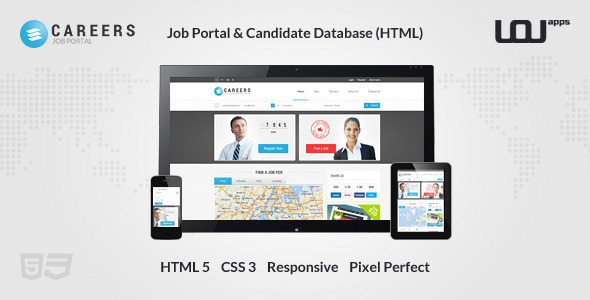
CAREERS is a static HTML template package for building a job board or candidate database, sold on ThemeForest for $40 under the miscellaneous category. It ships with a homepage, job and candidate listing pages, individual vacancy and profile pages, and a filter-driven advanced search interface. It suits freelancers and small agencies that want a front-end job portal design they can wire up to their own backend, and it is a poor fit for anyone expecting a working application out of the box.
The template comes from DirectoryThemes, a developer whose catalogue leans toward directory-style layouts, and it has accumulated 853 sales since its release. That figure matters because it tells a prospective buyer the design has been seen and used widely, even though the file itself has not been touched by the vendor since June 2014.
What the CAREERS miscellaneous template actually includes
The package is a set of linked HTML pages rather than a content management system theme. Everything a visitor sees is present as markup and styling; nothing is stored, searched or retrieved on a server unless the buyer adds that layer. Understanding that boundary early prevents a lot of disappointment later.
The centrepiece is the advanced search. Filters are exposed across the listing pages so a visitor can narrow a set of vacancies or candidates by the criteria the markup defines. Because the filtering logic is front-end only, the practical value depends entirely on how the buyer connects those controls to a real data source. The template gives the interface; the query layer is the integrator’s job.
Two parallel listing experiences are provided. The job listing page offers multiple view modes, so the same result set can be presented as a compact list or a more detailed card layout, and the candidate listing exists in versions with and without a sidebar. That duplication is deliberate: it lets a site mix a wide directory page with a narrower, filter-heavy page without redesigning anything.
Individual detail pages cover the vacancy view and the candidate profile view. The vacancy page is described as having an extendable view, which in practice means the layout accommodates additional blocks of descriptive content without breaking the column structure. The candidate profile page presents a person’s details in a comparable format, which is what makes the two-sided marketplace pattern work visually.
Supporting pages round out the set: a homepage with two special toggles that switch content regions, an About Us page, a Partners page and a Contact page. The toggles are the most interesting of these because they let a single homepage serve two audiences, typically employers and job seekers, without a second template.
One packaging detail is stated plainly by the vendor and is worth repeating: stock images and backgrounds are not included. Buyers should budget for licensing or substitute their own photography, and should expect the demo to look noticeably different once those assets are swapped out.
Where CAREERS miscellaneous fits, and where it does not
The strongest fit is a developer or studio building a niche job board where the front end is the hard part and the backend is already decided. A recruitment agency that wants a marketing-facing vacancy showcase, with applications handled by an existing ATS or a form service, can take these pages, populate them from a JSON file or a headless CMS, and launch quickly. The candidate listing variants also suit a directory-style site that indexes people rather than open roles, such as a freelance roster or a specialist talent pool.
A second reasonable use is prototyping. Because the pages are static, they can be shown to a client or tested with users before any database schema is committed to. That is cheaper than building a CMS theme and discovering the information architecture is wrong.
The wrong choice is any project that needs a functioning portal on day one. There is no job posting workflow, no application submission handling, no user accounts and no administrative interface in this package. A buyer who wants to install something, add jobs through a dashboard and accept applications without writing server-side code should be looking at a WordPress job board theme or a hosted job board platform instead. The same applies to anyone who needs multi-language content management, structured data output or an applicant tracking pipeline, none of which the vendor states as included.
Strengths and limitations of this job portal template
Strengths
- The search and filter interface is the most developed part of the package, which is the correct priority for a job or candidate directory where browsing is the primary user task.
- Two listing patterns for candidates, with and without a sidebar, plus multiple job listing views, give real layout flexibility without extra design work.
- The homepage toggles allow one page to address two distinct audiences, which is unusual in templates at this price point.
- Detail pages for both vacancies and candidates mean the two-sided marketplace model is covered end to end at the presentation layer.
- 853 sales provide a reasonable signal that the layout holds up in production use, and the $40 price is low enough that the design alone can justify it.
Limitations
- The last vendor update was June 2014. Any buyer should assume the markup predates current accessibility expectations, modern CSS layout techniques and contemporary responsive breakpoints, and should inspect the code before committing.
- There is no backend. Search, filtering, pagination and application handling must all be implemented by the buyer, which is a substantial amount of work that the listing does not quantify.
- Stock imagery is excluded, so the demo’s visual polish is not reproducible without additional licensing costs.
- Because the filtering is presentational, the template cannot demonstrate how it behaves against a large result set. Performance with thousands of records is untested and unstated.
- No documentation, browser support matrix or framework dependency is described in the product data, so compatibility with a chosen stack has to be verified after purchase.
How it compares with other ways of building a job board
The realistic alternatives fall into three groups. The first is a CMS-based job board theme, typically for WordPress, which bundles the template with posting, application and search functionality. Those cost more and constrain the technology stack, but they remove the backend work entirely. For a non-technical operator, that trade is almost always worth taking.
The second group is a hosted job board service, where the software, hosting and often the candidate traffic are provided for a recurring fee. These win on time to launch and lose on ownership, customisation and long-term cost.
The third group is a custom build or a general-purpose front-end framework. That offers complete control and no licensing questions, but it means designing the listing, filter and profile patterns from nothing.
CAREERS miscellaneous sits between the first and third options. It is cheaper than a CMS theme and faster than a custom build, and it imposes no technology decision on the buyer. The cost is that the buyer absorbs all integration work. Anyone comfortable with that division of labour gets a well-considered interface for a very small outlay; anyone who is not should choose the CMS route.
Frequently Asked Questions
Is CAREERS a WordPress theme or a plugin?
Neither. It is a static HTML template package containing linked pages, stylesheets and scripts, sold on ThemeForest in the miscellaneous category. It does not install into WordPress or any other CMS, and it has no PHP, database schema or admin panel. Buyers must supply their own backend to make the listings dynamic.
Does the template include a working job application system?
No. Application handling is not part of the package. The template provides the vacancy and candidate profile pages that would host an application form, but the form processing, storage and notification logic must be built or connected by the buyer. Common approaches are a third-party form service or an existing applicant tracking system.
Is CAREERS still maintained and compatible with modern browsers?
The vendor’s last recorded update was June 2014, and no maintenance schedule is stated. That age means the code should be reviewed for deprecated markup, fixed-width assumptions and accessibility gaps before use on a new project. It may still render acceptably, but compatibility is not guaranteed by the vendor.
What do buyers need to supply beyond the $40 purchase price?
At minimum, imagery, since stock photos and backgrounds are explicitly excluded from the package. Beyond that, a backend or data source to populate the listings, and developer time to connect the search filters to real queries. Those costs are not stated by the vendor and will usually exceed the template price.
Verdict on the CAREERS miscellaneous job portal template
Buy this if the front end is the obstacle and the backend is already solved. A developer building a niche job board, a recruitment agency with an existing application pipeline, or a studio that needs a credible directory interface quickly will find the listing views, filter controls and dual-audience homepage worth far more than $40, and the 853 sales suggest others have reached the same conclusion.
Do not buy it if a functioning portal is expected on installation, if the project depends on current accessibility standards, or if nobody on the team can write the server-side layer. In those cases a CMS-based job board theme is the more honest purchase, even at several times the price.
The most accurate description of CAREERS miscellaneous is a well-structured interface kit with an unresolved second half. It is a sound starting point for the right buyer and an incomplete product for the wrong one, and the difference is entirely about who is doing the integration work.