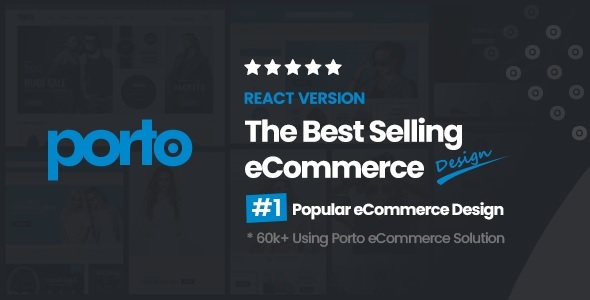
Porto retail is a React-based eCommerce template sold on ThemeForest by developer p-themes, priced at $29, that ships with more than 25 pre-built storefront demos and a full admin panel. It is aimed at developers and agencies who want a ready-made React front end for an online store rather than a WordPress theme, and it has accumulated 380 sales since its first release in late 2020. The template bundles product, category, blog, cart and checkout screens, so a working storefront can be assembled from existing layouts instead of built from scratch.
What the Porto retail template actually includes
The most consequential thing about this package is its breadth of pre-built demos. The vendor lists over 25 layouts, and the changelog shows the range expanded over time to cover grocery, electronics, skincare, wine, medical, sunglasses and general fashion niches, each with its own visual treatment. For an agency quoting fixed-price work, that variety shortens the design phase considerably: instead of commissioning a bespoke homepage, a developer picks the closest demo and adjusts colours, typography and imagery.
Under the hood, the template runs on React with React Redux for state management. Version 2.0 moved the project to Next.js and replaced the original mock server with Apollo, which matters because it means the demo data layer is closer to something a real API could be swapped into. That same release replaced redux-thunk with redux-saga for side effects. The practical benefit is that data fetching, cart state and product variation logic already follow recognisable patterns, so a developer joining the project is not reverse-engineering a bespoke architecture.
Product handling goes beyond the flat catalogue most templates offer. The changelog notes a variable product type where price changes according to colour and size, which is the behaviour a clothing or footwear store needs. Product pages support list and grid views, inner and outer image zoom, and the vendor describes the product and category page variations as unlimited, meaning layouts can be recombined rather than chosen from a fixed set.
Navigation and merchandising elements are covered in reasonable depth. There are multiple mega menu styles, a vertical mega menu, a sticky header, brand sliders, carousels, and new/hot/sale badges that can be applied to products. A header search was added in version 2.0. These are the components that make a store feel finished rather than like a prototype, and having them pre-styled saves the tedious work of building a mega menu from scratch.
Supporting pages are included as well: blog list, blog grid and single post templates, contact and about pages, a login popup, and checkout. Skeleton loaders were added across blog, shop and product pages in version 2.0, which improves perceived performance on slow connections. The vendor also ships documentation and states that support and updates are provided, though the listing does not specify a support period or response time.
Where this template fits, and where it does not
The clearest fit is a development team or freelancer building a custom React storefront who needs a head start on layout and component work. If the project uses Next.js and a GraphQL API, the v2.0 architecture aligns closely enough that the demo data layer can be replaced rather than rebuilt. Multi-niche agencies will get the most value from the demo library, since the same purchase covers grocery, fashion, electronics and specialty retail layouts.
It also suits projects where a client wants a distinctive storefront without paying for a fully custom design. The 25-plus demos give enough starting points that a store rarely looks like a stock template once colours and content are replaced.
Where Porto retail is the wrong choice is any project that needs to be live quickly with no developer involvement. This is a code template, not a hosted platform or a plugin. There is no visual page builder in the conventional sense, and no plugin ecosystem to fall back on. A shop owner without React experience will not be able to install this and start selling. Similarly, anyone who needs a WordPress or Shopify solution should look elsewhere entirely, because the template does not target those platforms.
A second poor fit is a project requiring long-term, actively evolving framework support. The last vendor update recorded in the listing is March 2022, which is a meaningful gap for a JavaScript codebase where React, Next.js and Apollo all move quickly. A team adopting this in a current project should expect to upgrade dependencies themselves.
Strengths and limitations
Strengths
- Over 25 demo layouts spanning grocery, fashion, electronics, wine, medical and other niches, which reduces design time on fixed-scope projects.
- Modern stack: React with Redux, Next.js for rendering, Apollo for data, and redux-saga for side effects.
- Variable product pricing by colour and size, a feature many template storefronts omit.
- Full set of supporting pages — blog, contact, about, login popup, cart and checkout — rather than shop screens alone.
- An admin panel was added in version 2.0, giving the template a back-office surface as well as a storefront.
- Skeleton loaders on shop, product and blog pages improve perceived load performance.
- At $29, the cost is trivial relative to the hours saved on layout and component work.
Limitations
- The last recorded update is March 2022. Dependencies such as React, Next.js and Apollo have moved on considerably since then, so a buyer should budget for an upgrade pass before starting.
- Internet Explorer support codes were removed in version 2.0, so the template will not serve legacy browser requirements — relevant for some enterprise or government-adjacent projects.
- There is no stated support period or response-time commitment in the listing, which is a risk on a commercial build.
- Because it is a code template rather than a platform, every content change and integration is a development task. Non-technical store owners cannot maintain it directly.
- 380 sales is a modest figure for a ThemeForest item, which means a smaller pool of community answers and third-party tutorials than more widely adopted templates enjoy.
- The vendor does not state which React or Next.js versions the current package targets, so version compatibility needs to be confirmed before purchase.
How Porto retail compares with the wider category
Templates in this category generally fall into two groups: theme-marketplace products built on a CMS, and code templates built on a JavaScript framework. Porto retail sits firmly in the second group. Against CMS-based themes, it offers far more control over rendering, routing and data flow, but requires a developer at every step and provides no admin experience for non-technical staff beyond the bundled panel. Against other React storefront templates, its differentiators are the size of the demo library and the Next.js plus Apollo architecture; its weakness is maintenance cadence, since many competing templates ship more frequent dependency updates.
For teams already comfortable in React, the comparison comes down to build-versus-buy on layout work. A template like this removes weeks of component styling and page assembly. For teams without React skills, the same purchase represents a liability, because the codebase becomes something to maintain rather than something to use.
Frequently Asked Questions
Is Porto retail a WordPress theme or a standalone React template?
It is a standalone React template, not a WordPress theme. The package is built on React with Redux, and version 2.0 moved it to Next.js with Apollo for data handling. That means it runs as its own JavaScript application and cannot be installed into WordPress, Shopify or any other CMS. Buyers expecting a dashboard-driven theme should look at CMS-based alternatives instead.
Do I need to know React to use this template?
Yes. Customising layouts, connecting a real API and deploying the storefront all require working knowledge of React, and ideally Next.js. The bundled admin panel helps with content, but the codebase itself is not editable through a visual builder. A developer or agency is effectively required, which is the main constraint on who can realistically use this product.
How many demo layouts does the template include?
The vendor states more than 25 pre-made demos. The changelog shows the library growing across versions, with dedicated layouts for grocery, electronics, skincare, wine, medical, sunglasses and fashion niches, plus a single product demo. Each demo can be adapted by changing colours, typography and imagery rather than building a layout from nothing.
Is Porto retail still updated?
The last update recorded in the listing is March 2022. The vendor does not state a support period or an update schedule, so buyers cannot assume ongoing maintenance. For a project starting now, that means checking dependency versions against current React and Next.js releases and planning an upgrade before development begins.
Verdict
Porto retail is a sensible purchase for React developers and agencies who need a head start on a custom storefront and are comfortable owning the codebase afterwards. The demo library, variable product pricing and Next.js plus Apollo architecture represent real value at $29, and the admin panel extends its usefulness beyond the customer-facing pages. It is not suitable for shop owners without development resources, for anyone needing a CMS-driven solution, or for projects with strict legacy browser requirements. The March 2022 update date is the single biggest caveat: treat the template as a strong starting point that will need dependency work, not as a maintained, drop-in product.