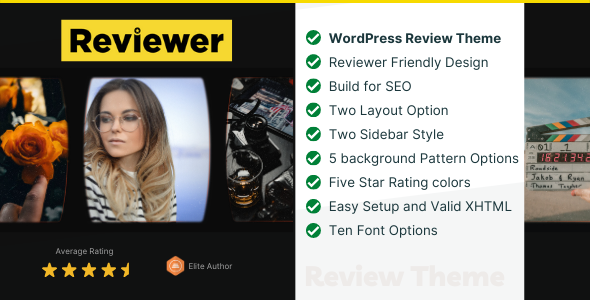
Reviewer Entertainment is a WordPress theme from developer scubetheme built specifically for publishing scored reviews of films and television shows rather than general blog content. It ships with star rating displays, a ratings graph widget, author profile templates and a set of presentation controls aimed at small review sites, fan publications and solo critics who want a ready-made structure without building one from scratch. It sells on ThemeForest for $39 and has been purchased a little over 500 times.
That focus is the theme’s defining characteristic. Most WordPress themes are general-purpose frameworks that can be bent into a review site with plugins and custom fields. Reviewer Entertainment takes the opposite approach: it assumes the content is a review, the key data point is a score, and the site’s job is to present both attractively.
What Reviewer Entertainment Actually Lets a Site Owner Do
The core of the theme is the review presentation layer. Star ratings can be rendered in five different colour schemes, which matters more than it sounds on a movie site where a bright yellow rating can clash with a dark poster-heavy layout. Links throughout the theme are controlled by colour pickers, so the accent colour used on category labels, hover states and rating elements can be tuned without touching a stylesheet.
Two widgets do most of the editorial heavy lifting. The Recent Ratings graph widget displays a visual summary of scores awarded across the site, giving visitors an at-a-glance sense of how the reviewer has been scoring recent releases. The Featured Reviewer/Author widget promotes a specific writer, which is useful for a multi-contributor site where individual critics develop their own followings. Neither widget is exotic, but both are the kind of thing that usually requires a plugin or custom code on a generic theme.
The Author’s Page template lists every writer on the site with their associated content, so a visitor who trusts one critic’s taste can navigate straight to their output. Combined with the featured author widget, this gives Reviewer Entertainment a lightweight editorial identity system that most single-purpose themes skip entirely.
On the homepage, sticky posts are promoted into a Featured Posts area with jQuery-driven hover effects. This is a straightforward way to keep a flagship review pinned above the chronological feed. The theme also offers two content-and-sidebar layout arrangements and two sidebar styling options, which is a modest but real degree of structural flexibility.
Elsewhere the feature set is deliberately conventional. There are ten Google Font options, five background pattern choices, social network icons in the header or footer area, and widgetised sidebar and footer regions. Contact Form 7 is supported for a contact page. A translation file is bundled, so the interface strings can be localised into any language, and the markup is described as valid XHTML.
Where Reviewer Entertainment Fits, and Where It Does Not
The clearest fit is a single-topic review site: a film blog, a television recap and ratings publication, or a niche outlet covering one genre. A solo critic who wants a site that looks like a review publication on day one, without assembling a ratings plugin, a custom post type and a widget stack, gets all of that in one purchase. Small fan sites and community publications covering releases on a regular schedule are the same story.
A second reasonable fit is a multi-author review outlet. The author listing template and featured author widget exist precisely because more than one person is writing, and the theme treats contributors as first-class content rather than as bylines buried in a post footer.
Where Reviewer Entertainment is the wrong choice is any project that needs structured review data at scale. The theme presents scores; it does not appear to define a review custom post type with discrete fields for score, pros, cons, verdict, runtime, release date or platform. A site planning to build a searchable database of thousands of titles, filter by rating threshold, or output review schema markup for rich results in Google will need a plugin such as a dedicated review or custom fields solution regardless of which theme it starts from. Sites that need block editor-native design control, full site editing, or a modern block theme architecture should also look elsewhere: this is a classic PHP template theme, and the last vendor update was in March 2021.
Strengths and Limitations of This Entertainment Review Theme
Strengths
- Purpose-built for review content, so the rating display, ratings graph and author templates are present without additional plugins.
- Colour control is unusually thorough for a theme at this price, with unlimited link colours and five rating palettes.
- The bundled translation file makes localisation realistic for non-English review sites.
- Author-centric features — the author listing template and featured author widget — suit multi-writer publications.
- Documentation is included and the vendor explicitly recommends a child theme, which is the correct workflow for customisation.
- At $39 with more than 500 sales, the entry cost is low and the theme has a track record of use.
Limitations
- The last vendor update was 8 March 2021. That is a long gap, and buyers should treat ongoing maintenance as uncertain rather than assume it.
- No review custom post type or structured score fields are documented. Ratings appear to be presentation rather than data, which limits filtering, sorting and schema output.
- There is no mention of Gutenberg block styles, full site editing or a block-based template system, so the editing experience is the older classic editor workflow.
- Design customisation is bounded by the vendor’s options panel: ten fonts, five patterns, two layouts. Sites wanting a distinctive visual identity will need custom CSS or a child theme.
- Valid XHTML is an outdated standard to advertise; modern expectations centre on HTML5 semantics and accessibility, and the listing says nothing about accessibility or WCAG conformance.
- No page builder integration is claimed, so Elementor, WPBakery or similar users should not expect drag-and-drop control.
How Reviewer Entertainment Compares to the Wider Theme Market
The general-purpose theme market solves this problem differently. A multipurpose theme plus a review plugin gives a site structured score data, schema markup, comparison tables and filtering, at the cost of more configuration and a heavier stack. Reviewer Entertainment trades that capability for immediacy: the review look is there on activation, with no plugin decisions to make.
Against other niche review themes, the differentiator is the author layer. Many entertainment themes handle the rating display adequately but treat writers as an afterthought. The author listing template and featured author widget are the parts of this package that are hardest to replicate quickly elsewhere, and they are the reason a multi-contributor site might prefer it over a generic theme with a ratings plugin bolted on.
The counterweight is maintenance. A theme last updated in 2021 sits in a different risk category from one updated within the last few months, particularly regarding compatibility with current WordPress and PHP versions. Buyers weighing this against a newer alternative should factor in the possibility of needing to patch or replace it sooner than expected. The vendor does state that bug fixes are released periodically, but the changelog date is the only evidence available and it is not recent.
Frequently Asked Questions
Does Reviewer Entertainment require any plugins to work?
No. The rating display, ratings graph widget, featured author widget and author page template are all built into the theme. The only plugin explicitly supported is Contact Form 7, and that is optional for a contact page. Any additional functionality, such as structured review data or SEO schema, would need separate plugins chosen by the site owner.
Can Reviewer Entertainment be used for non-English review sites?
Yes. A translation file is included with the theme, which allows the interface strings to be localised into another language using standard WordPress translation tooling. The bundled Google Font options are largely Latin-script faces, so sites using non-Latin scripts may need to supply their own typography rather than rely on the ten included choices.
Is Reviewer Entertainment compatible with the block editor and full site editing?
The vendor listing does not claim block editor styling, block patterns or full site editing support. It describes a classic theme structure with widgetised sidebars and footers, template files and an options panel. Sites built around the modern block theme workflow, or expecting to edit templates visually, should assume this theme does not provide that and plan accordingly.
Can review scores be filtered or sorted on a Reviewer Entertainment site?
Nothing in the product data indicates that scores are stored as queryable custom fields. The ratings appear to be presentation elements rendered within posts. Building a filterable archive by score, or sorting reviews by rating, would require adding a review plugin or custom fields rather than relying on the theme’s own capabilities.
Verdict on Reviewer Entertainment
Reviewer Entertainment suits a solo critic or small editorial team launching a film or television review site who wants the publication look and the author features in place immediately, at a low one-off cost, and who does not need structured score data. It is also a sensible pick for a multi-writer outlet where promoting individual critics matters. It is the wrong purchase for anyone building a large searchable review database, anyone who needs schema markup or score filtering out of the box, and anyone who requires a theme with a recent maintenance history and modern block-based editing. The 2021 last-update date is the single fact that should weigh most heavily in the decision, because it shifts part of the long-term risk onto the buyer.