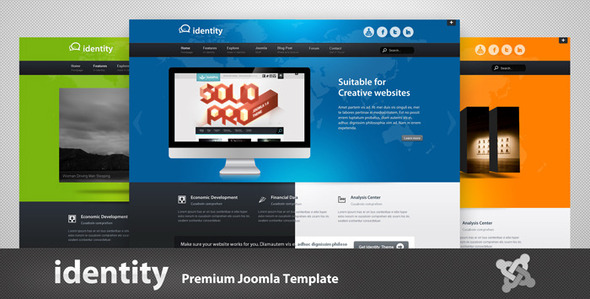
Identity is a premium Joomla template built by Twincore and sold on ThemeForest for $30, aimed at corporate, business, creative and portfolio sites running Joomla 1.6, 1.7 or 2.5. It ships with the T3 Framework v2, 25 colour schemes, a choice of mega menu or dropline navigation, 28 module positions and a large set of shortcodes for building marketing pages without custom code. Buyers researching Identity Cms Themes should understand one thing up front: this is a legacy product, last updated in February 2013, so its value today depends entirely on whether the project is already committed to an old Joomla installation.
What Identity Cms Themes Actually Deliver Under the Hood
The feature list is unusually deep for a template at this price point, and most of it is aimed at reducing the amount of custom CSS a site builder has to write.
Framework and layout control
Identity runs on the T3 Framework v2, a widely used Joomla template engine of that era. In practice this means layout changes are handled through the framework’s configuration rather than by editing template files directly. The template exposes eight layout variations: six three-column arrangements and two two-column arrangements, with fixed column widths of 20 and 28 units depending on which side the sidebar sits. A site owner can therefore flip between a content-left and content-right structure without rebuilding the template. Screen width is configurable as either a fixed 980px or a fluid layout, which was a meaningful distinction when responsive design was still inconsistent across commercial themes.
Colour schemes and typography
The headline number is 25 colour style themes, ranging from a default azure through deep crimson, chartreuse, indigo, magenta and amber variants. Each is a complete preset rather than a single accent colour swap, so switching schemes changes the palette across the whole site. For agencies producing several sites from one template, that breadth reduces the risk of two client projects looking identical.
Navigation and module positions
Two menu systems are included: a mega menu as the default and a dropline menu as the alternative. The mega menu is the more useful of the two for corporate sites, since it allows grouped links and richer dropdown content rather than a single column of items. There are 28 module positions, and the vendor states that additional positions can be created. Left and right module suffixes come with four badge styles, which lets a site owner visually flag specific modules without touching the stylesheet.
Sliders and content presentation
Identity bundles a large slider selection: Tabs GK4, the Yj Piecemaker 3D slider, and five separate Nivo slider styles. Content sliders are handled through Gavick’s News Pro GK4 and Tabs GK4 modules. That is more slider variety than most buyers will use, but it means a homepage can be assembled from pre-styled components instead of a third-party extension purchase. The shortcode library is similarly broad and clearly oriented towards business pages: highlight and blockquote formatting, dropcaps, styled lists, legend and note blocks, buttons, image frames, accordions, an FAQ element, three table styles, action button links, and both single and multi-column pricing boxes.
Mobile and supporting pages
The template includes what the vendor calls an iPhone view, added in the Joomla 2.5 release. This is a dedicated mobile presentation rather than a fluid responsive grid in the modern sense, and buyers should not read it as equivalent to a responsive framework. Styled error and offline pages are also included, which is a small detail that matters on production sites where Joomla’s default error output looks unfinished.
Where Identity Fits, and Where It Does Not
The clearest fit is a business or corporate brochure site on an existing Joomla 2.5 installation that needs a professional look without a redesign budget. The pricing boxes, action button links and table styles are all pointed at exactly that use case, and the 25 colour schemes make it straightforward to match an existing brand palette. Creative studios and freelancers building portfolio sites are the second natural audience; the image frames, lightbox gallery support and slider options cover the presentation needs of a visual portfolio. A third scenario is an agency maintaining several legacy Joomla client sites, where one $30 licence and a familiar framework reduce per-project setup time.
The wrong choice is any new project. Joomla 2.5 reached end of life in 2014, and a template whose most recent update was February 2013 has not been tested against Joomla 3.x or 4.x. Anyone starting a site today, or migrating one, should not build on this template. It is also a poor fit for a business that needs genuine responsive behaviour across phone, tablet and desktop breakpoints, or that depends on modern accessibility standards, since neither is addressed in the supplied feature set. Buyers who need ongoing vendor support should note that the listing points to a support forum and help documentation rather than an active release cycle.
Strengths and Limitations
Strengths
- Broad colour preset system — 25 complete style themes rather than a single accent setting, which suits multi-site work.
- Genuinely deep shortcode library covering pricing tables, FAQ blocks, action buttons and styled tables, all of which are common corporate page requirements.
- Eight documented layout variations with fixed column widths, giving predictable structure without custom template edits.
- Two menu systems, including a mega menu, plus 28 module positions and the ability to add more.
- Seven slider options bundled in, reducing reliance on separately purchased extensions.
- Styled error and offline pages included, which many templates of this era omitted.
- Low price relative to the volume of included components.
Limitations
- Last updated 24 February 2013. The template is not compatible with Joomla 3.x or later, and no newer release is listed.
- The mobile support is an iPhone-specific view, not a responsive grid. Tablet and other phone widths are not addressed in the feature list.
- Dependency on the T3 Framework v2 and on third-party Gavick modules means updates to those components are outside the vendor’s control.
- Slider variety is excessive for most projects; five Nivo styles plus a 3D slider and a tabs slider add weight that few sites will justify.
- The vendor does not state documentation depth, browser support matrix, or a support response time, so buyers are relying on the forum.
- No modern build tooling, no CSS custom properties, and no accessibility statement — expected for 2013, but a real constraint now.
How It Compares to the Wider Cms Themes Market
Identity belongs to the generation of Joomla templates that competed on bundled extras: colour presets, slider packs, shortcode libraries and framework-driven layout control. That approach still defines much of the commercial template market, and against that category Identity holds up reasonably well on paper — 25 colour schemes and a shortcode set that includes pricing boxes and action buttons is a competitive feature count for the price.
Where it falls behind the category is maintenance. Modern commercial Cms Themes are sold on a release cadence, compatibility with current CMS versions, documented browser and device support, and often a page builder. Identity offers none of those in verifiable form. A buyer comparing it against a current Joomla template is not comparing feature lists so much as comparing a supported product against an archived one.
Against free alternatives, the case is narrower still. Joomla’s default templates and community-built free themes cover basic corporate layouts, and the paid advantage here is mainly the shortcode library and colour presets. That is a real convenience, but it is convenience for a specific, ageing stack rather than a general advantage.
Frequently Asked Questions
Is Identity Joomla template compatible with Joomla 3 or Joomla 4?
No. The vendor’s latest listed release is version 1.1 for Joomla 2.5, dated 24 February 2013, and earlier releases cover Joomla 1.6 and 1.7. Nothing in the product data indicates Joomla 3.x or 4.x support, and no migration path is offered. It should be treated strictly as a Joomla 2.5 template.
How many colour schemes and module positions does Identity include?
Identity ships with 25 colour style themes, from a default azure through crimson, chartreuse, indigo, magenta and amber variants, plus 28 module positions. The vendor states that additional module positions can be created, and left and right module suffixes are available with four badge styles for visually marking individual modules.
Does Identity work on mobile phones and tablets?
It includes an iPhone view, added in the Joomla 2.5 release, which serves a mobile-specific presentation. That is not the same as a responsive layout with fluid breakpoints for tablets and varied phone sizes, and the vendor does not document tablet behaviour. Buyers needing full responsive support should look at a newer template.
What is included in the Identity shortcode library?
The shortcodes cover highlight text, blockquotes and dropcaps, styled lists, legend and note blocks, buttons and box icons, image frames, accordions, an FAQ element, three table styles, action button links, and both single and multi-column pricing boxes. Several of these are explicitly aimed at business websites rather than blogs or portfolios.
Verdict
Identity is worth buying only for a project already running Joomla 2.5 or earlier that needs a polished corporate or portfolio skin at minimal cost. At $30 with 351 sales recorded on ThemeForest, it has a track record, and the shortcode library, 25 colour presets and eight layout variations represent solid value for that narrow scenario. Buyers starting fresh, migrating to a current Joomla release, or requiring genuine responsive and accessible output should not purchase it — the 2013 update date is a hard ceiling, not a minor caveat. For anyone weighing Identity Cms Themes against a maintained alternative, the deciding factor is the CMS version already in place, not the feature list.