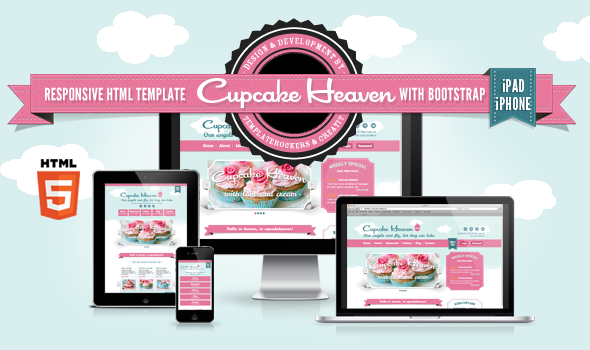
Delimondo Cupcakeheaven Fully Responsive HTML Entertainment is a static HTML5 template sold on ThemeForest for $16, aimed at bakeries, cafés, cake shops and similar food businesses that want a ready-made website without building one from scratch. It ships with multiple homepage layouts, menu card designs, sliders, a gallery, a blog layout and two table-booking forms, all built on Bootstrap and packaged with a Photoshop source file. It suits buyers who need a brochure-style site they can host anywhere and edit by hand, and it is a poor fit for anyone who wants a content management system.
The template was published by createit-pl, the developer behind the Template Rockers label, and has accumulated 408 sales since its last update in April 2013. That combination — a modest but real sales history and a very old revision date — shapes almost everything worth saying about it.
What the Delimondo Cupcakeheaven Fully Responsive HTML package actually contains
The core promise is layout variety without a build step. Two homepage arrangements are included, one using a two-thirds content column and one running full width. Both adapt to the browser viewport, which is what the “fully responsive” label refers to, and the vendor explicitly frames the design as working on tablets and phones as well as desktop screens.
Menu presentation gets unusual attention for a template at this price. There are two menu card designs: a two-thirds-width single-page layout and a full-width book-style layout. For a bakery or café, that matters more than it sounds, because the menu is usually the page visitors actually came to read, and a book-style presentation gives it a distinct visual treatment rather than dumping it into a generic content block.
Sliders are handled with Nivo, a long-established jQuery slider library. Two slider configurations are provided, again in two-thirds and full-width variants, and they resize with the screen rather than being fixed to a pixel width. On top of that sit three specialised content sliders: a featured dishes carousel, a team slider, and a daily recommendations section. A four-column gallery slider rounds out the media handling.
Two interactive forms are included: a contact form with client-side validation, and a “Book a Table” form supplied in separate desktop and mobile versions. Both send email notifications, and the vendor states plainly that PHP is required for that to work. This is the single most important technical constraint in the package, because it means the template cannot be dropped onto purely static hosting if the forms are expected to function.
Typography relies entirely on Google Fonts, with the vendor noting that only the logo falls outside that arrangement. In practice this keeps the site free of font licensing complications, which is a small but genuine convenience for a commercial food business.
The Photoshop file is not an afterthought. It uses layer comps, colour-coded and logically named groups, and smart objects for the elements most likely to be swapped out. For a buyer who wants to change the logo, adjust colours or produce matching print material, that structure saves real time compared with a flattened mockup.
Where this template fits, and where it does not
The natural buyer is a small food business — a bakery, cupcake shop, café, bar or restaurant — that needs a five-to-eight page presence: home, menu, gallery, about, blog and contact. A freelancer quoting a fixed-price brochure site for exactly that kind of client can deploy this quickly, particularly since the visual identity is already resolved and the menu layouts are purpose-built rather than generic.
It also suits agencies producing a small batch of near-identical sites for independent food retailers, where the two homepage and two menu variants provide enough variation to avoid obvious duplication between clients. The Photoshop layer structure supports that workflow, since recolouring is a matter of editing smart objects rather than rebuilding artwork.
Where it stops working is any project that needs the client to edit content themselves. This is an HTML template, not a theme. There is no admin panel, no database, no post editor. Every menu change, price update or new blog post means editing files directly. The vendor does link to a separate WordPress version of the same design elsewhere on the marketplace, and for most real clients that is the more sensible purchase. Anyone without HTML and CSS skills, or without a developer on hand, should treat this as the wrong product regardless of the low price.
A second poor fit is any project with modern expectations around accessibility, performance budgets or component-based development. Nothing in the supplied information suggests the markup has been audited against current WCAG guidance, and a template last revised in 2013 predates most of the tooling a contemporary front-end workflow assumes.
Strengths and limitations of Delimondo Cupcakeheaven Fully Responsive HTML
Strengths
- Two homepage layouts and two menu card designs give genuine structural choice rather than cosmetic variants.
- Purpose-built sliders for dishes, team members and daily recommendations remove the need to hand-code common restaurant content patterns.
- Separate desktop and mobile versions of the table-booking form show the developer thought about how the form is actually used on a phone.
- Google Fonts only, so no font licensing to manage beyond the logo.
- The PSD uses layer comps and smart objects, which makes rebranding substantially faster than working from a flat mockup.
- Detailed documentation is included, and the vendor states it was written with non-developers in mind.
- 408 sales at $16 indicates the template has been bought and used in real projects, not merely listed.
Limitations
- The last vendor update was April 2013. Any Bootstrap or jQuery dependency bundled at that time is now well behind current releases, and there is no indication of ongoing maintenance.
- Both forms require PHP with mail sending configured on the server. On static hosting, or on hosts that restrict mail functions, the forms simply will not deliver.
- There is no content management layer at all. Every text, price and image change is a file edit.
- The vendor does not state whether the markup has been tested for accessibility, and nothing in the feature list suggests it has.
- Support quality and responsiveness are not something the listing can demonstrate; the claim of “quick and friendly support” is the vendor’s own description rather than a verified fact.
- Because the design is tied to a specific pink-and-cupcake aesthetic, rebranding beyond colour and logo changes means working through the PSD and CSS in detail.
How this compares with the wider category
Static HTML templates in the entertainment and food space occupy a narrow band. Above them sit WordPress themes and page-builder kits, which cost more but hand content control to the site owner. Below them sit free Bootstrap starters, which cost nothing but require the buyer to design and assemble everything themselves.
Delimondo Cupcakeheaven Fully Responsive HTML sits closer to the free-starter end in terms of capability, but justifies its $16 through pre-built, food-specific sections: menu cards, dish sliders, a gallery and a booking form. That is the trade being made — money for time saved on layout and visual design, with no gain in content management or long-term maintainability.
Against a WordPress theme, the comparison is not close on flexibility. A theme gives the client an editor, plugin support and a maintenance path. Against a free starter, the comparison is closer, but the buyer would spend considerably longer producing menu and booking layouts of comparable quality. The template’s value is concentrated entirely in that initial build phase.
Buyers should also weigh the age factor honestly. A 2013 template is not automatically unusable — HTML and CSS do not expire — but the bundled JavaScript libraries, responsive techniques and browser assumptions will reflect the period. Anyone integrating it into a modern stack should expect to update dependencies rather than deploy as-is.
Frequently Asked Questions
Is Delimondo Cupcakeheaven Fully Responsive HTML a WordPress theme?
No. It is a standalone HTML5 template that runs without WordPress, a database or any CMS. The developer publishes a separate WordPress version of the same design on ThemeForest, and buyers who need client-editable content should look at that instead. The HTML version is intended for hand-coded or statically hosted sites.
Do the contact and table booking forms work without PHP?
No. The vendor states that PHP is required for both forms to send email notifications. On static hosting, or on servers where mail functions are restricted, the forms will display and validate but will not deliver messages. Buyers should confirm their hosting supports PHP mail before relying on these features.
Can the template be used for a restaurant rather than a bakery?
Yes, with caveats. The layout structure — menu cards, dish sliders, gallery, booking form — suits restaurants, cafés and bars just as well as bakeries. The visual identity, however, is built around a pink cupcake aesthetic, so a restaurant would need to rework the colour scheme and imagery through the included Photoshop file.
Is the template still maintained and updated?
The listing shows the last vendor update as April 2013, and nothing indicates active maintenance since. The template still functions as HTML and CSS, but bundled JavaScript libraries will be dated and may need replacing. Buyers should treat it as a finished, frozen product rather than one receiving ongoing improvements.
Verdict on Delimondo Cupcakeheaven Fully Responsive HTML Entertainment
This template is worth buying for freelancers and small studios that regularly produce fixed-price brochure sites for food businesses and want a head start on menu layouts, dish sliders and booking forms. The $16 price is easy to justify against the hours saved on those specific sections, and the 408 sales suggest others have reached the same conclusion.
It is the wrong purchase for anyone who needs a client to update content independently, anyone without HTML and CSS skills, and anyone building on a modern front-end stack who expects current dependencies. The absence of updates since 2013 and the PHP requirement on both forms are the two facts that should decide the question.
Buyers who understand exactly what they are getting — a static, hand-edited, food-specific layout kit — will find it efficient. Buyers expecting anything more should look at the WordPress version or a current theme instead.