Android TV Channel is a single-channel live streaming app source code for Android devices, sold on ThemeForest for $22. It lets a publisher ship a branded app that plays one live stream — typically an HLS (m3u8) feed or a YouTube live URL — on phones, tablets and Android TV hardware, with the stream address and interface settings managed from an admin panel rather than edited in code. It suits small broadcasters, community channels, event organisers and freelancers building a cheap single-purpose viewing app; it is not a multi-channel IPTV platform.
What Android TV Channel Actually Does Well
The product is a native Android Studio project, not a hosted service or a white-label subscription. Buyers receive the source, compile it themselves, and publish under their own developer account. That distinction shapes everything else about the package.
The core function is narrow and deliberate: one stream, one app. The player accepts HLS playlists (m3u8) and YouTube live links, which covers the two most common ways a small broadcaster distributes a live feed. It also handles progressive video files across a long list of containers — mp4, mkv, m4v, mov, flv, avi, rmvb, rm and tp among them — with stated support for 720p and 1080p playback. In practice that means the same build can serve a genuine live channel and a looping video file without swapping components, which is useful for organisations that stream live only part of the day.
Configuration sits in an admin panel rather than in the source. The November 2024 release replaced the older panel with a new one, and version 10.1 in January 2025 added right-to-left support for the admin interface. For a non-developer client, that is the difference between “call your developer to change the stream URL” and “log in and paste a new link.” The vendor does not state whether the panel is self-hosted or supplied as a service, so that is worth confirming before purchase.
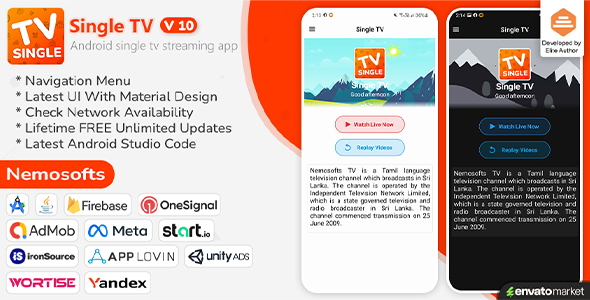
Monetisation is unusually broad for a $22 script. The listing names AdMob, Meta, Startapp, Wortise, Ironsource, AppLovin, Unity and Yandex as supported ad networks, and the vendor tags specifically mention AdMob with GDPR. Multi-network support matters because ad fill varies enormously by region; a publisher targeting a market where one network underperforms can switch rather than rebuild.
Around the player, the app ships Material Design layouts with light and dark themes, a navigation menu, network-availability checking before playback starts, and OneSignal push notifications for alerting viewers when a stream goes live. Chromecast is listed among the vendor tags, which extends the app from a phone screen to a television set.
Where a Single-Channel Android TV App Fits — and Where It Does Not
The clearest fit is an organisation that already has one live feed and wants a dedicated icon on a viewer’s home screen. A church streaming weekly services, a local sports club, a radio station adding video, a conference running a multi-day broadcast, or a retailer looping a product channel all match the product’s shape. Freelancers and small agencies will find it attractive as a fixed-scope deliverable: the feature set is bounded, the admin panel reduces handover friction, and the price leaves room for labour.
Android TV specifically is a sensible target. Set-top boxes and smart televisions are awkward to reach with a web player and a remote control, so a native leanback-style app is a real improvement for living-room viewing. The same build covering phones means one codebase serves both.
It is the wrong choice in several common scenarios. Anyone planning a multi-channel lineup — an IPTV aggregator, a directory of dozens of feeds, an EPG-driven service — will outgrow this immediately, because the architecture is built around a single stream. Publishers who need subscription billing, user accounts, DRM-protected content or catch-up libraries should look at a different class of product entirely; none of those are listed. And anyone unwilling to open Android Studio, manage signing keys and handle store review should recognise that this is a code package, not a turnkey app.
Strengths and Limitations of the Android TV Channel Script
Strengths
- Low entry cost relative to scope. At $22 the source code costs less than an hour of most developers’ time, so the financial risk of evaluating it is minimal.
- Genuine source code delivery. The Android Studio project can be modified, rebranded and extended rather than locked behind a licence server.
- Broad ad-network coverage. Eight named networks, including AdMob with GDPR handling, give real flexibility for regional monetisation.
- Admin panel reduces maintenance. Stream URLs and app settings can change without a new store release, which is the single biggest ongoing cost in a live-streaming app.
- Format breadth. HLS, YouTube live and a long list of progressive video containers mean the app is not tied to one encoding pipeline.
- Active maintenance signal. Two releases within three months — a new admin panel in November 2024 and RTL support plus API and library updates in January 2025 — suggest the developer is still working on the codebase.
Limitations
- No disclosed sales history. The listing shows no sales figure, so there is no track record of real-world deployments to weigh. Buyers are early adopters.
- Single-channel architecture is a hard ceiling. Adding a second channel is not a configuration change; it is a development project.
- No subscription or paywall layer. Monetisation is advertising-only as described. Anyone wanting recurring revenue must build it.
- Documentation quality is asserted, not demonstrated. The listing claims detailed documentation and easy configuration, but the public material does not show setup depth, panel hosting requirements or store-submission guidance.
- Dependency on third-party platforms. YouTube live links are subject to YouTube’s terms and embedding rules, and ad networks change SDK requirements regularly — both create maintenance work the buyer owns.
- No stated DRM or geo-restriction support. Premium content rights holders will find the security model insufficient.
How Android TV Channel Compares With the Wider Category
The alternatives fall into three groups, and the comparison is really about fit rather than features.
First, multi-purpose IPTV and streaming app source codes on the same marketplace. These typically cost more and carry heavier configuration, but they support channel lists, categories and often EPG data. A buyer who is even slightly unsure whether one channel will stay one channel should pay the premium; retrofitting multi-channel support onto a single-channel codebase usually costs more than the difference.
Second, white-label streaming platforms sold as monthly subscriptions. These remove the build and store-submission burden entirely and often bundle analytics, subscriptions and CDN handling. They cost far more over time and leave the publisher without code ownership, but for a broadcaster with no technical staff they are the lower-risk route. Android TV Channel assumes the opposite: a buyer who can compile and ship.
Third, building from scratch or from open-source player libraries. A competent Android developer can assemble a comparable player, admin configuration and notification layer, but the effort is measured in weeks. The script’s value is compressed setup, not unique capability.
Within that field, this product occupies a specific niche: the cheapest credible route to a branded, ad-supported, single-feed app on Android and Android TV. It does not compete on breadth, and buyers who need breadth should not force it to.
Frequently Asked Questions
What is Android TV Channel and what does it include?
It is an Android Studio source code package for building a one-stream live TV app. The purchase includes the app project, an admin panel for managing the stream and settings, Material Design layouts with light and dark themes, OneSignal notifications, Chromecast support and integrations for eight advertising networks. Buyers compile and publish the app themselves under their own developer accounts.
Can Android TV Channel play YouTube live streams as well as m3u8 links?
Yes. The listing states support for both m3u8 HLS playlists and YouTube live-type links, alongside progressive video files in formats including mp4, mkv, mov and flv. Publishers should note that YouTube live playback remains subject to YouTube’s own embedding terms, and that unlisted or restricted streams may not play reliably through a third-party player.
Do I need coding skills to use this app?
Yes, at least once. The initial build, branding, signing and store submission require Android Studio and a working knowledge of the platform. Day-to-day operation is different: once deployed, stream URLs and app settings are changed through the admin panel, so a non-technical operator can manage content without touching the codebase.
How much does Android TV Channel cost and is it a one-time payment?
It is listed at $22 on ThemeForest as a one-time purchase of the source code, rather than a recurring subscription. That price does not cover ongoing costs, which include Google Play developer registration, hosting for the admin panel if self-hosted, any CDN or streaming bandwidth, and developer time for SDK and library updates as ad networks change requirements.
Verdict: Who Should Buy Android TV Channel
Android TV Channel is a sensible purchase for a developer or small agency that needs to deliver a branded, ad-supported single-feed live app on Android and Android TV at minimal cost, and is comfortable owning the build and maintenance. It also fits organisations with an in-house Android developer and exactly one stream to publish. Buyers needing multiple channels, subscriptions, DRM or a no-code deployment should choose a different product category; the single-channel design and advertising-only monetisation make those requirements unworkable here. The absence of any disclosed sales history means the code should be evaluated on its own merits during the pre-sale period rather than on reputation. At $22 the downside is limited, but the buyer is committing to a development relationship with the codebase, not buying a finished service.