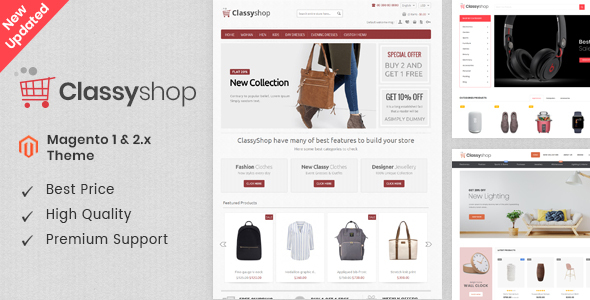
Classy Shop Ecommerce is a Magento theme sold on ThemeForest by the developer TemplateMela, priced at $49 and aimed at apparel, fashion and clothing retailers that want a ready-made storefront rather than a custom build. It ships with HTML5 and CSS3 markup, a responsive layout, a configurable product grid, mega menu, cloud zoom image handling and CMS blocks, and it has been purchased roughly 690 times. The theme is best understood as a low-cost starting point for small and mid-sized fashion catalogues, not as a long-term platform for stores that need current Magento releases.
What Classy Shop Ecommerce Actually Delivers
The feature set is organised around the needs of a visual, image-heavy catalogue. The smart responsive product grid is the centrepiece: it reflows the listing layout across screen widths, which matters for fashion stores where customers browse on phones and expect a consistent number of products per row. The vendor exposes grid behaviour through the admin panel rather than hard-coded templates, so a store owner can adjust presentation without editing files.
Product discovery is handled by three separate merchandising modules — featured, bestseller and latest products — each with its own admin options. In practice this means a store owner can build a homepage that mixes promotional picks with automatically populated bestsellers and new arrivals, without installing third-party extensions for each block. A manufacturer and brand logo slider is included on the same basis, which suits multi-brand apparel retailers that need to surface labels prominently.
The product detail page carries several practical additions. Cloud Zoom integration gives shoppers a magnified view of fabric and detail shots, custom tabs let the vendor add sizing charts or care instructions alongside the standard description, and next/previous navigation keeps visitors moving through a category instead of bouncing back to the grid. The header shopping cart dropdown shows basket contents without a page load, which reduces friction at the point where apparel shoppers most often abandon.
On the structural side, the theme uses a fluid grid, Google Fonts, CSS sprites for faster asset loading, and multi-language support. The vendor states that no core Magento files are modified, which is the single most important claim here: it means upgrades and extension installs are less likely to collide with theme code. Full PSD files and a user guide are included, and the markup is described as valid XHTML and CSS with commented, structured code. The vendor does not publish performance benchmarks, so load-speed claims should be treated as design intent rather than measured results.
Where This Theme Fits and Where It Does Not
The clearest fit is a small or mid-sized clothing, footwear or accessory retailer running an existing Magento 1.9 store that wants a refreshed storefront quickly and cheaply. A freelancer or small agency delivering a fashion catalogue on a tight budget can deploy this in days rather than weeks, and the PSD files make it straightforward to hand a designer the layered source for brand customisation. Multi-brand retailers benefit from the logo slider and mega menu combination, and stores selling into more than one language region can use the built-in language support without a separate localisation extension.
It is also a reasonable choice for a store that has already invested in Magento extensions and wants a theme that explicitly avoids touching core files, since that reduces the chance of breaking existing functionality during installation.
The wrong choice is any project on Magento 2.3 or later that expects ongoing maintenance. The compatibility list covers Magento 2.2.x and 2.3.x, and the last vendor update was April 2019 — a date that matters enormously in Magento, where release cycles are short and security patches frequent. A merchant launching a new store today on a current Magento release should not build on a theme whose most recent change predates several platform versions. Similarly, a high-traffic retailer with strict performance budgets or a headless commerce roadmap will find a template-based front end limiting compared with a modern PWA or headless approach.
Strengths and Limitations
Strengths
- Admin-configurable merchandising blocks (featured, bestseller, latest, brand logos) remove the need for separate extensions for common homepage modules.
- No core file modifications, which keeps the theme isolated from Magento’s own codebase and simplifies upgrades and extension conflicts.
- Genuinely fashion-oriented detail work: cloud zoom, custom product tabs, next/previous navigation and a header cart dropdown all target apparel browsing behaviour.
- Full PSD source files and a documented user guide lower the cost of visual customisation for agencies.
- At $49 with roughly 690 sales, the entry cost is low and the theme has a track record rather than being an untested release.
Limitations
- The last vendor update is dated 29 April 2019. For a Magento product this is a significant risk: the theme has not tracked platform releases since then, and compatibility with anything beyond the listed 2.3.x range is not stated by the vendor.
- Magento 1.8.x and 1.9.x support is legacy. Magento 1 reached end of life and no longer receives official security patches, so the theme’s broadest compatibility claim is also its weakest selling point for new projects.
- The feature list is broad but shallow in places — “lots of CMS blocks” and “unlimited banners” are described without specifics, and the vendor publishes no performance data despite claiming fast loading.
- There is no stated accessibility work (no WCAG conformance claim, no mention of ARIA or keyboard navigation), which is a gap for retailers in markets with accessibility obligations.
- Documentation and support scope beyond the included user guide are not described in the listing, so buyers should assume self-sufficiency is required.
How Classy Shop Ecommerce Compares to the Broader Template Market
Commercial Magento themes generally fall into two camps: cheap, feature-dense templates like this one, and premium themes with active release cycles, dedicated support desks and regular compatibility patches. Classy Shop Ecommerce sits firmly in the first camp. Its advantage is breadth per dollar — a single $49 purchase covers grid layouts, merchandising modules, mega menu, zoom, sliders and PSD sources that would otherwise be assembled from several extensions.
The trade-off is lifecycle. A premium alternative costs more but typically ships updates alongside new Magento releases, which matters more than any individual feature once a store is live and taking payments. Custom-built front ends sit at the other extreme: maximum control and performance, but a development budget an order of magnitude higher. For a merchant weighing these options, the deciding question is not which theme has more features but how long the store needs to run on the platform version it launches with.
Against free or default Magento themes, the case is clearer — the merchandising modules, fashion-specific product page features and PSD files represent real work that a default theme does not provide.
Frequently Asked Questions
Which Magento versions does Classy Shop Ecommerce support?
The vendor lists Magento 1.8.0.0, 1.8.1.0, 1.9.x.x, 2.2.x and 2.3.x. Two layouts were added in April 2019 specifically for Magento 2.2.x. Anything newer than 2.3.x is not stated as compatible, and no update has been issued since that date, so buyers on current Magento releases should verify compatibility before purchasing.
Is this theme suitable for a new online clothing store?
It is suitable only if the store runs on one of the listed Magento versions. For a brand-new build on a current Magento release, the 2019 update date makes it a poor foundation. For an existing Magento 1.9 or 2.2/2.3 store needing a cheap fashion-focused redesign, it remains workable.
Does the theme require coding to customise?
Most day-to-day changes are handled through admin options, including the product grid, merchandising modules, mega menu, sliders and zoom. Deeper visual changes typically require CSS or template edits, which is why the vendor supplies commented code and full PSD files. The listing does not describe any page-builder style drag-and-drop editing.
What is included in the $49 purchase?
The theme package, full PSD source files and a user guide covering installation and use. The vendor does not state a support period, extension bundle or update guarantee in the listing, so buyers should treat the purchase as a self-supported template rather than a subscription with ongoing maintenance.
Verdict
Classy Shop Ecommerce makes sense for one specific buyer: an existing Magento 1.9, 2.2 or 2.3 store owner in apparel or fashion who wants a low-cost, feature-rich storefront with PSD files and admin-configurable merchandising, and who accepts that the theme has not been updated since April 2019. At $49 with around 690 sales, the risk is small and the feature coverage is generous for the price.
It is the wrong purchase for anyone launching on a current Magento release, anyone who needs documented accessibility compliance, and anyone who expects vendor updates to track platform security patches. Those buyers should budget for a maintained premium theme or a custom front end instead, because the cost of migrating off an unsupported theme later will exceed the savings now.