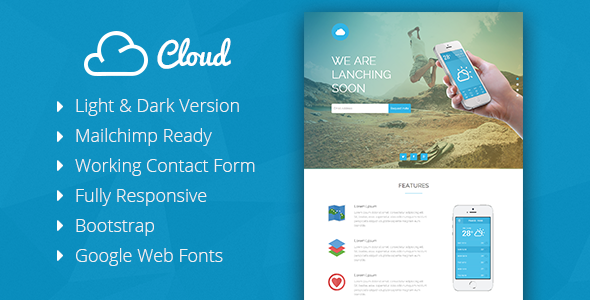
Cloud – Mobile App Coming Soon Responsive Template is a static HTML landing page kit sold on ThemeForest for $13, built to hold a single pre-launch screen for an Android or iOS app. It ships with light and dark colour variants, a Mailchimp-ready signup form, a draggable and swipeable carousel, and Bootstrap 3 underpinnings. It suits indie developers, small studios and marketing freelancers who need a credible holding page live in an afternoon rather than a full WordPress build.
Among the many Cloud Site Templates listed on the marketplace, this one is deliberately narrow. It is not a multi-page marketing site, a blog theme, or a framework for a product ecosystem. It is a one-screen teaser, and judging it means judging how well it does that single job.
What Cloud Site Templates of This Type Actually Deliver
The core promise of a coming-soon template is that it converts curiosity into an email address before the product exists. Everything in this package serves that goal, and the feature set is organised around it rather than around general site building.
The signup form is wired for Mailchimp, which matters more than it sounds. A pre-launch page has one measurable outcome, and connecting the form to a real list without writing custom integration code removes the most common reason these pages sit unfinished. The vendor also includes a working contact form, so the same page can handle press enquiries or partnership messages without a second template.
Two colour schemes ship in the box. Light and dark versions of the same layout mean a team can match an existing brand palette or test which treatment holds attention, without rebuilding the page from scratch. That is a practical inclusion for a template at this price point, where a single fixed colourway is the norm.
The carousel is the most distinctive element. It responds to mouse dragging on desktop and touch swipes on mobile, which lets the page present app screenshots or feature panels as a browsable strip rather than a static grid. For an app with visual selling points, that interaction is closer to how a user would actually handle the product than a row of thumbnails.
Underneath, the build uses HTML5 and CSS3 with Bootstrap 3, retina-ready icon fonts, and Google Web Fonts. Bootstrap 3 is dated by current standards, but it is also extremely well understood, so a developer inheriting the file will recognise the grid and class structure immediately. The vendor states the code is commented and documented, and that documentation includes links to a free iPhone PSD for producing mockup imagery.
Where This Template Fits and Where It Does Not
The clearest fit is a solo developer or small team with a finished app in private beta and a launch date a few weeks out. The page can go up quickly, collect addresses, and be replaced by a full site later. The same applies to a studio running a waitlist for an unreleased tool, or a freelancer delivering a launch page as part of a fixed-scope client engagement.
It also works for agencies producing several app landing pages in parallel. Because the template is static HTML rather than a CMS theme, cloning and restyling it for a second client is a file-copy operation, not a database migration. At $13 per licence, that is a low marginal cost per project.
Where it falls down is any project that needs to grow. There is no blog, no pricing table, no multi-page navigation, and no CMS behind it. A team that expects to add a changelog, a support knowledge base, or localised landing pages will end up rebuilding rather than extending. Anyone who needs editors to update copy without touching code should look at a WordPress coming-soon theme instead, because this package assumes someone is comfortable editing HTML directly.
It is also the wrong pick for a product that is already live. The layout is structured around anticipation, and a launched app needs download links, feature comparisons and social proof, none of which this template provides.
Strengths and Limitations
Strengths
- Two complete colour schemes, light and dark, included rather than sold as an add-on.
- Mailchimp-ready signup plus a working contact form, covering both list building and enquiries from one page.
- Carousel supports mouse drag and touch swipe, so the same component behaves correctly on desktop and mobile.
- Bootstrap 3 grid makes the markup predictable for any developer who has worked with the framework.
- Retina icon fonts and Google Web Fonts keep the page sharp on high-density screens without image assets.
- Documentation includes a free iPhone PSD, useful for teams without a designer on hand.
- 575 sales and a maintained update history give some indication that the file has been used in production.
Limitations
- Bootstrap 3 is several major versions behind current Bootstrap, so the grid and utility classes will feel dated to developers working on modern stacks.
- The last vendor update was January 2023, meaning the template has not been refreshed against recent browser behaviour or Mailchimp form changes.
- It is a single-purpose page. There is no blog, pricing section, or additional layout to repurpose.
- No CMS integration, so every copy change requires editing source files and redeploying.
- The vendor does not state whether the Mailchimp integration uses the current API or a legacy embedded form, which is worth verifying before purchase.
- Because it is a static template, there is no built-in analytics, SEO plugin layer, or consent management for the signup form.
How It Compares With Other Cloud Site Templates in the Category
Coming-soon templates generally fall into three groups: static HTML kits like this one, CMS themes built for WordPress or similar platforms, and drag-and-drop page builder packs that require a subscription to a separate tool.
Static kits win on deployment speed and cost. There is no hosting stack to configure beyond a web server, no database, and no plugin updates to maintain. The trade-off is that nothing can be edited by a non-technical team member, and any structural change means working in code. Cloud sits firmly in this group, and its $13 price is at the low end of it.
CMS themes cost more and require a WordPress install, but they give editors a familiar admin interface and make it trivial to add pages later. For a project that will definitely expand, that extra overhead pays for itself. For a page with a six-week lifespan, it is unnecessary weight.
Page builder packs offer the most visual control and the least code, but they tie the project to a third-party platform and often a recurring licence. Cloud avoids that dependency entirely, which is an advantage for freelancers handing files to a client at project close.
Within the static group, the differentiators are usually the form integration, the number of colour variants, and whether the carousel works properly on touch devices. Cloud covers all three, which is a reasonable argument for choosing it over a cheaper single-colour alternative.
Frequently Asked Questions
Do I need WordPress to use this template?
No. Cloud is a standalone HTML, CSS and JavaScript template, so it runs on any standard web host with no CMS, database or PHP requirement. That makes deployment simple, but it also means content updates happen by editing files directly rather than through an admin dashboard.
Can the signup form connect to Mailchimp without coding?
The template is described as Mailchimp ready, which typically means the form markup is prepared for a Mailchimp embed or endpoint. The vendor does not specify whether it uses the current API or a legacy form action, so the integration should be tested against a live list before the page goes public.
Is the carousel usable on phones and tablets?
Yes. The carousel supports both mouse dragging and touch swiping, so the same component responds to desktop pointer input and mobile gestures. Combined with the responsive Bootstrap 3 grid, the layout adapts across screen sizes without a separate mobile version.
Can this template be used for a full app marketing website?
Not without significant extension. It is designed as a single coming-soon screen with a signup form and carousel, and it has no blog, pricing page, documentation section or multi-page navigation. Teams needing a full marketing site should treat this as a starting point rather than a complete solution.
Verdict
Cloud – Mobile App Coming Soon Responsive Template is a sensible purchase for developers, small studios and freelancers who need a polished pre-launch page for an app and want it live quickly. The dual colour schemes, Mailchimp-ready form and touch-enabled carousel cover the essentials, and 575 sales with a documented update history suggest the file holds up in real deployments. Pixininja has kept the scope tight, and that focus is the product’s main strength.
Buyers should avoid it if the project needs a blog, a CMS, or room to grow into a multi-page site, and anyone uncomfortable editing HTML should choose a WordPress alternative instead. The Bootstrap 3 foundation and the January 2023 update date are the two details worth weighing before committing, particularly for teams already working on modern front-end stacks. For a short-lived launch page with a clear deadline, the trade-offs are easy to accept.