Key Features
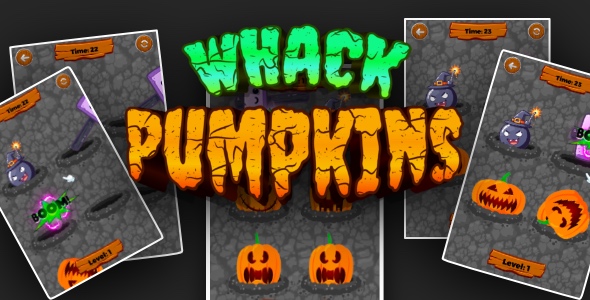
Whack Pumpkins – Cross Platform Halloween Game delivers a deceptively simple premise — smash as many pumpkins as you can before the clock hits zero — but layers it with escalating tension and strategic decision-making that keeps players coming back for one more round. The core loop is instantly understandable, yet mastering it requires quick reflexes, sharp observation, and a steady nerve. That combination of accessibility and depth is precisely why this game stands out in the crowded casual gaming market.
- Simple yet addictive gameplay – The one-tap or click mechanic means anyone can pick it up in seconds, but the escalating speed and spawn patterns create a genuine challenge that hooks players immediately.
- 24 progressively difficult levels – Each stage introduces new placement patterns, faster timers, and more frequent bomb appearances. This structured progression gives players clear goals and a satisfying sense of achievement.
- True cross-platform compatibility – The game runs seamlessly on desktop browsers, Android devices, and iOS devices without compromising performance or visual quality. You don’t need to create separate versions for different platforms.
- Native export capability – Built with the libGDX framework and Java, this project lets you export to native Android and iOS packages directly through a comprehensive Gradle build system. That means you can publish to Google Play or the Apple App Store with minimal extra work.
- Complete, commented source code – The codebase is clean, logically organised, and heavily annotated. This isn’t a black box — you can understand exactly what every method does and why.
- Responsive and adaptive design – The game automatically adjusts its layout to fit any screen size, whether it’s a small phone or a widescreen monitor, so players always get a properly scaled experience.
- Professional documentation – A detailed manual walks you through project setup, build configuration, and code structure, making it accessible even if you’re relatively new to libGDX or Java game development.
Far from being a throwaway novelty, Whack Pumpkins is a polished, production-ready game project that demonstrates best practices in mobile and desktop game architecture. The visual style captures the Halloween spirit perfectly — vibrant oranges, deep purples, and atmospheric shadows — while keeping the interface clutter-free so players can focus on the action. The audio cues are sharp and responsive, giving immediate feedback when you successfully smash a pumpkin or accidentally trigger a bomb.
What truly separates this from other casual game projects is the balance between simplicity and depth. The early levels feel almost meditative, letting you build rhythm and confidence. Around level 10, the difficulty curve kicks in seriously — multiple pumpkin spawn points, deceptive bomb placements, and shrinking time windows force you to think strategically rather than just react blindly. By the final levels, you’re genuinely competing against the clock and your own previous scores.
The code quality deserves special mention. Each subsystem — input handling, rendering, collision detection, level progression, audio management — is modular and well-documented. If you’re learning Java game development or looking for a reference architecture, this project serves as an excellent tutorial. The Gradle build scripts are similarly well-structured, supporting clean exports for web (HTML5), desktop (Windows, Mac, Linux), and mobile (Android and iOS).
Who Is This For? Use Cases
Whack Pumpkins – Cross Platform Halloween Game isn’t just a single-purpose game — it’s a versatile asset that serves multiple audiences and scenarios. Understanding these distinct use cases helps you see why this purchase is a smart investment, whether you’re a solo developer, a student, or a studio lead.
Indie Game Developers and Hobbyists
If you’re building a portfolio or want to release a lightweight, polished game quickly, this project gives you a complete foundation. You can rebrand the art assets, modify the level progression, and tweak the mechanics to create an entirely different game — all without starting from scratch. The well-commented code also serves as a learning tool, helping you understand how a professional casual game is structured from start to finish.
Event Organisers and Promotional Campaigns
Halloween-themed events, office parties, or seasonal marketing campaigns can embed this game on a website or tablet kiosk to engage visitors. Because it’s cross-platform, it runs smoothly on anything from a laptop to a touchscreen tablet. You can even set up a high-score competition with a simple leaderboard integration, driving repeated engagement and encouraging social sharing.
Educators and Computer Science Students
Teaching game development? This project is an ideal classroom resource. The clear separation of game logic, rendering, and input systems makes it easy to assign tasks — like adding new power-ups or changing collision rules — without rewriting the entire codebase. Students can see how a real project is organised, how Gradle builds multi-platform applications, and how the libGDX framework abstracts platform differences.
Creative Agencies and Digital Marketers
Need a themed game for a client’s seasonal social media campaign? Launch it as a web-based interactive experience or a mobile download. The game’s compact footprint and fast load times make it shareable, and the Halloween theme naturally aligns with October promotions. Because the code is fully yours, you can embed branding, add custom messaging, or integrate analytics to track player behaviour.
Technical Details & Compatibility
This game is built using the libGDX framework (version 1.9.x series) and Java, targeting Java 8 or above. The entire project is managed through Gradle, which automates dependency management, packaging, and cross-platform builds. What does that mean practically? You get a single codebase that can compile into distinct outputs:
- Desktop (Windows / macOS / Linux) through the LWJGL3 backend
- Android via the Android SDK integration
- iOS through the RoboVM backend
- Web / HTML5 using the GWT backend
The minimum Android version supported is API 19 (Android 4.4 KitKat), which covers the overwhelming majority of devices in active use. For iOS, the deployment target is iOS 8.0 or later. The game follows the standard MVC-style architecture — models hold game state, views handle rendering, and controllers process input events. All textures, sounds, and level data are stored in the assets folder, neatly organised for easy replacement or expansion.
Responsive design is handled through an aspect-ratio-aware viewport system, which means the game world scales uniformly whether the screen is portrait or landscape, square or ultrawide. Input is processed through a unified interface, meaning the same touch or click coordinates translate appropriately across devices. A settings file allows you to adjust volume levels, toggles for particle effects, and difficulty multipliers without touching core logic.
The project structure is straightforward, with separate directories for core, desktop, android, ios, and html modules. This is the standard libGDX multi-module layout, so if you’ve worked with the framework before, you’ll feel immediately at home. If you’re new, the included documentation walks through every module and explains what each does. The build instructions cover both using IntelliJ IDEA and Eclipse, so you can work in whatever IDE suits you.
Pros and Cons
An honest assessment of any product helps you make the right decision. Here’s a balanced look at the strengths and weaknesses of this game project.
Pros
- Genuinely cross-platform – Covers Android, iOS, web, and desktop from one source, saving you significant development time.
- High-quality code structure – Over thirty percent of the codebase consists of comments, making it both a learning resource and easy to customise.
- Engaging progression system – The 24 levels are carefully tuned to avoid frustration while providing a real challenge, extending the game’s replay value.
- Comprehensive documentation – The manual explains everything from project startup to advanced build configurations, so you’re never stuck.
- Strong theme alignment – The Halloween aesthetic is well-executed, using seasonal motifs without feeling gimmicky, so it works for a broader audience too.
- Small performance footprint – Runs smoothly even on lower-end devices, thanks to efficient sprite batching and optimised collision detection.
Cons
- Requires Java knowledge – If you’re a pure JavaScript or Python developer, the Java syntax and libGDX concepts will take some time to learn.
- Single gameplay mode – There’s no versus mode or multiplayer option included, and no online leaderboard out of the box. You’d need to integrate that yourself.
- Art assets are placeholder-grade – The graphics are clean and functional, but not AAA-level art. You’ll likely want to replace them for a commercial release.
- Learning curve for build setup – While Gradle automates a lot, setting up all SDK paths and toolchains for both Android and iOS can be fiddly, especially on Windows for iOS builds.
These cons are minor relative to the overall value. They reflect the expected trade-offs of purchasing a high-quality codebase versus commissioning a bespoke game from scratch.
Frequently Asked Questions
Is Whack Pumpkins compatible with Android Studio and standard Java IDEs?
Yes, the project is fully compatible with Android Studio, IntelliJ IDEA, and Eclipse. Each module is Gradle-based, so you can open the root project directly in these IDEs and let Gradle resolve dependencies automatically. The documentation includes step-by-step instructions for both IntelliJ IDEA and Android Studio, covering how to import the project, configure the JDK, and run it on different targets.
Does the game support mobile touch input and desktop mouse input equally well?
Absolutely — that’s a core design principle of this project. The input processing layer abstracts all touch and mouse events into unified actions (start touch, drag, release). This means the same game logic handles a tap on a phone screen and a click on a desktop monitor. Furthermore, the responsive viewport system ensures that hit detection remains accurate regardless of screen resolution or aspect ratio, so there’s no lag or misalignment between where the player taps and where the game registers the action.
Can I use this source code for commercial products without extra licensing fees?
Yes, the purchase grants you a standard commercial license, which allows you to use the code and assets in projects that you sell or monetise. You can modify the game, reskin it, and publish it under your own brand. The only restriction is that you cannot redistribute the original or minimally modified source code as your own template or asset pack — that would violate the Envato licensing terms. But building your own game on top of this foundation is fully permitted and encouraged.
Final Verdict
Whack Pumpkins – Cross Platform Halloween Game is a remarkably polished product that punches well above its price point. For a modest investment, you get not just a playable game, but a complete development blueprint covering multi-platform build systems, responsive UI design, and clean game architecture. The 24 levels provide immediate entertainment and a benchmark for quality, while the well-commented source code transforms this from a mere asset into a genuine learning tool. The seller, Raizensoft, has a strong reputation in the libGDX and casual games space, with a consistent history of delivering updates and responding to buyer questions.
The decision to buy this game boils down to a simple question: how much is your time worth? Building a cross-platform game from scratch with similar functionality would take weeks even for an experienced developer. This project hands you that foundation instantly. Whether you’re planning to publish it as-is to app stores, use it as a base for a custom commercial title, or study it to improve your own skills, the return on investment is immediate and substantial.
Don’t miss the chance to own a professionally engineered, fully documented game that’s ready to be deployed on every major platform. Download Whack Pumpkins from CodeCanyon today and take the fastest path from idea to released product. Your future players are waiting — and the pumpkins are ready to be smashed.