Wobbly Boxing Games is a 3D boxing title built in Construct 3 and sold as a complete HTML5 game package, with the full .c3p source project, 3D models, UI assets and audio included in the download. It runs in a browser on desktop and mobile, supports touch and keyboard input, and ships with both a single-player arcade mode against a CPU opponent and a local two-player mode. It is aimed at developers and studios that want a finished, reskinnable boxing game to publish under their own brand rather than a game for players to buy directly.
The project comes from Mikal, the developer behind the Mikal’s 3D Object Plugin that the game depends on, which matters because the source file will not open in Construct 3 without that add-on installed. The price is $199, and the vendor does not disclose a sales figure, so there is no adoption data to lean on when judging it.
What Wobbly Boxing Games Actually Delivers
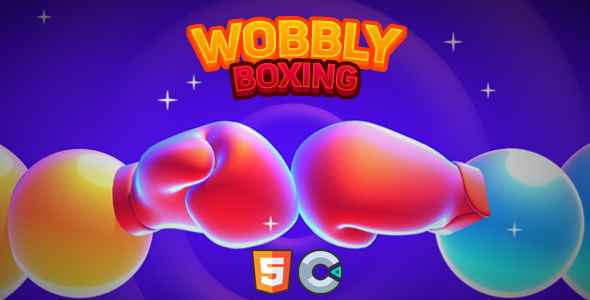
The headline technical fact is that this is a genuine 3D game rather than a 2D sprite project dressed up with parallax layers. Characters are assembled from multiple spheres, which produces the loose, bouncy movement the title is named after. That construction method is also the thing most likely to divide buyers: it gives the game a distinctive silhouette that reads instantly in screenshots and store listings, but it is not a simulation-grade boxing model and should not be evaluated as one.
The package is unusually complete for a template-style game. Buyers receive the compiled HTML5 build alongside the editable Construct 3 project, the .gltf 3D model files, layered .psd files for the interface, and audio in .webm format. In practice that means a studio can change the fighters, the ring, the menus and the sound without commissioning art from scratch, which is where most of the value sits at this price point.
Two gameplay modes are included. Arcade mode pits the player against a CPU opponent, which is the mode that matters for a casual web release where a visitor plays alone. The two-player mode is local rather than networked, so both players share one device and one screen. That is a reasonable fit for a keyboard on a desktop and an awkward one on a phone, where two people cannot comfortably share a touchscreen.
Input handling covers both touch and keyboard, which is the correct baseline for an HTML5 release that has to work on desktop browsers, Android and iOS from a single build. The download is small — the vendor states 3.6 MB zipped — and that figure is worth taking seriously, because a lightweight build loads quickly on mobile connections and is far easier to drop into a web portal, a branded microsite or a playable ad slot than a multi-hundred-megabyte WebGL project.
The changelog records a single fix, dated 8 March 2023, for a tutorial that did not work correctly on mobile. A one-entry changelog tells the buyer something useful: the project has not been iterated on publicly since, so treat the current state as stable but not actively evolving.
Where Wobbly Boxing Games Fits, and Where It Does Not
The strongest use case is a web portal or publisher that needs a boxing title in its catalogue without building one. Because the source is included, the game can be rebranded — new fighters, new colour scheme, new audio — and published under a different name. The small file size and single HTML5 build keep hosting and distribution simple.
A second fit is the marketing or agency context. A branded browser game is still an effective engagement mechanic for a campaign page, an event microsite or a lead-generation landing page, and a boxing theme with a light, comedic visual style is broadly safe for general audiences. The two-player mode in particular works well on a shared kiosk or trade-show screen where two visitors can play against each other on one keyboard.
Education and prototyping are a third reasonable fit. The .c3p file is a working reference for anyone learning how 3D objects, physics-style wobble and multi-input control are wired together in Construct 3, and the dependency on a specific third-party plugin is itself instructive about how that ecosystem works.
Where it is the wrong choice: anyone expecting a competitive fighting game with netcode, matchmaking, progression systems or online leaderboards will be disappointed, because none of that is present. Equally, a studio that does not use Construct 3 should look elsewhere. The source is only useful if the team already works in that engine, and the plugin requirement adds a setup step before the project will even open.
Strengths and Limitations
Strengths
- The full Construct 3 source project is included, so the game can be genuinely modified rather than merely resold as-is.
- Art and audio assets ship in editable formats — .gltf models, .psd interface files and .webm sound — which removes the most expensive part of a reskin.
- One HTML5 build covers desktop, Android and iOS, with both touch and keyboard input already handled.
- The 3.6 MB zipped footprint is small enough for fast mobile loading and for embedding in constrained environments.
- Two distinct modes, solo arcade and local two-player, cover both the individual visitor and the shared-screen scenario.
- Built and documented against Construct 3 r330, so the engine version needed is stated explicitly rather than left ambiguous.
Limitations
- The project requires Mikal’s 3D Object Plugin to open in Construct 3. The plugin is free, but it is an external dependency that must be obtained and installed before the source file is usable at all.
- The vendor pins the project to Construct 3 r330. Opening it in a substantially newer release is not guaranteed to behave correctly, which creates a maintenance question for long-lived projects.
- Two-player mode is local only. There is no online multiplayer, no matchmaking and no networked play of any kind.
- No sales figures are published, so there is no evidence of how the game performs commercially or how many other buyers have shipped it.
- The changelog contains a single entry from March 2023, which suggests limited ongoing maintenance rather than an actively developed product.
- No documentation is described in the listing beyond the plugin and version notes, so buyers should not assume a written integration guide is included.
- The spherical character construction is a stylistic choice that will not suit a project wanting realistic boxers.
How Wobbly Boxing Games Compares to Other HTML5 Game Scripts
The broader market for HTML5 game source on marketplaces splits into two rough groups. The first is the cheap, single-file arcade template — often a 2D endless runner or a match-three clone — sold for a fraction of this price with minimal art and no editable source. The second is the fuller game kit, where the buyer gets a complete project, layered assets and a genuine reskin path. Wobbly Boxing Games sits firmly in the second group, and the $199 price reflects that.
Against the cheap template tier, the difference is not really the gameplay. It is that a 2D template with baked-in sprites cannot be meaningfully rebranded, whereas this package hands over the models, the interface files and the project itself. For an agency delivering a client-branded game, that is the difference between a usable asset and a dead end.
Against other full 3D game kits, the trade-off runs the other way. A 3D project is heavier to modify than a 2D one, requires some familiarity with 3D asset pipelines, and here carries an engine-plugin dependency that a 2D sprite project would not. Buyers weighing this against a simpler alternative should be honest about whether the team can actually work with .gltf models and a Construct 3 3D workflow. If not, the extra capability is theoretical.
The category also includes subscription-based game platforms and no-code builders, which offer ongoing updates and support in exchange for recurring fees and far less control. This product is a one-off purchase of a static codebase. That is a better deal for a team that wants to own and modify the files, and a worse one for a team that wants someone else to keep the game current.
Frequently Asked Questions
Do I need to own Construct 3 to use Wobbly Boxing Games?
Yes. The download includes the .c3p source project, which only opens in Construct 3, and the vendor also requires Mikal’s 3D Object Plugin to be installed first. The plugin is free, but Construct 3 itself is a separate purchase or subscription. Without both, the source files cannot be opened or edited, though the compiled HTML5 build would still run.
Can Wobbly Boxing Games be published on Android and iOS app stores?
It can, in principle, because the game is a standard HTML5 build that the vendor states runs on Android and iOS. Getting it into the Apple App Store or Google Play normally means wrapping the web build in a native container such as Cordova or Capacitor. The vendor does not include or document that wrapping step, so it is the buyer’s responsibility.
Is there online multiplayer in Wobbly Boxing Games?
No. The two-player mode is local only, meaning both players use the same device and screen. There is no networking, matchmaking or online leaderboard code in the package. Anyone needing online play would have to build that layer themselves, which is a substantial engineering task rather than a configuration change.
How much can the game be customised before publishing?
Substantially. Buyers get the Construct 3 project, .gltf 3D models, layered .psd interface files and .webm audio, so fighters, environments, menus and sound can all be replaced. The realistic constraint is skill: editing 3D models and rebuilding the project requires familiarity with a 3D asset pipeline and with Construct 3’s event system.
Verdict on Wobbly Boxing Games
Wobbly Boxing Games is worth buying for developers already working in Construct 3 who need a finished, lightweight 3D browser game they can rebrand and ship quickly, particularly for web portals, campaign microsites or kiosk setups. The inclusion of editable models, interface files and audio at $199 is the core justification, and the small build size makes distribution straightforward.
It is not the right purchase for teams outside the Construct 3 ecosystem, for anyone who needs online multiplayer, or for buyers who expect ongoing updates and support — the single-entry 2023 changelog and the undisclosed sales count both point to a static product. The plugin dependency and the pinned r330 engine version are real friction points that should be weighed before purchase rather than discovered afterwards.
For the specific buyer it targets, the trade-offs are acceptable and the asset package does most of the persuading. For everyone else, the constraints are structural and no amount of reskinning will remove them.