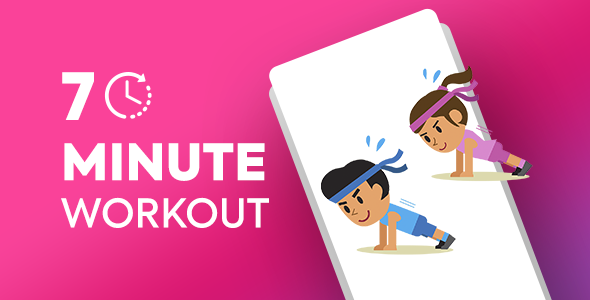
7 Minute Workout for Android is a complete Android Studio source-code project for building a high-intensity interval training (HIIT) app around the well-known seven-minute bodyweight routine. It ships with twelve timed exercises, voice and sound prompts, adjustable difficulty, a BMI calculator, a workout log, reminders and pre-wired AdMob placements, so a buyer gets a working fitness app rather than a design mockup. It suits freelancers and small studios who want to publish a branded workout app quickly, and it is a poor fit for anyone hoping for a no-code app builder.
What the 7 Minute Workout for Android package actually contains
The purchase delivers the full Android source code plus a documentation file. The vendor states the project is built on Android Studio 4.x and describes the code as clean and well documented, which matters because most of the value here is in how easily the codebase can be rebranded and extended. The exercise programme itself follows the format popularised by the ACSM’s Health & Fitness Journal routine later covered by the New York Times: twelve bodyweight movements performed for 30 seconds each, with 10-second rest intervals between them.
Several capabilities are worth separating from the feature list, because each changes what the buyer can realistically ship:
- Guided session playback. Countdown timers and audio prompts run through each exercise and each rest period, so the app functions as a usable workout companion without the buyer writing any timing logic. Difficulty levels can be adjusted, which lets the same twelve exercises serve different fitness levels.
- BMI calculator with metric and US units. This adds a second utility screen that gives users a reason to open the app outside a workout session, and it handles both measurement conventions rather than forcing one.
- Workout log and reminders. A history screen and a next-workout reminder turn a one-off timer into a habit tool — a meaningful retention feature for a category where uninstalls are common.
- AdMob banner and interstitial integration. Monetisation slots are already wired in. The buyer supplies their own AdMob unit IDs and a Google Developer account to publish, so revenue setup is a configuration task rather than a development one.
- Presentation and distribution extras. The interface uses illustrated characters, and the app includes sound customisation, social sharing, an in-app rating prompt and an app-listing screen — the small pieces that are tedious to build from scratch.
Resource requirements are stated plainly: a Mac or Windows machine on a current OS, the latest Android Studio with some familiarity with its interface, an image editor such as Photoshop for asset changes, a Google Developer account and an AdMob account. The vendor does not state a minimum Android SDK level, app size or the exact libraries used, so those details need confirming before purchase if they matter to a project.
Where this 7 Minute Workout for Android codebase fits — and where it does not
The clearest use case is a freelance developer or small agency that has a client wanting a branded fitness app on a short timeline. Because the workout engine, timers, logging and ad slots already exist, the work shifts to reskinning, copy changes and publishing — days rather than weeks. The same applies to a publisher running a portfolio of niche apps who wants a fitness title with monetisation built in.
It also suits a developer learning Android who wants a real, complete project to study: a timer-driven app with media, local storage and third-party SDK integration touches most of the core skill areas in one codebase.
It is the wrong choice in a few specific situations. Anyone wanting to launch without writing or reading code should look at app builders instead. A team planning a subscription-based training platform with accounts, cloud sync and adaptive programming will find the scope here too narrow — this is a single-routine app, not a coaching platform. And a buyer who needs an iOS version is out of luck: the listing covers Android only, and the vendor does not mention a cross-platform counterpart.
Strengths and limitations of the 7 Minute Workout for Android source
Strengths
- Complete, working feature set: timing, audio cues, difficulty levels, BMI, logging and reminders are all present, so nothing essential has to be built from zero.
- Monetisation is pre-integrated through AdMob banner and interstitial units, removing the most fiddly part of ad setup.
- Documentation is included, and the vendor’s own support terms cover bugs in the original code — a reasonable safety net for a code purchase.
- At $18 the cost is low relative to the hours saved on timer logic, sound handling and ad wiring alone.
- The exercise format is a recognisable, evidence-referenced routine rather than an arbitrary set of movements, which helps with app-store description and user trust.
Limitations
- The project targets Android Studio 4.x. Buyers working on a current Android Studio release should expect to update the Gradle configuration and dependency versions before the project builds cleanly.
- Free support covers unmodified code only. Once the buyer edits the project, fixes may attract a fee, and the vendor reserves the right to charge for repairs — worth factoring in if extensive customisation is planned.
- There is no indication of cloud sync, user accounts or wearable integration, so the app is local-first by design.
- No sales figures are disclosed on the listing, so there is no purchase-volume signal to weigh alongside the feature set.
- Ad revenue depends entirely on the buyer’s own AdMob account and traffic; the integration is plumbing, not a business model.
How the 7 Minute Workout for Android project compares with the wider category
Android fitness templates generally fall into three groups: timer-only workout apps, full gym-logging apps with exercise databases, and broader health suites that bundle calculators and tracking. This product sits firmly in the first group, with a light nod to the third through its BMI tool.
Against timer-only templates, it competes well because the extras — logging, reminders, sharing, rating prompts, ad slots — are already assembled. Against gym-logging apps, it is narrower: there is no exercise library beyond the twelve movements, no set-and-rep tracking and no progress charts. Against full health suites, it is simpler and cheaper but less extensible out of the box.
On documentation and support, the listing is more explicit than many code listings, which often say nothing about post-purchase help. The trade-off is the conditional support policy. On price, $18 places it at the low end of the source-code market, consistent with a single-purpose app rather than a platform.
Frequently Asked Questions
What is 7 Minute Workout for Android?
It is an Android app source-code package that implements a twelve-exercise, seven-minute HIIT routine with 30-second work intervals and 10-second rests. The purchase includes the full Android Studio project and documentation, plus built-in BMI calculation, workout logging, reminders and AdMob ad integration. It is a development starting point, not a finished app published under the buyer’s name.
Do I need coding experience to use this 7 Minute Workout for Android template?
Yes, some coding experience is effectively required. The vendor lists the latest Android Studio and familiarity with its interface as prerequisites, and rebranding means editing layouts, assets and configuration files. Buyers with no development background should consider a no-code app builder instead, because the package provides source code rather than a drag-and-drop editor.
Can I publish the app on Google Play and earn from ads?
Yes, publishing and monetisation are both supported. A Google Developer account is needed to submit to the Play Store, and an AdMob account supplies the banner and interstitial unit IDs that the app already has slots for. The vendor does not state any restriction on commercial publishing, but buyers should confirm licensing terms in the documentation.
Does the 7 Minute Workout for Android app work offline?
Yes, the core workout experience is local. Timers, sound prompts, the BMI calculator and the workout log run on the device without a network connection, which suits the vendor’s “offline” tag. Only ad delivery and the social sharing and rating features depend on connectivity, so the app remains usable in a gym or without data.
Verdict: who should buy the 7 Minute Workout for Android source
This is a sensible buy for a developer or small studio that wants a credible fitness app live quickly and is comfortable working inside Android Studio. The combination of a complete routine engine, monetisation slots and included documentation justifies the modest price, and the 7 Minute Workout for Android package is easy to recommend for client work or a first portfolio app. It is not the right purchase for non-coders, for teams needing accounts, sync or wearable support, or for anyone expecting a current-generation build configuration without touching Gradle. Buyers planning heavy customisation should also weigh the conditional support policy before committing.