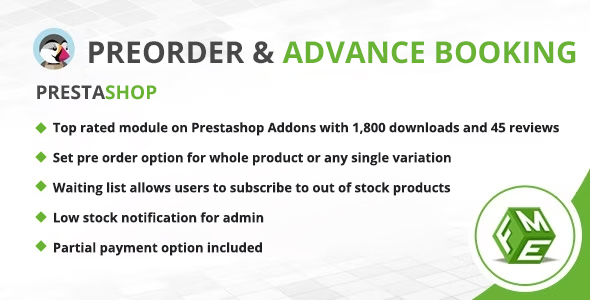
The Prestashop PreOrder and Waiting List Module Plugins category exists to solve a specific retail problem: selling stock that has not arrived yet. This module, developed by FmeModules.com, adds pre-order buttons, waiting-list subscriptions, countdown timers and split-payment options to a PrestaShop store, so shoppers can commit to an out-of-stock item before it is restocked. It suits merchants who sell made-to-order goods, limited runs, seasonal lines or supplier-delayed inventory and want to capture demand instead of losing it to a “sold out” page.
What the Prestashop PreOrder and Waiting List Module Plugins Actually Add to a Store
The module’s core function is to convert an out-of-stock product page from a dead end into a lead-capture and revenue surface. It does this through two parallel mechanisms that can run at the same time on the same item: a pre-order path, where the customer pays something now, and a waiting-list path, where the customer registers interest and pays nothing until stock returns.
Pre-order with full, partial or customer-chosen payment
Merchants choose how much money changes hands at the point of pre-order. Full payment collects the entire price upfront. Partial payment takes a deposit — set either as a fixed amount or a percentage of the product price — with the balance collected when the item is restocked and the customer is emailed a prompt to settle. The dynamic option lets the shopper decide the amount, bounded by a minimum the administrator defines. That last mode is unusual in this category and is worth thinking through carefully, because it shifts the pricing decision to the buyer.
Waiting-list subscriptions with AJAX sign-up
Instead of committing money, a shopper can subscribe to a stock notification. The notify button works over AJAX, so the page does not reload, and the vendor states that registration is required before a customer can subscribe. That requirement is a deliberate trade-off: it produces a cleaner, contactable list tied to real accounts, but it adds friction for first-time visitors who may abandon rather than create an account.
Variant-level control
Pre-order and subscription can be applied to specific combinations rather than whole products. In practice this means a shirt can be sold normally in small and medium while the large size — the one that is out of stock — carries the pre-order button. The vendor also supports multi-lingual pre-order text per product or variant, so the label can be worded differently in each store language rather than falling back to one string.
Timers, labels and storefront visibility
A countdown timer and pre-order label appear on the product detail page and on catalogue listing pages, and merchants can attach an image or custom content alongside the timer. When a pre-ordered product comes back in stock, a pop-up is shown to the user. These are presentation features rather than functional ones, but they matter for expectation-setting: a visible date reduces support tickets asking when an item will ship.
Administration and demand data
All pre-orders are managed from a single back-office page, with bulk enable and disable available from the list view. Pre-orders can also be created or managed from a dedicated section. The administrator can cap the maximum number of pre-orders a product accepts, which prevents overselling beyond what a supplier has promised, and receives a warning when stock runs low. Because every pre-order is recorded, the merchant ends up with a demand signal — a count of committed buyers per item — that can inform purchasing decisions with suppliers.
On the customer side, the account area lists all pre-ordered products with their current status, and subscriptions are manageable from the same place. The module is multi-store and multi-lingual.
Where This Module Fits and Where It Does Not
The clearest fit is a store with predictable but delayed supply. A merchant who knows a container arrives in six weeks can open pre-orders today, take deposits, display a countdown and collect the balance on arrival — all without custom development. Limited-edition and drop-based sellers benefit from the pre-order cap, which lets them stop taking commitments at a defined number. Print-on-demand and made-to-order businesses can use partial payment to fund production. Stores with wide variant matrices — apparel, footwear, spare parts — get the most from combination-level control, since the pre-order button only appears where it is genuinely needed.
The waiting-list half is a reasonable fit for stores that restock unpredictably and simply want to notify interested buyers rather than take money. It is a lighter commitment for the shopper and still produces a marketing list.
The module is the wrong choice in at least one common scenario: a store that sells only in-stock goods and has no intention of accepting orders against future inventory. Pre-orders introduce obligations — a restock date the merchant must honour, a balance to collect, a customer expecting an email — and a merchant without reliable supplier timelines will generate more complaints than revenue. Stores that cannot or will not require account registration before a notification sign-up should also look elsewhere, since that constraint is built in.
Strengths and Limitations
Strengths
- Three payment models — full, partial and customer-defined — cover most deposit strategies without add-on modules.
- Variant-level pre-order and subscription means out-of-stock combinations are handled individually rather than product-wide.
- Pre-order caps and low-stock warnings give a degree of overselling protection that many modules in this category lack.
- Demand data is a by-product of normal operation, giving merchants a concrete count of interested buyers per item.
- Multi-store and multi-lingual support, including per-variant translated pre-order text, suits agencies running localised shops.
- The developer, FmeModules.com, is described as an official PrestaShop partner with more than 120 modules released, which is a meaningful signal of longevity in a niche where abandoned modules are common.
Limitations
- Waiting-list subscription requires a registered account. Guest notification is not offered, which will cost sign-ups on stores that normally allow guest browsing and checkout.
- The dynamic payment mode lets the shopper choose the amount. That is flexible but introduces reconciliation work and the risk of trivial deposits that do not meaningfully commit the buyer.
- Partial payments are collected as a second transaction rather than through automatic charging of a stored card, based on the vendor’s description of emailing the customer to pay the remainder. Merchants should expect some customers not to complete the balance.
- The listing does not state which PrestaShop versions are supported, nor whether the module has been tested against the current major release. That is a question to settle before purchase.
- No sales figure is disclosed on the marketplace listing used here, so there is no independent volume signal to weigh alongside the feature set.
- At $79 the price sits in the mid-to-upper range for a single-purpose PrestaShop module, which is defensible only if the deposit and variant features are actually used.
How It Compares With the Wider Category
Modules in this space generally fall into three groups. The first is simple “notify me” plugins that add an email capture field to out-of-stock pages and nothing more. They are cheap and light, but they take no payment and produce no committed orders. The second group adds pre-order buttons but treats the whole product as pre-orderable, with no variant logic and no payment splitting. The third group — where this module sits — combines pre-order, deposits, variant targeting and waiting lists in one package.
Against the first two groups, the functional gap is real: partial payment and combination-level control are the features that separate a demand-capture tool from a genuine forward-selling system. Against the third group, the differentiators are narrower. The pre-order cap, the low-stock warning and the customer-defined payment amount are the standout items; multi-store and multi-lingual support is table stakes at this price point. The account requirement for waiting lists is a genuine disadvantage relative to lighter notification plugins, which typically accept any email address. Buyers comparing options should weigh that friction against the cleaner data an account-tied list provides.
Frequently Asked Questions
What is the Prestashop PreOrder and Waiting List Module used for?
It lets a PrestaShop store accept orders for products that are not yet in stock, either by taking payment upfront or as a deposit, or by letting customers join a waiting list for a restock alert. It also displays countdown timers and pre-order labels, and records every commitment in the back office for demand analysis.
Can customers pre-order just one size or variation?
Yes. Pre-order and subscription can be enabled on specific combinations rather than the whole product, so only the out-of-stock variant shows the pre-order button. The vendor also supports separate pre-order text per variant and per language, which allows different wording for each combination in a multi-lingual store.
Does the module support partial payments or deposits?
Yes. Merchants can require full payment, a partial deposit set as a fixed amount or a percentage, or a dynamic amount chosen by the customer above an administrator-defined minimum. When stock returns, the customer is emailed and pays the remaining balance to complete the order.
Do customers need an account to join the waiting list?
Yes. The vendor states that registration is required before a customer can subscribe to a stock notification. This keeps the waiting list tied to real accounts and lets shoppers manage subscriptions from their account area, but it adds a sign-up step that guest-friendly notification plugins avoid.
Verdict on the Prestashop PreOrder and Waiting List Module Plugins
This is a solid, feature-dense option for merchants who genuinely sell against future stock and want deposits, variant-level control and a waiting list in one module. The pre-order cap and low-stock warnings show the developer has thought about the operational risk of forward selling, not just the storefront button. It is a poor fit for stores with unreliable supplier timelines, for shops that cannot ask customers to register before a notification, and for anyone who only needs a simple email-capture field. Buyers should confirm PrestaShop version compatibility directly with the vendor, since the listing does not state it, and should be realistic about chasing outstanding balances on partial-payment orders. For agencies building localised or multi-store PrestaShop sites with made-to-order inventory, the Prestashop PreOrder and Waiting List Module Plugins set is worth a close look.