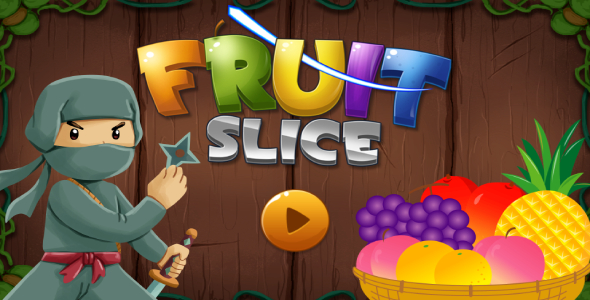
Fruit Slice Games is a commercial HTML5 arcade title built in Construct 3 and sold on ThemeForest for $99. Players fling a bouncing shuriken at fruit that appears on screen, aiming to cut through as many pieces as possible in a single throw by reading the shuriken’s rebound path. It is aimed at developers and publishers who want a ready-made, touch-friendly browser game to brand, reskin and deploy across desktop and mobile rather than building one from scratch.
The package ships as a Construct 3 project file plus an exported HTML5 build, so the buyer gets both the editable source and something that runs immediately. That combination is the main selling point: the game is a starting point for a fruit-slicing arcade product, not a finished live-service title. The vendor, whose marketplace handle appears on the listing, has not disclosed sales figures, so there is no public adoption data to weigh.
What Fruit Slice Games Actually Delivers
The core loop is a physics-driven throwing mechanic rather than the swipe-to-slice pattern most people associate with the fruit genre. A shuriken bounces off surfaces and continues travelling, so the skill ceiling comes from predicting ricochets and lining up multi-fruit cuts. That single design decision separates the game from the crowded field of swipe-based clones, and it gives the product a distinct hook worth marketing.
Around that loop, the listing describes a modest but coherent feature set:
- Cross-platform HTML5 output. The build is described as playable on desktop, web, Android and iOS. In practice this means a browser-based game that can be wrapped for app stores or embedded in a web page, which is the standard delivery model for Construct 3 exports.
- Responsive scaling. The game is stated to support PC, tablet and mobile screen sizes. For a casual arcade title this matters more than it sounds, because a fixed-resolution canvas that letterboxes badly on phones is one of the most common reasons a reskinned game fails in the wild.
- Touch and mouse controls. Both input methods are supported, which covers desktop browsers and mobile browsers without separate builds. There is no mention of keyboard or gamepad support.
- Editable Construct 3 source. The download includes the .c3p project alongside the HTML5 export and a documentation file. Anyone with a Construct 3 subscription can open the project, change art, adjust difficulty, rebalance the shuriken physics and rebuild.
- Configurable game settings. The listing advertises easy customisation of game settings, though it does not enumerate which values are exposed or whether they are editable from a config file versus inside the Construct editor.
- Audio with a mute toggle. Background music and sound effects are bundled, with an in-game option to silence them. That is table stakes for a casual game but worth confirming, since audio licensing is a frequent hidden cost in resold assets.
One omission is stated plainly on the listing: AdMob is missing. For a mobile-oriented HTML5 game, that is a meaningful gap, because the usual monetisation route for a cheap arcade title is interstitial or rewarded ads. A buyer who wants ad revenue will need to integrate a monetisation SDK themselves or commission that work, and the vendor does not say whether the codebase is structured to make that straightforward.
Where Fruit Slice Games Fits and Where It Does Not
The strongest fit is a web publisher or small studio that needs a playable arcade game for a portal, a branded microsite or an advergame campaign. The bouncing-shuriken mechanic is simple to explain in a banner, the art is fruit-themed and family-friendly, and the HTML5 build drops into an iframe or a WebView without a backend. A marketing team reskinning the fruit sprites to match a beverage or grocery brand is a realistic use case, and the Construct 3 source makes that reskin feasible without a full engine rewrite.
A second fit is an app developer testing the waters in the casual games category on iOS or Android. Wrapping an HTML5 build in a native shell is a well-trodden path, and a $99 starting point is cheaper than commissioning original art and mechanics. The touch controls and responsive layout reduce the usual porting friction.
It is the wrong choice for anyone who needs a monetised, live-ops-ready product out of the box. There is no ad integration, no leaderboard, no analytics, no in-app purchase layer and no backend. A studio planning seasonal content, player accounts or retention mechanics would spend more extending this than building a comparable game in a framework it already knows. It is also a poor fit for buyers without a Construct 3 licence, since the editable source is the main reason to pay for this over a free HTML5 template.
Strengths and Limitations of This Fruit Slice Games Package
Strengths
- The ricochet-based shuriken mechanic is a genuine differentiator in a genre dominated by direct swipe controls, giving the game a marketable angle.
- Buyers receive both the Construct 3 project and a working HTML5 export, so the game can be evaluated before any editing begins.
- Responsive scaling and dual touch/mouse input mean one build covers desktop and mobile browsers.
- Bundled music and sound effects with a mute option remove a small but real production cost.
- Documentation is included, and the vendor advertises free email support, which is more than many low-volume marketplace game assets offer.
Limitations
- AdMob integration is explicitly absent. Any ad-based monetisation has to be added by the buyer, and the listing gives no guidance on how much work that involves.
- No sales figures are published, so there is no evidence of how the game performs in real deployments or how large the buyer base is.
- There is no rating data on the listing, which means no independent signal from previous purchasers.
- The feature set stops at the core loop: no leaderboards, achievements, progression system, analytics or backend services are mentioned.
- Customisation is described only as “easy” without naming the exposed parameters, so the depth of configurability cannot be assessed from the listing alone.
- Editing requires a Construct 3 subscription, an ongoing cost that sits on top of the $99 purchase price.
How Fruit Slice Games Compares With the Wider HTML5 Game Market
The marketplace category for HTML5 arcade games splits into three rough tiers. At the bottom are free or near-free templates, usually single-file canvas games with placeholder art and no editor project. In the middle sit reskinnable Construct or Phaser projects in the $20–$80 range, often with thinner documentation. At the top are licensed game frameworks and custom builds that cost hundreds or thousands.
At $99, this product sits at the upper end of the mid tier. What justifies the premium over cheaper templates is the combination of a complete Construct 3 source, a documented export and a mechanic that is not a straight clone of the most saturated pattern in the genre. What it does not offer is the monetisation scaffolding, backend services or content pipeline that a studio-grade package would include. Buyers comparing against free templates should weigh whether they need the editable source at all; buyers comparing against custom development should recognise that $99 buys a starting point, not a finished product.
The honest positioning is that Fruit Slice Games is a well-scoped casual arcade asset with one clear hook. It competes on speed to market and on the quality of its core loop, not on breadth of features.
Frequently Asked Questions
What engine is Fruit Slice Games built in?
It is built in Construct 3, and the download includes the editable .c3p project file. That means changes to art, physics, difficulty and audio are made inside the Construct 3 editor rather than by hand-editing exported JavaScript. A Construct 3 subscription is required to open and rebuild the project.
Can Fruit Slice Games be published on Android and iOS?
Yes, the listing states the HTML5 build runs on desktop, web, Android and iOS. In practice that means wrapping the exported build in a native shell such as a WebView container or a hybrid app framework. The vendor does not supply native project files, so the wrapping and store submission work is the buyer’s responsibility.
Does Fruit Slice Games include AdMob or any ad monetisation?
No. The listing states plainly that AdMob is missing, so there is no built-in advertising layer. Anyone wanting interstitial or rewarded ads must integrate a monetisation SDK into the Construct 3 project or the wrapper app themselves. The vendor provides no documentation on that integration.
Is Fruit Slice Games suitable for a children’s game site?
The theme is fruit, the mechanic is non-violent in effect, and the listing tags the product for kids, so it suits family-oriented portals. However, the vendor does not state that the game includes COPPA or GDPR-K compliance features such as age gates or consent prompts. Sites targeting children should verify compliance separately before publishing.
Verdict on Fruit Slice Games
Fruit Slice Games is worth buying for web publishers, small studios and agencies that need a polished, touch-ready arcade game they can reskin and ship quickly, and who already hold a Construct 3 licence. The bouncing shuriken mechanic gives it a clearer identity than most $99 marketplace games, and the inclusion of both source and export is the right call. It is not the right purchase for anyone who needs ad monetisation, leaderboards, analytics or live-ops tooling without additional development, nor for buyers unwilling to pay for Construct 3 on top of the purchase price. Treat the $99 as the cost of a head start rather than a finished commercial product, and the value proposition holds up.