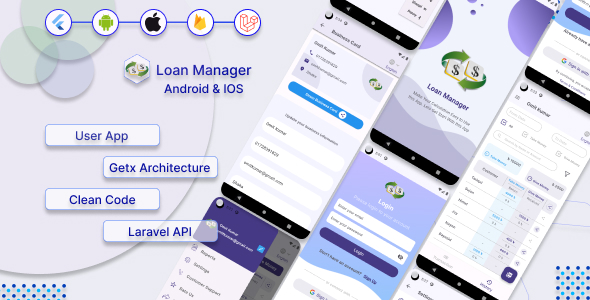
Loan Manager Flutter is a source-code package for building a mobile app that records money lent and money borrowed, tracks balances per contact, and reminds users about due payments. It ships as a complete Flutter project for Android and iOS together with a REST API backend, documentation and installation support, and it is aimed at developers or small agencies who want a working starting point for a lending, bookkeeping or personal-debt tracking product rather than a finished consumer app.
The listing sits in the Flutter category on ThemeForest at $20, which places it firmly in starter-kit territory: the value proposition is time saved on scaffolding, not a polished commercial release. The vendor, whose marketplace identity is not named in the listing data, sells it as a bundle of application source, server source, docs and setup help.
What Loan Manager Flutter Actually Includes and How the Pieces Fit Together
The package is split into two halves that matter equally. The first is the Flutter client that runs on Android and iOS; the second is a REST API codebase that stores the records and handles authentication. Buyers get both, plus documentation and free installation support. That two-part structure is the single most important thing to understand before purchasing, because it means deployment is not a matter of uploading a zip to a hosting panel — a server environment has to be provisioned and the API connected to the app before anything works.
Transaction recording and per-customer ledgers
The core data model is deliberately simple. Users can log a “take money” entry (money received) and a “give money” entry (money handed out), then edit or delete either. Each entry can be viewed in a global transaction list or filtered down to a single customer, which effectively produces a running ledger per person. For a lending scenario — a small moneylender, a shop running tabs, an individual tracking informal loans to friends — that per-customer view is the feature that does most of the daily work.
Search, filtering and reporting
History can be searched and filtered by date, time, transaction type or customer name. A separate reports screen aggregates all take-money and give-money activity, giving a summary rather than a raw list. The filtering vocabulary is practical rather than analytical: there is no indication of charts, category budgets or trend analysis, so the reporting layer should be read as a totals view rather than a business-intelligence dashboard.
Payment reminders and notifications
A local notification can be scheduled against a specific date and time to flag a due payment. This is the feature that turns the app from a passive record book into something with a reason to be opened again. It is worth noting the word “local”: these are device-side notifications, so they fire on the handset that scheduled them and are not described as server-pushed or multi-device synced alerts. For a single user tracking their own lending that is sufficient; for a team sharing a ledger it is a meaningful constraint.
Sharing, PDF export and the business card module
Individual transactions can be shared to a customer through messaging apps, WhatsApp, Gmail and the platform share sheet, and the full transaction set can be rendered as a PDF for download or sharing. There is also a business card builder with share functionality — a slightly unusual inclusion in a loan tracker, but a plausible fit for a moneylender or agent who wants to hand out contact details alongside a statement. A customer support section and an in-app rate/share prompt round out the utility screens.
Localisation and multi-currency handling
Multiple languages are supported through Flutter’s localisation system, and transactions can be recorded in more than one currency. The listing does not state how exchange rates are handled, whether conversion is manual or fetched from a rate provider, or whether reports consolidate across currencies. Buyers with cross-border requirements should treat multi-currency as a data-entry convenience until the vendor confirms the reporting behaviour.
Where Loan Manager Flutter Fits and Where It Does Not
The strongest fit is a developer or small studio with a client already asking for a debt-tracking tool. A shopkeeper who extends credit, a pawnbroker, a landlord tracking deposits, a micro-lending operation or an individual managing informal loans between acquaintances — all of these map cleanly onto the take/give/customer/reminder model. Because the source is included, the app can be rebranded, extended with new fields, or narrowed to a single use case before release. At $20 the economics are straightforward: the cost is recovered if it saves even a day of scaffolding work on authentication, API wiring and CRUD screens.
It is the wrong choice for anyone wanting a hosted SaaS they can configure and launch without touching code. There is no indication of a web dashboard, no accounting-standard compliance, no bank feed integration, no double-entry bookkeeping and no multi-user roles or permissions described. A small business needing VAT-ready books, reconciliation against bank statements or accountant-friendly exports should be looking at dedicated accounting software instead. Equally, an agency pitching a polished consumer finance app to a paying client should expect to invest substantially in design and QA, because a starter kit’s screens are functional rather than brand-ready.
Strengths and Limitations of This Loan Manager Flutter Package
Strengths
- Both sides of the stack are included. Client and REST API source arrive together, removing the most tedious part of a from-scratch build.
- Genuinely complete CRUD coverage. Create, read, update and delete are present for both transaction types, plus per-customer views.
- PDF export and share targets. Statements can leave the app in a form a customer can actually keep, via WhatsApp, email or the share sheet.
- Scheduled due-payment notifications. A concrete retention hook rather than a decorative extra.
- Localisation and multi-currency built in. Useful for regional markets where a single-language, single-currency app would be dead on arrival.
- Low entry price with installation support. At $20 with setup help offered, the risk on a failed evaluation is small.
Limitations
- No disclosed sales history or rating. The listing shows no track record, so there is no crowd signal to lean on — buyers are evaluating on the demo alone.
- Local notifications only. Reminders are device-bound; the listing describes nothing that pushes alerts to a second device or to the customer.
- Server deployment is on the buyer. A REST API backend has to be hosted, configured and secured, and the listing gives no detail on the stack, database or hosting requirements.
- No stated exchange-rate mechanism. Multi-currency is listed without explaining conversion or consolidated reporting.
- No roles, permissions or team features. The model appears to be single-user, which rules out staff accounts on a shared ledger.
- Design depth is unverified. The demo APK shows the flow, but the listing makes no claims about UI polish, accessibility or tablet layouts.
How Loan Manager Flutter Compares With Other Flutter Finance Starters
The broad alternative category is the Flutter app template: pre-built UI kits and full-stack starters sold on marketplaces, usually in the $20–$60 band. Most of them are front-end only, offering screens and widgets that still need a backend invented from scratch. Loan Manager Flutter’s differentiator is that it ships the server too, which shifts the work from architecture to deployment and customisation. That is a better trade for a solo developer than for a team that already has an API convention it prefers.
Within finance specifically, the alternatives split into expense trackers and budgeting apps on one side, and lending or invoicing tools on the other. An expense tracker template will typically offer categories, charts and budget goals that this package does not describe. A lending tool brings the per-customer ledger and due-date reminder that expense trackers usually lack. Loan Manager Flutter sits on the lending side, and its business card module and customer support screen suggest it was designed for someone who deals with borrowers face to face rather than for personal budgeting. Anyone whose real need is categorised spending analysis should compare against expense-tracker templates before committing.
The honest positioning is this: it competes on completeness of the transaction model and on including the backend, not on visual sophistication or analytical depth. A buyer comparing purely on screenshots may find richer-looking UI kits; a buyer comparing on how much working logic arrives in the download will find this one further along.
Frequently Asked Questions
What do I actually get when I buy Loan Manager Flutter?
The purchase delivers the Flutter application source code, the REST API source code, documentation and free installation support. Both the Android and iOS builds come from the same Flutter project, so one codebase covers both platforms. There is no hosted service, subscription or managed backend included — the buyer hosts and maintains the server side.
Can Loan Manager Flutter be used for a real lending business?
It can serve as the foundation for one, but not as a finished compliance-ready system. It records money given and taken per customer, exports PDF statements and schedules due-payment reminders, which covers the operational core of small-scale lending. It does not describe interest calculation, contracts, audit trails or regulatory reporting, so those would need to be built or handled outside the app.
Does the app work without internet access?
The listing does not state offline support, and the architecture points the other way. Transactions are stored through a REST API, which implies a network connection is needed to read and write records. Local notifications are scheduled on the device itself, so a reminder may still fire without connectivity, but the underlying data would not refresh until the app reaches the server.
Is technical knowledge required to launch it?
Yes, a working knowledge of Flutter and server deployment is effectively required. The package includes source code rather than a no-code builder, so compiling for Android and iOS, configuring the API, and hosting a backend all fall to the buyer. Free installation support reduces the friction of first setup, but ongoing customisation and maintenance remain a developer’s job.
Verdict: Who Should Buy Loan Manager Flutter and Who Should Walk Away
This Loan Manager Flutter package is worth buying for developers, freelancers and small agencies that need a head start on a debt-tracking or small-lending app and are comfortable deploying a REST backend. The combination of client and server source, per-customer ledgers, PDF statements and scheduled reminders covers the functional core of that product type at a price that is hard to argue with. It is a poor fit for non-technical buyers hoping for a turnkey app, for businesses needing accounting-grade books or multi-user permissions, and for anyone who requires a proven track record before purchasing — the listing discloses no sales or rating data. Treat it as a scaffold to be extended, budget design and QA time accordingly, and the value is there; treat it as a finished product and the gaps will surface quickly.