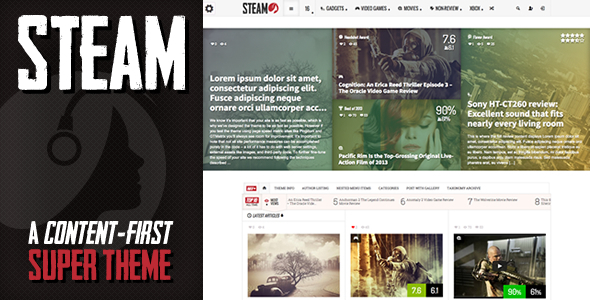
Steam is a WordPress theme built for review-driven editorial sites: magazines, film and music publications, gadget blogs and multi-topic news portals that publish scored articles rather than plain posts. It ships with a native rating engine, a “minisite” system for running several verticals under one installation, and a Bootstrap-based page builder. It is aimed at publishers who want a scored, ranked, filterable archive rather than a simple blog, and it costs $49 on ThemeForest from developer IndustrialThemes.
The Steam blog-magazine concept is unusual in that the review system is not a plugin dependency bolted on afterwards. Scores, criteria weighting, editor versus reader ratings and ranking logic are part of the theme framework itself, which shapes almost everything else about how the product behaves.
What the Steam blog-magazine theme actually does well
The centrepiece is the review engine. Each article can carry a score expressed as stars, a number, a percentage or a letter grade, and that score can be broken into weighted criteria so that, for example, a laptop review weights performance more heavily than packaging. Editor scores and user scores can run side by side or independently, and user totals update live over AJAX as votes come in. Readers can also submit their own structured reviews through the comment form, which turns a comments section into a second layer of scored content rather than a flat discussion thread.
Ranking flows directly out of that data. The theme can sort and filter post loops by most recent, most liked, most viewed, highest editor rating, highest user rating, most commented or most awarded, all without a page reload. The Top Ten carousel builds a ranked list from a chosen metric over a chosen time window, and the Top Reviewed widget does the same thing in sidebar form. For a publication whose value proposition is “we score things and tell you which is best”, this is the core workflow and it is handled natively.
The minisite system is the second differentiator. A single WordPress install can host several distinct sections — film, music, technology, gaming — each with its own taxonomy, its own front page layout, its own sidebars and its own directory listing. The mega menu pulls posts dynamically from those minisites, taxonomies, categories and tags, so navigation stays current without manual curation. Unlimited custom sidebars and a page builder that can be configured per minisite make this more than a labelling exercise.
Around the edges there is a large amount of supporting machinery: WooCommerce integration for selling products or subscriptions, BuddyPress compatibility for community features, a custom ad manager that accepts AdSense or any other network, an awards and badges system, a related-posts engine with five selectable algorithms, 30 footer layouts, and a shortcode library covering alerts, buttons, tabs, accordions, progress bars, modals, tooltips and a twelve-column grid. The front-end is built on Bootstrap 2.3, validated as HTML5, responsive from a 1140px widescreen layout down to mobile, and HiDPI-ready. CSS and JavaScript are combined and minified, and icon fonts are used instead of image sprites, which keeps request counts down.
Where a Steam blog-magazine build makes sense — and where it does not
The strongest fit is an established or aspiring review publication that wants scored content to be the organising principle of the site. A film site that ranks releases by editor score, a hardware blog that lets readers vote and then surfaces the highest-rated products of the month, or a multi-vertical magazine that needs separate section front pages without running separate WordPress installations — all of these map cleanly onto what Steam provides out of the box.
Agencies building review or comparison sites for clients are a second natural audience, particularly where the client expects to manage scores, criteria and rankings without developer involvement. The one-click minisite builder and the theme options importer/exporter reduce the setup cost of spinning up a similar structure for a second client.
It is the wrong choice for a straightforward personal blog, a corporate brochure site, or a publication that publishes long-form journalism with no scoring component. In those cases the review framework is dead weight: it adds admin screens, database tables and template complexity that will never be used, and a lighter editorial theme would be faster to configure and easier to maintain. Sites that depend on the WordPress block editor for layout will also find the shortcode and page-builder approach dated, since content is composed through shortcodes rather than native blocks.
Strengths and limitations of the Steam blog-magazine theme
Strengths
- The review and rating system is native, not a plugin add-on, so scores, weighted criteria and ranking queries are first-class data rather than post meta bolted on by a third party.
- Reader-submitted reviews in comments create a genuine two-tier scoring model that most review themes do not attempt.
- Minisites let one installation serve several editorial verticals with independent layouts, sidebars and directories.
- AJAX sorting across seven metrics gives visitors real control over how archives are ordered.
- Bootstrap shortcodes, 630 Google fonts, 130 icon fonts and unlimited colour options cover most styling needs without custom CSS.
- Performance work is visible in the spec: combined and minified assets, icon fonts, and correct use of WordPress’s internal jQuery libraries for plugin compatibility.
- 1,193 sales on ThemeForest indicate a reasonably established install base for a niche review theme.
Limitations
- The last vendor update was August 2018. That is a long gap, and it matters for a theme that integrates with WooCommerce and BuddyPress, both of which have changed substantially since then. Buyers should verify current compatibility before committing.
- Bootstrap 2.3 is several major versions behind. The grid and component classes will not match contemporary Bootstrap documentation, which slows down anyone customising the markup.
- Layout is built through shortcodes and a page builder rather than the block editor, so content editing feels like a pre-Gutenberg workflow.
- The vendor does not state a tested-up-to WordPress version in the listing, which makes forward compatibility with recent core releases an open question.
- Browser support is documented only up to IE10, and no accessibility conformance is claimed for the front end beyond the sticky login bar.
- Feature breadth is genuinely large — carousels, minisites, awards, ad manager, social widgets — and that surface area has to be configured and maintained, which is a real cost on smaller projects.
How Steam compares with other review and magazine themes
Most themes in the blog-magazine category are editorial templates with a rating plugin recommended alongside them. That approach is cheaper and more flexible in the sense that the rating layer can be swapped out, but it also means scores live in plugin-specific tables and the theme’s archive queries have no awareness of them. Steam takes the opposite position: the rating data model is inside the theme, so ranking, filtering and widget logic all understand what a score is. The trade-off is lock-in — moving away from Steam means migrating that review data.
Against general-purpose multipurpose themes, Steam is narrower and deeper. A multipurpose theme can be bent into a review site with plugins, but the minisite architecture, the seven-metric AJAX sorting and the comment-based user reviews are not things that come free with a page builder. Against lightweight magazine themes, Steam carries considerably more overhead in exchange for capabilities those themes simply do not have.
The honest comparison point is maintenance. A theme with this much integrated functionality is only as good as its update cadence, and a 2018 last-update date puts Steam behind newer competitors on that single axis, regardless of how capable the feature set remains.
Frequently Asked Questions
Does the Steam blog-magazine theme require plugins for its review system?
No. The rating and review system is built into the Industrial Theme Framework that ships with the theme, covering weighted criteria, editor and user scores, and ranking by either. That means no separate rating plugin licence and no dependency on a third-party developer. It also means the review data is tied to the theme rather than portable between themes.
Can Steam run several different magazine sections on one WordPress install?
Yes, through the minisite system. Each minisite gets its own taxonomy, front page layout, sidebars and directory entry, and the mega menu can pull posts dynamically from any minisite, category, tag or taxonomy. This avoids running multiple WordPress installations for a multi-topic publication, though it does concentrate all content in one database.
Is Steam compatible with current versions of WordPress and WooCommerce?
The vendor’s listing states WordPress 3.5+ and WooCommerce 2.0+, with the last update in August 2018. It does not state a tested-up-to version. Given how much both WooCommerce and WordPress core have changed since then, compatibility should be confirmed directly with the developer before purchase rather than assumed from the listing.
How does the Steam blog-magazine theme handle mobile and retina displays?
The layout is responsive from a 1140px widescreen grid down to mobile, and the theme is HiDPI-ready, so graphics and icon fonts render sharply on high-density screens. Icon fonts are used instead of image sprites, which reduces HTTP requests. Browser support is documented only as far as IE10, and no formal accessibility conformance is claimed.
Verdict on the Steam blog-magazine theme
Steam is worth buying for publishers whose site is genuinely organised around scores and rankings — review sites, comparison publications, multi-vertical magazines — because the rating engine, minisite architecture and AJAX sorting are integrated rather than assembled from plugins. The 1,193 sales suggest a real audience found that combination useful. It is not the right purchase for a personal blog, a brochure site, or any project that does not need scored content, where the extra framework is pure overhead. The decisive caveat is the August 2018 last-update date: anyone buying now should confirm current WordPress, WooCommerce and BuddyPress compatibility with IndustrialThemes first, because a capable feature set does not compensate for a stalled maintenance cycle.