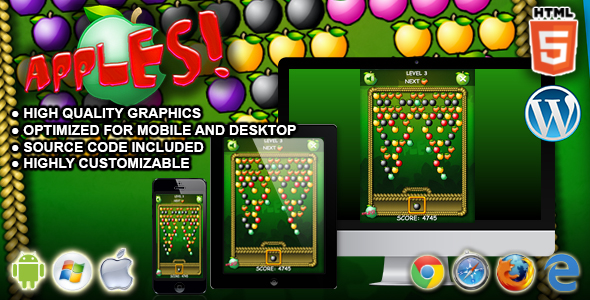
Apples Games is a browser-based puzzle title built in HTML5 and JavaScript, sold as a downloadable source package on ThemeForest for $17. The player’s objective is to clear every apple from a level without letting any apple cross the bottom line of the play area. It is aimed at developers, small studios and site owners who want a ready-made casual game they can host, rebrand or wrap into a mobile app rather than build from scratch.
The product comes from a vendor on Envato’s ThemeForest marketplace, and the listing does not disclose a sales figure, so there is no meaningful purchase history to weigh up. That matters for buyers: with no track record, the decision rests almost entirely on the technical specification, the licence terms and how much work the buyer is willing to put in afterwards.
What Apples Games Actually Delivers
The package is a complete, playable puzzle game rather than a template or a starter kit. The core loop is a physics-flavoured matching challenge: apples sit in the level, the player interacts with them to clear the board, and failure is defined by a single rule — if an apple falls past the bottom boundary, the level is lost. That constraint is what separates it from the more common match-three grid format, and it gives the game a fail state that is easy to communicate to a player in a single line of on-screen text.
Technically, the game is written in HTML5 and JavaScript on top of CreateJS, the third-party canvas library. The vendor explicitly notes that it was not built in Construct 2 or a similar visual game framework. For a developer, that distinction is practical rather than cosmetic: the code is readable JavaScript that can be edited directly, extended with new level logic, or integrated into an existing web stack, instead of being locked inside a proprietary editor that the buyer may not own. Anyone comfortable with canvas rendering and event handling will be able to follow the structure.
The build targets a 768×1024 portrait resolution and scales to fit the current screen. The vendor is upfront that on very wide screens the game may not fill the display perfectly — an honest caveat that reflects the fixed portrait aspect ratio rather than any defect in the code. In practice this means the title is designed for phones and tablets first, with desktop browsers as a secondary target where letterboxing or side margins are acceptable.
Audio is handled with a documented caveat. Sound is enabled on mobile, but the vendor states that full audio compatibility cannot be guaranteed across all mobile devices because of known conflicts between certain mobile browsers and HTML5 audio. The documentation explains how to disable sound loading entirely if that is preferable. On Windows Phone, sound cannot be enabled at all, because of what the vendor describes as unresolvable issues with the audio and video tags on that platform. Buyers targeting a modern Android and iOS audience can largely ignore this; anyone still supporting legacy Windows mobile hardware cannot.
The changelog shows the product has been maintained rather than abandoned. A 2016 update added a full-screen mode, a level panel and an event handler for the CTL Arcade WordPress plugin, which is the clearest signal that the game is intended to be dropped into a WordPress arcade site as well as a standalone page. A 2019 update added a favicon and page title handling, centred the top of the game, introduced loading and sound-loading recovery for slow connections, fixed a full-screen bug on Android, and added text autofit to make language customisation easier. The autofit detail is worth noting: it means translated strings are less likely to overflow their containers, which reduces the friction of localising the interface.
Where Apples Games Fits, and Where It Does Not
The most obvious fit is a WordPress arcade or casual gaming site. The CTL Arcade integration means the game can be registered as a playable entry inside an existing plugin-driven catalogue, which is a faster route to publishing than wiring up a custom embed. Site owners running a games portal, a school or library intranet, or a brand microsite with a playable component can deploy it without writing a game engine.
Indie developers and freelancers looking for a foundation to reskin are the second natural audience. The vendor recommends reskinning or at least rebranding before releasing it as a mobile app, and that advice is sound — a $17 asset sold on a public marketplace will appear on other sites in its original form, so visual differentiation is a commercial necessity, not just a nicety. Agencies building a quick interactive piece for a campaign, a kiosk or an event landing page can also use it as a low-cost starting point.
It is the wrong choice for anyone who needs a complete, store-ready mobile product out of the box. The vendor states plainly that support is not offered for issues encountered when the game is used inside third-party packaging tools such as PhoneGap, Cordova or Iudei. Wrapping a web game into a native shell involves platform-specific work — permissions, splash screens, audio behaviour, store compliance — and none of that is covered here. Buyers who cannot do that work themselves, or who need guaranteed audio parity across every device, should look at a native engine or a licensed game SDK instead. Teams needing a landscape or desktop-first experience are also poorly served by the fixed portrait layout.
Strengths and Limitations of This HTML5 Puzzle Game
Strengths
- Editable source code in plain HTML5 and JavaScript, built on CreateJS rather than a closed visual framework, so the logic can be modified and extended.
- A single, clearly defined losing condition — an apple crossing the bottom line — which makes the rules easy to explain and the difficulty easy to tune.
- Portrait 768×1024 base resolution that scales to device screens, which suits the phone-first audience this genre attracts.
- Documented integration with the CTL Arcade WordPress plugin, giving arcade site owners a direct publishing path.
- A changelog spanning 2016 to 2019 with real fixes, including slow-connection loading recovery and an Android full-screen bug, suggesting the vendor responds to problems.
- Text autofit support that lowers the effort required to localise the interface into other languages.
- A low entry price of $17 relative to the cost of commissioning even a simple puzzle game.
Limitations
- No disclosed sales volume, so there is no independent evidence of how the game behaves in production environments or how many buyers have shipped it.
- Audio is explicitly not guaranteed across all mobile devices, and is unavailable entirely on Windows Phone — a real constraint for anyone with a broad device matrix.
- The vendor disclaims support for third-party packaging tools, so the mobile app route is effectively unsupported.
- Very wide screens will not display the game perfectly, because the layout is locked to a portrait aspect ratio.
- Only one game mode and one mechanic are described; there is no indication of level editor tooling, analytics hooks or monetisation features such as ads or in-app purchases.
- Localisation is limited to text autofit — no translated string files are mentioned, so translation work is the buyer’s responsibility.
- The listing carries no information about the licence terms beyond the standard marketplace framework, and nothing about update frequency after 2019.
How Apples Games Compares With the Wider Category
The market for ready-made HTML5 casual games splits roughly into three tiers. At the low end are single-mechanic puzzle assets in the $15–$30 range, typically sold as source code with minimal documentation and no support. At the middle are multi-game bundles and arcade packs that include several titles, a shared menu system and sometimes a backend for scores. At the top are licensed game engines and white-label platforms where the buyer gets a level editor, ad mediation and ongoing updates for a recurring or much larger one-off fee.
Apples Games sits firmly in the first tier, and it is honest about that. What it offers over a bare code dump is the CreateJS foundation, the WordPress plugin hook and a maintenance history. What it does not offer is the tooling layer — no level editor, no score backend, no ad integration — that the middle and top tiers provide. Buyers comparing options should therefore weigh how much of that layer they intend to build themselves. If the answer is “most of it”, a bundle or a licensed platform will usually work out cheaper once development hours are counted. If the answer is “none of it, I just need one playable puzzle for a page”, the single-asset approach is the more sensible spend.
The other axis of comparison is the mechanic itself. Physics-driven clearing puzzles are less crowded than match-three grids, which means less direct competition for player attention but also fewer reference implementations to borrow from. That cuts both ways for a developer: the code is more distinctive, but there is less community material to lean on when something breaks.
Frequently Asked Questions
What is Apples Games and how does it play?
Apples Games is an HTML5 puzzle game in which the player must clear all apples from a level without letting any apple cross the bottom line of the play area. Touching that boundary ends the attempt. It is played in a browser in portrait orientation and scales to fit the screen of the device being used.
Can Apples Games be turned into an Android or iOS app?
Yes, but without vendor support. The listing suggests reskinning or rebranding the game before releasing it as an app, and states that the vendor cannot be held responsible for issues arising from third-party packaging tools such as PhoneGap, Cordova or Iudei. Buyers need their own native wrapping experience and should test audio behaviour carefully on each target platform.
Does Apples Games work with WordPress?
It can, through the CTL Arcade WordPress plugin. A 2016 update added an event handler specifically for that plugin, which lets the game be registered as a playable entry inside an arcade catalogue. Buyers not using CTL Arcade would need to embed the game manually or write their own integration.
Is the sound reliable on mobile devices?
Not universally. The vendor enables sound on mobile but states that full audio compatibility cannot be guaranteed, citing known conflicts between some mobile browsers and HTML5 audio. Sound cannot be enabled at all on Windows Phone. The documentation explains how to skip sound loading entirely if reliability matters more than audio.
Verdict on Apples Games
Apples Games is a sensible purchase for a developer or site owner who wants one clean, editable puzzle mechanic at a low price and is prepared to handle reskinning, packaging and testing themselves. The CreateJS source, the WordPress arcade hook and the documented bug fixes make it a more considered asset than the average $17 game listing. It is a poor fit for anyone expecting a store-ready mobile app, guaranteed audio across every device, or built-in level editing and monetisation tools, because none of those are included and the vendor explicitly declines support for the packaging stage. The absence of a disclosed sales figure means buyers are taking the specification on trust, which is a reasonable risk at this price but not a trivial one. For a quick playable addition to an arcade site or a starting point for a reskin, it is worth the spend; for a commercial mobile release, it is only the first step.