Bindlex Social Traffic – Premium Edition is a Windows desktop application that generates automated visits to a website by running a configurable set of bots on the user’s own machine. It is aimed at site owners and marketers who want to inflate or simulate traffic figures and on-page engagement signals, and it sits in the software category commonly described as a Bindlex Social Traffic Apps tool. The $489 price and the hardware requirements mean it is a considered purchase rather than an impulse one.
The product is sold on ThemeForest under the Apps category and is developed by the vendor behind the Bindlex name. No sales figures are disclosed on the listing, so there is no public adoption data to weigh. The review below works from the vendor’s stated specifications and assesses where the tool genuinely fits, where it does not, and what the trade-offs are.
What Bindlex Social Traffic Apps Actually Do Under the Hood
The core mechanism is straightforward: the application launches a controlled number of automated browser sessions that load a target URL, and those sessions can be told to behave in ways that resemble a real visitor rather than a bare page request. The vendor claims a ceiling of roughly 100,000 to 150,000 visits per day, which is the headline figure the pricing is built around.
Simulated engagement beyond a simple page load
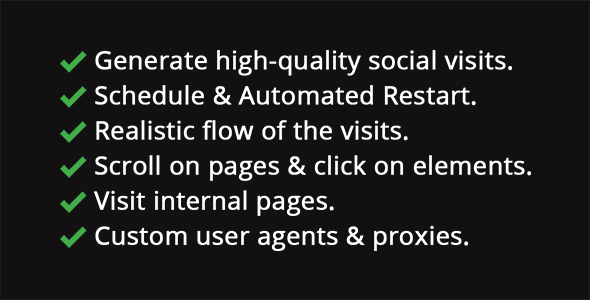
Raw hits are easy to spot and easy to dismiss, so the more interesting part of the feature set is the interaction layer. Bots can be configured to move through internal pages rather than bouncing off the landing page, to scroll down the page, and to perform clicks on page elements. For anyone evaluating whether the traffic looks plausible in an analytics dashboard, those behaviours matter more than the raw count, because they produce session duration, pages-per-session and scroll depth rather than a stream of single-page bounces.
Traffic shaping and scheduling
The vendor describes a “natural flow” mode in which visit volume rises and falls over time instead of arriving as a flat line. Visits can also be scheduled, which allows campaigns to be confined to particular windows. Both features address the same weakness in traffic-generation tools: uniform, round-the-clock volume is one of the clearest fingerprints of automated activity, and shaping the curve is an attempt to avoid that pattern.
Configuration control and per-site profiles
Saved configurations can be imported and exported per site, which is useful for anyone running the tool across several properties or moving a setup between machines. Custom user-agent lists can be supplied, letting the operator control how the bot sessions identify themselves at the browser level. There is also an option to disable CSS and JavaScript on the page, which reduces the load each session places on the target server and on the local machine — a practical concession given how many concurrent sessions the tool is designed to run.
Unattended operation
The Premium Edition adds an automatic refresh timer: the program can stop and restart itself after a set interval without anyone at the keyboard. The vendor frames this as self-repair for when something goes wrong mid-run. In practice it is an uptime feature, and it is the main functional difference between this edition and a lighter one.
Hardware footprint
The stated requirements are a 64-bit Windows system with .NET Framework 4.8, at least an Intel Core i5-8400 at 2.80GHz and 8GB of DDR4 RAM. Those are modest by current desktop standards, but they are the floor for running the application itself, not a guarantee that the machine stays responsive while pushing five figures of daily sessions. The vendor’s claim that the software is optimised for low-end computers should be read alongside that caveat.
Where This Tool Fits and Where It Does Not
The honest use cases are narrower than the marketing implies. The most defensible one is testing: a site owner or developer who wants to see how a layout, a heatmap tool, an analytics setup or a server configuration behaves under sustained concurrent load can use Bindlex Social Traffic Apps as a crude load and behaviour simulator without standing up dedicated infrastructure. The internal-page navigation and click options make it more useful for that than a plain request flood.
A second fit is demonstration and presentation. Agencies that need a dashboard to show activity during a pitch, or that want to populate a staging environment with session data for a client walkthrough, can use the tool to generate that activity on demand. The scheduling and import/export features make repeatable demo setups practical.
The wrong choice is any project where the goal is to influence search rankings or advertising metrics. Automated visits do not produce the behavioural or conversion signals that search and ad systems actually reward, and the vendor makes no claim that they do. Anyone buying this expecting organic ranking movement is buying the wrong product at a high price. It is equally unsuitable for teams without a spare Windows machine to dedicate to it, and for anyone who needs traffic that survives scrutiny from a sophisticated analytics or fraud-detection setup.
Strengths and Limitations of the Premium Edition
Strengths
- Behavioural simulation goes beyond page loads — internal navigation, scrolling and clicks produce session metrics that a bare hit generator cannot.
- Traffic shaping and scheduling give control over the shape of the visit curve, not just the total.
- Per-site configuration import and export makes managing multiple properties considerably less tedious.
- Custom user-agent lists and the option to disable CSS/JS give meaningful control over how each session presents itself and how much load it creates.
- The auto-refresh timer supports genuinely unattended runs, which matters for a tool designed to operate over long periods.
- Modest stated hardware requirements mean it will run on ordinary office machines rather than requiring a server.
Limitations
- The $489 price is high for a single-purpose desktop utility, and the listing discloses no sales volume, so there is no track record to justify the premium.
- It is Windows-only and depends on .NET Framework 4.8, which rules out macOS and Linux users entirely and adds a dependency to manage.
- All load is generated from the operator’s own machine and IP address, which is a significant constraint for anyone concerned about how that traffic is attributed.
- The vendor publishes no information on proxy or IP rotation, so the practical diversity of the visit sources is unstated.
- There is no documented reporting or analytics layer — the operator has to rely on external tools to see what the runs actually produced.
- Running five-figure daily session volumes will compete for CPU and memory with whatever else the machine is doing, regardless of the stated minimums.
How Bindlex Social Traffic Apps Compare to the Wider Category
Traffic-generation software broadly splits into three groups: hosted services that run sessions from a provider’s infrastructure, browser-automation frameworks that a developer scripts themselves, and desktop utilities like this one. Hosted services remove the hardware burden and usually offer IP diversity, but they are typically subscription-priced and put the operator’s data on someone else’s system. Scripted automation using headless browsers is free and infinitely flexible, but requires real engineering time and ongoing maintenance as sites change.
Bindlex Social Traffic Apps sits in the desktop-utility group and competes on convenience rather than capability. It offers a point-and-configure interface, saved profiles and unattended operation — things a custom script does not give for free. What it does not offer is the infrastructure diversity of a hosted service or the adaptability of code. Buyers comparing on fit should ask whether they want to own the machine and the IP, or rent someone else’s; this product assumes the former. On price, $489 places it above most desktop utilities in the category and into the range where a hosted subscription or a few days of developer time becomes a serious alternative.
Frequently Asked Questions
What is Bindlex Social Traffic – Premium Edition used for?
It is a Windows application that sends automated visits to a website, with bots configured to navigate internal pages, scroll and click. Site owners use it to simulate traffic and engagement, test how a site handles concurrent sessions, or populate dashboards and staging environments with activity data.
Does Bindlex Social Traffic improve search engine rankings?
No. The vendor makes no ranking claim, and automated visits do not create the behavioural or conversion signals search engines reward. Anyone buying it to move organic rankings is likely to be disappointed. Its realistic value is in testing, demonstration and load simulation rather than SEO outcomes.
What are the system requirements for Bindlex Social Traffic Apps?
It requires 64-bit Windows with .NET Framework 4.8, an Intel Core i5-8400 at 2.80GHz or better, and at least 8GB of DDR4 RAM. Those are the vendor’s stated minimums for running the program. Running high daily session volumes will place additional load on the same machine.
Can Bindlex Social Traffic run without supervision?
Yes, in the Premium Edition. The auto-refresh timer lets the program stop and restart itself after a set interval, so a run can continue without anyone at the keyboard. The vendor presents this as self-repair when problems occur during a session.
Verdict: Who Should Buy Bindlex Social Traffic Apps
Buyers who should consider Bindlex Social Traffic Apps are agencies and site owners who need a configurable, unattended way to generate realistic-looking session activity on Windows hardware they control — for load testing, demos or staging data. The behavioural options and traffic shaping are genuinely more capable than a basic hit generator.
Buyers who should not are anyone hoping for ranking or advertising gains, anyone on macOS or Linux, and anyone who needs traffic originating from diverse IP addresses rather than a single machine. At $489 with no disclosed sales history, the price demands a clear, specific use case before purchase. For most SEO-focused projects, the money is better spent elsewhere.