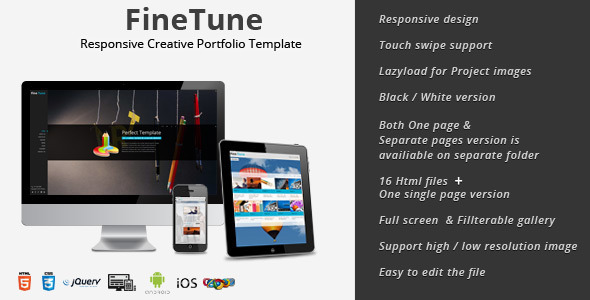
FineTune is a responsive creative portfolio template sold on ThemeForest for $17, built by the developer FMedia. It packages a one-page layout and a multi-page layout in the same download, along with light and dark colour variants, and targets photographers, designers and small studios that need a visual-first site without commissioning custom development. The listing has accumulated 394 sales, which is a modest but real signal of demand in a crowded category.
The template’s central promise is flexibility of presentation rather than depth of functionality. Buyers get six portfolio layouts, a filterable gallery, a full-screen image viewer and a choice between a scrolling single-page site and a conventional multi-page structure. Everything is driven by static HTML, CSS and jQuery rather than a CMS, which shapes both what the product does well and where it falls short.
What FineTune Creative Actually Delivers
The most useful thing about this template is that the one-page and multi-page versions ship as separate folders inside the same purchase. That matters because the two formats suit different browsing behaviours: a single scrolling page works for a short, curated body of work, while separate pages make more sense once a portfolio runs past a dozen projects and needs its own navigation. Being able to switch without buying again removes a common source of regret.
Portfolio presentation is where the template invests most. There are six layout variations, and the thumbnail count per row is configurable rather than fixed, so a photographer with square crops and a designer with wide case-study images can both find a workable grid. The Isotope-powered filter lets visitors narrow projects by category without a page reload, and the full-screen gallery includes animated captions over the images.
Performance handling is more thoughtful than the price suggests. Lazy loading means project and news images are only fetched when they scroll into view, and each page can carry separate high- and low-resolution background images so that phones download the lighter asset. For a portfolio where large photography is the whole point, that distinction has a direct effect on mobile load times.
Navigation details include a history plugin that assigns each page a bookmarkable URL, so visitors can link to a specific project rather than always landing on the homepage. Touch swipe gestures are supported in the gallery, and there is a full-screen toggle button for presentations and client reviews. Video embeds from YouTube and Vimeo are supported with an optional cover image, and the contact form submits via Ajax so the page does not reload.
Customisation is deliberately shallow. The colour scheme is controlled by editing a single colour.css file, which is genuinely quick, and the Open Sans web font can be swapped by changing a link in custom.js. Layered PSD files are included for buyers who want to rebuild the visual design rather than just recolour it. The vendor also bundles a help document, though the listing does not describe its scope or depth.
Where FineTune Fits and Where It Does Not
This template suits a photographer, illustrator or small design studio that wants a static marketing site with a strong visual gallery and does not need a content management system. It also works for a freelancer building a one-off showcase for a client who will not be updating the site themselves, and for anyone who wants a starting point they can restyle heavily using the included PSDs.
It is a poor fit for anyone who needs to publish new work regularly without touching code. There is no WordPress or CMS integration here, so every new project means editing HTML and uploading image files manually. A blogger publishing several posts a week, or an agency running multiple client sites with different editors, will find that workflow unsustainable and should be looking at a theme rather than a static template.
It is also the wrong choice for projects that depend on modern front-end expectations. The template was last updated by the vendor in February 2014, and the codebase reflects that era: jQuery plugins, a Skeleton grid, and a touch-detection snippet the vendor had to patch after a Chrome update broke it. Anyone needing accessibility compliance, Core Web Vitals performance, or a build pipeline should treat this as a legacy starting point, not a finished product.
Strengths and Limitations of FineTune Creative
Strengths
- Both one-page and multi-page structures ship in the same download, so the format decision can be deferred or reversed.
- Six portfolio layouts with adjustable thumbnail counts give real flexibility across different image aspect ratios.
- Lazy loading plus separate high- and low-resolution images is a concrete performance measure, not a marketing claim.
- Bookmarkable page URLs via the history plugin make individual projects directly linkable.
- Colour changes are confined to one CSS file, which keeps restyling fast.
- PSD source files are included, which is uncommon at this price point.
- Light and dark versions are both provided rather than sold as an upsell.
Limitations
- No CMS. Content updates require editing HTML files directly, which rules out non-technical site owners.
- The last vendor update was in February 2014. Dependencies such as Isotope, Fancybox and FlexSlider have moved on considerably since then, and the vendor does not state whether newer versions are compatible.
- Preview images are licensed from a stock library and are explicitly excluded from the download, so a buyer’s site will look nothing like the demo until they supply their own photography.
- Touch handling was patched reactively after a Chrome release broke it, which raises a fair question about how the template behaves on current mobile browsers.
- Accessibility is not addressed anywhere in the listing: no mention of keyboard navigation, focus states, or ARIA roles.
- Typography is limited to a single Google font plus a system font stack, with no typographic scale system described.
FineTune Creative Versus the Wider Template Market
The realistic alternatives fall into three groups. The first is a modern static HTML template from a current marketplace listing, which will typically offer a build step, responsive images, and dependencies that are still maintained. That route costs similar money and carries far less technical risk, at the expense of the one-page/multi-page duality and the PSD files.
The second group is a WordPress portfolio theme. Those cost more and require hosting plus ongoing maintenance, but they hand content editing to a non-technical owner and usually include plugin-based galleries, SEO tooling and accessibility work out of the box. For anybody whose portfolio changes monthly, that trade is straightforward.
The third group is a site builder such as Squarespace or Webflow. These remove the code layer entirely and include hosting, but they lock the design into a subscription and offer less control over the underlying markup. FineTune sits between all three: cheaper than a builder subscription over a year, more design control than a hosted platform, and considerably less capable than a maintained CMS theme. The deciding factor is whether the buyer wants to write markup.
Frequently Asked Questions
Does FineTune require WordPress?
No. FineTune is a static HTML, CSS and JavaScript template, not a WordPress theme. All content lives in the HTML files included in the download, and any change to text, images or project listings is made by editing those files and re-uploading them to a web host. It cannot be installed through a WordPress dashboard.
Is FineTune still compatible with current browsers?
The vendor does not state current browser support, and the last recorded update was February 2014. The listing itself documents a patch required after a Chrome update broke touch detection, which suggests the code has needed maintenance to keep working. Buyers should test thoroughly on modern mobile browsers before committing a client project to it.
Can the colour scheme and fonts be changed easily?
Colours are straightforward: the template routes its palette through a single colour.css file, so editing that one file restyles the whole site. Fonts are handled by a Google Fonts link in custom.js, and the Open Sans default can be swapped for another Google font by changing that link. Deeper typographic changes require editing the stylesheets directly.
Are the demo images included in the purchase?
No. The preview photography is licensed from Depositphotos and is explicitly excluded from the download file. Buyers receive the template, the PSD files and the help document, but must supply their own licensed imagery. Budget for stock photography or a shoot, because the template will not resemble the demo without comparable images.
Verdict on FineTune Creative
FineTune is worth buying for a developer or designer who wants a cheap, good-looking static starting point and is comfortable editing HTML, CSS and jQuery. The dual one-page and multi-page structure, the PSD files and the lazy-loading image handling are all genuine value at $17, and 394 sales suggest others have found the same. It is not the right purchase for anyone who needs a CMS, expects a maintained codebase, or has accessibility and performance requirements to meet. The 2014 last-updated date is the single most important fact in this review: treat FineTune as a design asset to be modernised, not a finished product to be deployed.