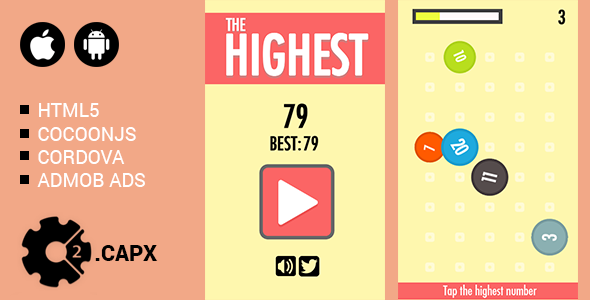
The Highest Games is a single-title HTML5 game package sold on ThemeForest for $20, built in Construct 2 and supplied with full source files so a buyer can rebrand and republish it. It is an endless, score-chasing arcade game that runs in a browser and can be wrapped for Android and iOS through Cordova-based tooling. It suits developers and small studios who want a ready-made mobile or web game they can reskin quickly, rather than teams looking for a deep, content-rich game to build a brand around.
What The Highest Games actually includes and what each part lets a buyer do
The listing is short, and the honest reading is that this is a starter kit rather than a finished commercial product. The value sits almost entirely in the source files and the export pipeline, not in the game itself.
Construct 2 project files and an editable event system
Buyers receive the .CAPX project file, which opens in Construct 2 (the vendor states version 244 or later). That means the game logic is editable in a visual, event-sheet-driven editor rather than buried in hand-written JavaScript. For anyone already comfortable with Construct, this is the single most useful part of the package: difficulty curves, scoring rules, spawn rates and UI behaviour can all be adjusted without touching code. For anyone who has never used Construct, the .CAPX file is a locked door until they learn the tool.
Cross-platform export paths for web, Android and iOS
The package is positioned for HTML5 first, so the game can be dropped onto a website and played in a desktop or mobile browser. For app stores, the vendor points to Cordova-based wrappers — PhoneGap and CocoonJS/Ludei are both named — which is the standard route for turning an HTML5 build into an installable app. In practice this means one codebase feeding a browser build and two store builds, which is the main efficiency argument for buying a Construct template at all.
Input handling across touch and mouse
Both touch and mouse input are supported, and the layout is described as responsive across devices. For an arcade game with a single interaction verb, that is the correct scope: one input model that works with a finger tap and a mouse click without separate control schemes to maintain.
AdMob integration and social sharing
AdMob ad support is wired in, which matters for the free-to-play, ad-supported distribution model most template buyers are aiming at. Twitter sharing is also included, giving a basic virality hook on the game-over screen. Neither is a monetisation strategy on its own, but both remove setup work that would otherwise fall to the buyer.
Reskinning as the core workflow
The vendor markets the package as easy to reskin, and that is the intended use case: swap the art, adjust the palette, rename the game, and publish. Whether that holds up depends on how cleanly the assets are organised in the project, which the listing does not document. Buyers should expect to inspect the project structure before committing to a large art pass.
Where The Highest Games fits, and where it does not
The clearest fit is a developer or small agency that already ships Construct projects and needs to fill a slot in a portfolio of small arcade titles. A studio running several ad-supported hyper-casual apps could use this as a base and reskin it repeatedly, which is where a $20 source-file purchase pays for itself fastest.
It also suits a web publisher who wants a lightweight browser game for a landing page or a content site, since the HTML5 export drops straight into a page without a server-side stack. Freelancers bidding on a small game project with a tight deadline are another reasonable buyer, provided the client’s brief is close to an endless score-attack format.
It is the wrong choice for anyone wanting a finished, store-ready product with polished art, onboarding, retention loops, leaderboards or analytics. None of those are stated as included. It is equally wrong for a team that does not use Construct and has no intention of learning it — the source files are only an asset if the buyer can actually open and modify them. And it is a poor fit for a project that needs original game design, since the whole point of the package is that the design already exists.
Strengths and limitations of The Highest Games
Strengths
- Full source included. The .CAPX file and export-ready assets mean the buyer owns the project, not a licence to a locked build.
- Genuine multi-target export. HTML5, plus Cordova-based paths to Android and iOS, from a single project.
- Low entry price. At $20 the commercial risk is minimal; a single reskin for one client or one ad-supported app covers the cost.
- Ad and share hooks pre-wired. AdMob and Twitter sharing remove routine integration work.
- Simple input model. Touch and mouse support with a responsive layout keeps the QA surface small.
Limitations
- Construct 2 is a legacy engine. The vendor specifies Construct 2 build 244 or later, not Construct 3. Buyers are working in an older toolchain, and the listing does not state whether the project imports cleanly into Construct 3.
- No sales or rating history disclosed. There is no public track record to weigh, so the buyer is assessing on the listing alone.
- Thin documentation in the listing. Asset organisation, file structure and reskin instructions are not described, and the vendor does not state what support is provided after purchase.
- Narrow game format. An endless score-attack loop has limited depth; there is no indication of level content, progression systems or meta-game.
- Wrapper dependency. The mobile route relies on third-party Cordova tooling, which brings its own maintenance burden and store-compliance overhead that the buyer inherits.
- No stated analytics or leaderboard support. Retention and competition features would have to be built from scratch.
How The Highest Games compares with other HTML5 game templates
The HTML5 game template category splits roughly into three tiers: single-mechanic arcade templates like this one, multi-game bundles, and full game frameworks with backend services. The Highest Games sits firmly in the first tier, and it competes on source access and export breadth rather than on content volume.
Against multi-game bundles, it offers less variety for a similar or slightly higher price, but a single well-organised project is often easier to reskin than a bundle where each title has its own quirks. Against full frameworks with leaderboards, accounts and analytics, it is far behind on features — but those products typically cost multiples of $20 and assume a backend the buyer has to host and maintain.
The more interesting comparison is against building from scratch in Construct. A competent Construct developer could produce an equivalent endless arcade game in a few days; the $20 purchase is really buying those days back, plus a working export pipeline. That trade is favourable for anyone billing hourly and unfavourable for anyone with more time than budget. Compared with Unity-based mobile templates, the Construct route is lighter and faster to export but weaker on 3D, physics fidelity and the depth of the surrounding tooling ecosystem.
Frequently Asked Questions
What engine does The Highest Games run on?
It is built in Construct 2 and requires version 244 or later to open the project. The vendor supplies the .CAPX source file, so all editing happens inside Construct rather than in a text editor. Buyers who use Construct 3 should confirm compatibility with the vendor before purchasing, because the listing does not address it.
Can The Highest Games be published to the App Store and Google Play?
Yes, through Cordova-based wrappers. The vendor names PhoneGap and CocoonJS/Ludei as export targets for Android and iOS, alongside a direct HTML5 build for websites. The buyer is responsible for the wrapper configuration, signing, store submission and any compliance work, none of which is included in the package.
How hard is it to reskin The Highest Games?
The vendor describes reskinning as straightforward, and the source-file model supports that in principle. In practice the effort depends on how the art assets are organised inside the project, which the listing does not document. Buyers should plan to review the project structure before committing to a full art replacement.
Does The Highest Games include ads and social sharing?
AdMob ad integration and Twitter sharing are both included. That covers the two most common monetisation and distribution hooks for a small arcade title. Neither is configured for a specific account, so the buyer still needs their own AdMob publisher ID and app registration before either feature works in a live build.
Verdict on The Highest Games
Buy The Highest Games if the buyer already works in Construct, wants full source files, and needs a small arcade title to reskin for a client project or an ad-supported app portfolio. At $20 the economics are easy to justify for anyone who values a few days of development time. Do not buy it if the team uses a different engine, needs a finished store-ready product with retention features, or expects documentation and support guarantees the listing does not offer. The absence of any sales or rating history means the purchase is a judgement call on the source files alone, and the legacy Construct 2 dependency is the detail most likely to cause friction after purchase. For the right buyer, The Highest Games is a cheap, practical head start; for everyone else it is a project file they will never open.