Pop Gallery Tumblr Theme Blogging is a premium Tumblr theme sold on ThemeForest for $24, built by the developer themelantic for visual portfolios, gallery-style blogs and small handmade shops. It replaces Tumblr’s default stream with a grid of circular thumbnails, separates the homepage and tag listings from the single-item view, and adds status labels for new, sold and reserved products. It suits photographers, illustrators, craft sellers and anyone whose Tumblr presence depends on images rather than long-form text.
The theme has accumulated 987 sales since its release and carries a strong satisfaction record from buyers, which is a meaningful signal for a niche product in a marketplace where most Tumblr themes are free or abandoned. It was last updated in April 2019, a fact that matters more than the sales figure for anyone evaluating it now.
What the Pop Gallery Tumblr Theme actually does well
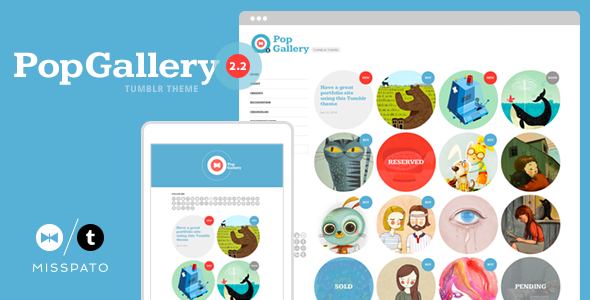
The defining design decision is the split between listing and detail views. On most Tumblr themes, the index page and the permalink page share the same layout, so a photo set looks roughly the same whether it appears in the stream or on its own URL. Pop Gallery breaks that convention: the homepage and tag pages render as a dense thumbnail grid, while individual posts open into a fuller content page with configurable positioning for the sidebar, logo, content block and footer. For a portfolio, this is the correct structure — browsing happens at speed, reading happens deliberately.
Circular thumbnails are the signature visual element, and they can be switched off if the round crop does not suit the work. A tiling mode is also available for a tighter mosaic effect, and thumbnails can be forced to a uniform shape across photo, audio and video posts, which prevents the ragged grid that plagues mixed-media Tumblr blogs. Three custom tags and three “bubble” tags let the owner control how individual thumbnails display, so specific posts can be pulled out of the default treatment without editing code.
The commerce-oriented feature is the most distinctive: thumbnails can be labelled as new, sold or reserved, with a distinct visual treatment for each state. That is a small feature, but it solves a real problem for makers who list one-off items on Tumblr and do not want to delete sold pieces from the archive. The listing stays as a record of past work while the label communicates availability.
Under the surface, the theme covers the practical ground expected of a modern Tumblr build. All post types are supported, including the answer post type and the Ask form. Infinite scrolling on the thumbnail pages keeps the grid loading without pagination clicks. The layout is responsive down to phone widths and was additionally tuned for iPad viewing, which is a sensible priority for a gallery theme. Comments run through either Disqus or Facebook, and the theme is wired for Google Analytics, ShareThis, AddThis and a long list of social profile links including Dribbble, Flickr, DeviantART and Stumbleupon. Google WebFonts and an editable colour scheme handle typography and palette without touching CSS.
Smaller details show the theme was built by someone who used Tumblr rather than just themed it: a logo image slot, header and footer HTML injection fields, a credit toggle, an option to show the author’s name, pagination as numbered page links or reversed order, FitVids for responsive video embeds, and a custom video thumbnail handler written specifically for this theme. Localisation tags are present, so interface strings can be translated.
Where the Pop Gallery theme fits, and where it does not
The clearest fit is a visual archive: a photographer’s portfolio, an illustrator’s sketchbook, a ceramics or jewellery maker’s catalogue, or a design studio’s project index. Any blog where the thumbnail grid is the primary navigation benefits from the listing/detail split, and the sold/reserved labels make it unusually well suited to small-batch commerce where inventory changes constantly.
It also works for group blogs. Support for contributors was added in version 2.2, so a collective or studio account with multiple posters can maintain a consistent grid without each contributor fighting the layout.
It is the wrong choice for text-first publishing. A long-form essay blog, a news commentary site or anything where the writing carries the value will look thin in a circular thumbnail grid, and the theme offers no reading-optimised alternative layout. It is also a poor fit for anyone who needs a full shopping cart: the sold/reserved labels are informational only, and the vendor does not state that any checkout, inventory or payment integration exists. Transactions would still happen elsewhere, with the theme acting as a display case.
A third mismatch is anyone who needs ongoing support or compatibility guarantees. The last vendor update was April 2019, and Tumblr’s platform has continued to change since then.
Strengths and limitations
Strengths
- Separate listing and single-item layouts, which is genuinely uncommon among Tumblr themes and is the right architecture for a portfolio.
- Sold, reserved and new thumbnail states give small sellers a way to keep an archive visible without misrepresenting availability.
- Uniform thumbnail sizing across photo, audio and video posts keeps mixed-media grids tidy.
- Broad configuration without code: colour scheme, WebFonts, sidebar side, content width, logo alignment, footer alignment and info position are all exposed as options.
- Responsive down to phone widths and separately tuned for iPad, with FitVids handling embedded video.
- Infinite scrolling on thumbnail pages, with an option to reverse pagination if the default order is wrong for the content.
- Header and footer HTML fields allow analytics, verification tags or chat widgets to be added without editing theme files.
- 987 sales and a strong buyer rating indicate the theme has held up in real use, and the changelog shows a genuine multi-year maintenance history through versions 2.1 to 2.4.
Limitations
- The last release was version 2.4 in April 2019. That update addressed the Tumblr bar overlapping interface elements and nothing since has been published, so buyers should assume no further compatibility work.
- No shopping cart, checkout or inventory management. The sold and reserved labels are purely presentational, which limits how far the theme can carry a shop on its own.
- Circular thumbnails crop the source image. Work with important detail near the edges — wide landscapes, tall portraits, typography-led graphics — will lose content unless the circular option is disabled.
- The demo illustrations are licensed from individual artists and are explicitly not included in the theme files, so a new install looks considerably emptier than the preview.
- Social sharing is built around ShareThis, AddThis and Facebook, with Google+ still referenced in the feature set — a sign of the theme’s age rather than a current integration strategy.
- There is no block editor or modern Tumblr theme architecture here; it is a classic custom theme, which means updates to Tumblr’s own editor features may not surface automatically.
How it compares with the alternatives
The realistic alternatives fall into three groups: free Tumblr themes from the platform’s own gallery, generic premium multipurpose themes that happen to support Tumblr, and custom development.
Free themes cost nothing and are more likely to receive ongoing updates, but they are built for the widest possible audience, which usually means a single unified layout for index and permalink pages and no concept of item status. Pop Gallery’s advantage is specialisation: the listing/detail split and the sold/reserved labelling are features a general-purpose theme will not offer, because most users do not need them.
Multipurpose premium themes typically bundle more page templates and broader plugin-style integrations, but they treat Tumblr as one output among many, so the Tumblr-specific touches — custom thumbnail tags, bubble tags, the video thumbnail handler, the Ask form styling — are absent. A buyer choosing between the two is really choosing between breadth and depth.
Custom development offers full control and a current codebase, at a cost far above $24 and with an ongoing maintenance obligation. For a working illustrator or craft seller who wants a finished gallery this week, that trade-off rarely makes sense.
The honest summary is that Pop Gallery competes on fit rather than freshness. It is more capable than a free theme for its specific use case and more focused than a multipurpose theme, but it is also older than both.
Frequently Asked Questions
Is the Pop Gallery Tumblr Theme still supported in 2024?
No. The vendor’s most recent update was version 2.4 in April 2019, and no release has been published since. The theme still installs and runs on Tumblr, and the 2019 patch specifically fixed the Tumblr bar overlapping interface elements, but buyers should not expect new fixes, feature additions or platform-compatibility work going forward.
Can the Pop Gallery theme run an online shop with payments?
Not directly. The theme can label thumbnails as new, sold or reserved, which is useful for showing availability, but the vendor does not state that any cart, checkout or payment integration is included. Sellers typically link out to a separate storefront or handle transactions through Tumblr’s own post tools.
Does the Pop Gallery theme work on mobile phones?
Yes. The theme is responsive and the vendor states it is enhanced for the smallest devices as well as optimised for iPad viewing. Thumbnail grids reflow at narrow widths, and FitVids keeps embedded video proportional. The circular thumbnail treatment still crops images on small screens, so very detailed work may lose edge content.
Are the illustrations shown in the demo included with the theme?
No. Every illustration in the demo belongs to its original artist and is displayed with permission, and the vendor states plainly that none of them are part of the theme files. A fresh installation will contain placeholder content and the buyer’s own posts, so the demo’s visual density should not be treated as the out-of-the-box result.
Verdict
Pop Gallery Tumblr Theme Blogging is worth buying for a narrow but real audience: illustrators, photographers, craft sellers and small studios who need a thumbnail-driven archive with distinct listing and detail views, and who value the sold/reserved labelling enough to justify a specialised theme. The 987 sales and strong buyer rating support that it delivers on those specific promises.
Buyers who need a text-first blog, an integrated store with checkout, or a theme that will keep pace with Tumblr’s platform changes should look elsewhere. The 2019 update date is the deciding factor for that group, and it is not a small caveat.
At $24 the risk is low, and for the right project the listing/detail architecture is difficult to replicate without custom work. The purchase decision rests less on price than on whether the buyer’s content is genuinely image-led and whether they can accept a theme that is effectively frozen in time.