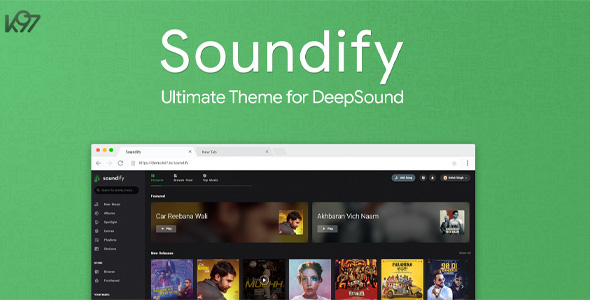
Soundify is a miscellaneous ThemeForest skin built for DeepSound, a PHP music-sharing platform that lets site owners run their own streaming, upload and download community. The theme replaces DeepSound’s default front-end with a redesigned welcome page, track pages, user profiles and discovery layout, and it is aimed at anyone already running the DeepSound script who wants a more polished public-facing site. It is not a standalone product: without the DeepSound script installed, Soundify does nothing at all.
The Soundify miscellaneous listing is a useful case study in how the ThemeForest skin market works. Buyers pay a small amount for a design layer that sits on top of a much larger, separately licensed application, and the value of that layer depends almost entirely on how closely it tracks the parent script’s release cycle. The changelog here tells most of that story before a single screenshot does.
What the Soundify miscellaneous theme actually changes
The theme does not add new functionality to DeepSound. It restyles what is already there. That distinction matters, because the vendor’s feature list reads like a set of capabilities when it is really a set of screens.
Redesigned core pages
Soundify ships alternative layouts for the welcome (landing) page, individual track pages, user profiles, the Discover section, albums, the home feed, account settings and the store. In practice, a site owner swapping from the stock DeepSound front-end gets a different visual hierarchy on each of those templates: track pages are treated as the centrepiece, profiles are reorganised to present an artist’s catalogue more prominently, and the Discover page is rearranged to make browsing less list-like. The welcome page is the most distinctive piece, since DeepSound’s default landing screen is fairly utilitarian and a custom one is the easiest way to differentiate a new site from every other installation.
Responsive behaviour and layout work
The vendor states the theme is fully responsive and adapts to mobile devices. For a music community this is not a nice-to-have — a large share of listening and browsing happens on phones, and a track page that breaks on a narrow viewport undermines the whole product. The layout overhaul also extends to the store and settings screens, which are the parts of a music platform that most themes neglect.
SEO and RTL handling
Soundify claims SEO-friendly markup, which in a skin context generally means clean heading structure, sensible template output and no obvious crawlability obstacles rather than any built-in optimisation engine. The changelog also records a fix for the welcome page in RTL mode (v1.4.1.2), which is a meaningful signal for right-to-left language sites — it indicates the vendor has at least tested that configuration rather than assuming it.
Maintenance tied to the parent script
The most substantive thing in the entire listing is the changelog. Almost every entry from v1.2 onward is a compatibility update matching a DeepSound release, from v1.3.1 through to v1.5.2. There are also targeted bug fixes: payment issues (v1.4.1), event-related problems (v1.4.7) and general issue patches. A skin that receives regular compatibility updates is worth considerably more than one abandoned after launch, because a DeepSound upgrade that breaks template overrides will take a live site down.
Where Soundify fits, and where it does not
The clearest fit is an operator who has already bought and installed DeepSound and finds the default interface too plain for a public launch. That covers independent music communities, small streaming startups, artist collectives and niche genre sites where the visual identity is part of the pitch. A freelancer or agency building a DeepSound-based site for a client is also a natural buyer: the theme is cheap relative to the build, and it removes a chunk of custom CSS work on the templates that matter most.
It is the wrong purchase in three situations. First, anyone who has not yet licensed DeepSound — the vendor explicitly requires the script, and the theme is inert without it. Second, anyone expecting the theme to add features DeepSound lacks, such as new payment gateways, different audio formats or new social mechanics; a skin cannot do that. Third, projects on a different music platform entirely, including WordPress-based audio themes, where Soundify is simply incompatible.
Strengths and limitations
Strengths
- Broad template coverage. The redesign reaches beyond the landing page into profiles, albums, the store and settings, which is more thorough than many skins that stop at the homepage.
- Documented compatibility history. The changelog shows repeated updates against successive DeepSound versions, which is the single best proxy for whether a skin will survive the next script upgrade.
- Low entry cost. At $25 the theme is a small fraction of the cost of commissioning equivalent template work.
- RTL attention. A recorded RTL fix suggests the theme has been considered for non-Latin markets rather than left to break.
- Mobile-first intent. Responsive behaviour is stated as a core property, which suits a listening audience.
Limitations
- Hard dependency on DeepSound. There is no fallback. Without the script, the theme cannot be previewed meaningfully or used at all, and the script is a separate purchase.
- No disclosed sales or rating data. The listing shows no sales figures or review score, so there is no independent signal of how the theme performs on live sites.
- Design-only scope. Nothing in the listing suggests added functionality. Buyers wanting new features will be disappointed.
- SEO claim is unquantified. “SEO friendly” is asserted without specifics about schema, metadata handling or performance budgets, and the vendor does not state measured results.
- Upgrade coupling. Because compatibility is patched release by release, a site that lags behind on DeepSound updates, or updates the script before the theme catches up, risks broken templates.
- Thin public documentation. The listing itself is short on installation guidance, browser support detail and customisation options beyond the changelog.
How Soundify miscellaneous themes compare with the wider category
Skins for hosted platforms sit in an awkward middle ground between WordPress themes and standalone templates. WordPress themes compete on customiser options, page-builder integration and ecosystem breadth; Soundify offers none of that, because DeepSound is not a CMS in the WordPress sense and the theme has no page builder to hook into. Standalone HTML templates, by contrast, compete on raw design quality and are platform-agnostic, but they require integration work that a DeepSound skin avoids entirely.
Within its own niche — DeepSound skins — the differentiators are narrower: how many templates are covered, how quickly compatibility patches ship, and whether the design holds up on mobile. On template coverage Soundify looks competitive, reaching the store and settings screens that simpler skins skip. On maintenance, the changelog is the strongest evidence in its favour. What it lacks relative to the category leaders is any visible track record: no sales count, no rating, no showcase of live installations. Buyers comparing options should weigh that absence honestly rather than treating the low price as sufficient reassurance.
Frequently Asked Questions
Do I need to buy DeepSound separately to use Soundify?
Yes. Soundify is a theme layer for the DeepSound script and will not function without it. The vendor states this requirement directly in the listing and links to the script separately. Budget for both purchases, and confirm the DeepSound version matches the theme’s most recent compatibility entry — currently v1.5.2 — before installing.
Does Soundify add new features to a music site?
No. It changes design and layout only. The features a visitor uses — uploading, streaming, downloading, purchasing, following other users — come from DeepSound itself. Soundify restyles the welcome page, track pages, profiles, Discover, albums, settings and store, but it does not extend the platform’s functionality in any documented way.
Is Soundify compatible with the latest DeepSound release?
According to the changelog, version 1.5.2 adds compatibility with DeepSound v1.5.1 and v1.5.2, which is the most recent pairing the vendor documents. Anyone running an older or newer script version should check the changelog carefully, because mismatches between theme and script are the most common cause of broken templates on this kind of setup.
Can Soundify be used on a WordPress site?
No. Soundify targets DeepSound, a separate PHP application, and has no relationship to the WordPress theme system. Sites built on WordPress would need an audio-focused WordPress theme or plugin instead. The same applies to other music platforms: the theme’s templates are written for DeepSound’s structure and cannot be repurposed elsewhere without a rebuild.
Verdict: who should buy the Soundify miscellaneous theme
Soundify makes sense for DeepSound owners who have the script running and want a more considered front-end without commissioning custom template work. The $25 price is easy to justify against the hours saved on profiles, track pages and the store, and the compatibility changelog suggests the vendor intends to keep pace with the parent script. Agencies building DeepSound sites for clients fall into the same category.
Buyers without a DeepSound licence, or anyone hoping the Soundify miscellaneous theme will add capabilities the platform lacks, should stop here — the product cannot deliver either. The absence of sales and rating data also means there is no community track record to lean on, so the decision rests on the changelog and the demo rather than on proof from other site owners.