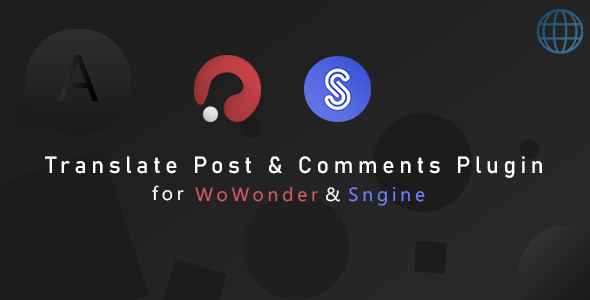
Translation Post & Comments for WoWonder & Sngine is a small add-on script that adds machine translation to two PHP social-network platforms, letting members read posts, comments and stories written in languages they do not speak. It is aimed at network owners running multilingual communities who want on-demand translation built into the feed rather than a browser extension or a copy-and-paste workaround. At $19 it is a low-cost extension rather than a standalone product, and it only makes sense on top of an existing WoWonder or Sngine installation.
What Translation Post & Comments for WoWonder & Sngine actually adds to a community
The core function is a translate action attached to user-generated content. A member viewing a post written in another language can request a translation in place, and the same applies to the comment thread beneath it. Since version 2.4 the script also covers stories, the short-lived text updates that both platforms support. The practical effect is that a network with members spread across several language groups stops fragmenting into separate conversations, because nobody has to leave the page to understand what was said.
Translation is handled by external engines rather than a bundled dictionary. The listing names GPT and Lingvanex as the two providers, and the changelog shows the GPT path being added in early 2023 and upgraded for GPT-4 later that year. That means the quality of output depends on which provider is configured and on the API credentials the site owner supplies — the script is the plumbing, not the translator.
Language detection is built in. The script identifies the language of a piece of text automatically, and the changelog records support for more than sixty detectable languages as of version 2.4, alongside a check for identical languages so that a Portuguese post is not “translated” into Portuguese for a Portuguese reader. That last detail matters more than it sounds: a translate button that does nothing visible is a common source of user confusion in social scripts.
Formatting preservation is the other area the developer has invested in. Posts on these platforms contain hashtags, URLs, line breaks and spacing, and a naive translation pass tends to mangle all of them. The changelog tracks this specifically — hashtag and URL retention arrived in version 1.5, and broader post-structure preservation followed in 2.6 for WoWonder and 2.7 for Sngine. Version 2.8 added the ability to toggle between the original and translated text, which is a sensible safeguard given that machine translation of informal social posts is frequently approximate.
On the administrative side, the requirements are modest but not optional: PHP 7.3 or newer and SSL enabled on the server. The SSL requirement is effectively universal on modern hosting, but the PHP floor is worth checking on older shared plans. The vendor does not state whether a Lingvanex or OpenAI key is included in the purchase, so it is reasonable to assume the buyer supplies their own API access and absorbs any usage costs.
Where this translation add-on fits, and where it does not
The clearest fit is an established WoWonder or Sngine community that has already grown past a single language. Diaspora networks, regional forums with members who have moved abroad, fan communities built around international creators, and marketplace-style sites where buyers and sellers speak different languages all benefit from in-feed translation. In each case the alternative — asking members to paste text into Google Translate — breaks the flow of the conversation and discourages participation from the very users the feature is meant to serve.
It also suits agencies and freelancers who build these platforms for clients. A translation layer is an easy line item to add to a social-network build, and at this price point it can be resold or bundled without distorting a project budget. The compatibility record is relevant here: the changelog shows the script tracking WoWonder releases from 4.0.1 through 4.1.5 and Sngine through 4.1.1, plus theme compatibility with Wondertag, Elengine and Xngine. That pattern of updates suggests a developer who keeps pace with upstream releases, which is the main risk with any third-party add-on for a fast-moving platform.
Where it is the wrong choice: a single-language community. If the membership all writes in one language, the translate button is dead weight in the interface and the API costs buy nothing. It is also a poor fit for anyone who needs certified or legally reliable translation — machine output from GPT or Lingvanex is fine for casual social posts and unsuitable for contracts, medical information or official notices. And anyone running a heavily customised fork of WoWonder, with modified templates or a rewritten feed, should expect integration work; the vendor does not claim compatibility with bespoke modifications.
Strengths and limitations of Translation Post & Comments for WoWonder & Sngine
Strengths
- Covers posts, comments and stories in one add-on, so the translation experience is consistent across the main content types rather than limited to the feed.
- Automatic language detection with a check for matching languages removes the most common cause of a useless translate button.
- Preserves hashtags, links, spacing and line wrapping, which keeps translated posts readable and stops internal links from breaking.
- A toggle between original and translated text gives members a way to verify anything that reads oddly.
- Two translation backends (GPT and Lingvanex) let the site owner choose between cost and quality rather than being locked to one provider.
- An unusually long and specific changelog for a $19 item, with regular compatibility updates for both WoWonder and Sngine through 2025.
- Low price relative to the development time required to build equivalent functionality in-house.
Limitations
- Translation quality is entirely dependent on the third-party API. The script cannot improve a weak GPT or Lingvanex result, and informal slang, sarcasm and regional dialect will sometimes come out wrong.
- API usage is a recurring cost that the vendor does not quantify. A busy network could spend far more on translation calls over a year than the script itself cost.
- Support runs through a direct email address rather than a structured help desk, and the vendor does not publish response-time commitments.
- Compatibility is version-pinned. Sites that lag behind on WoWonder or Sngine updates, or that run ahead of them, may find the add-on unsupported until the next release.
- No sales figures are disclosed on the listing, so there is no public signal of adoption to weigh alongside the changelog.
- Installation requires editing a PHP-based platform and handling API keys, which puts it out of reach for non-technical site owners.
How it compares with the wider category of social translation options
The alternatives fall into three groups. The first is doing nothing and relying on members to translate manually or through browser features; that costs nothing but leaves non-native speakers on the outside of conversations, which is precisely the problem a multilingual network needs to solve. The second is a general-purpose multilingual plugin built for WordPress or a CMS, which typically translates whole pages rather than individual user posts, cannot distinguish one member’s comment from another’s, and has no concept of stories or feed structure. Those tools solve a different problem.
The third group is custom development: wiring an OpenAI or Lingvanex call into the WoWonder or Sngine feed directly. That gives full control over caching, prompt design and interface placement, and for a large network with specific needs it may be the better long-term route. The trade-off is cost and maintenance — the developer has to keep pace with every upstream platform release, which is exactly the work this add-on’s changelog shows being done across roughly three years of updates.
Against both, the case for this script rests on price and upkeep rather than unique capability. Nothing it does is technically remarkable; the value is that it has already been done, debugged against real platform versions, and priced at less than an hour of most developers’ time. For a small or mid-sized community, that is a reasonable trade. For a network with unusual requirements or heavy traffic, building it in-house remains defensible.
Frequently Asked Questions
Does Translation Post & Comments for WoWonder & Sngine work with the latest WoWonder version?
The most recent WoWonder compatibility entry in the changelog is version 4.1.5, added in March 2023, with later releases focused on Sngine. Buyers running WoWonder versions released after that should confirm support with the developer before purchasing, since the listing does not state compatibility beyond 4.1.5.
Do I need my own OpenAI or Lingvanex API key?
The listing does not state that any API access is included, so a buyer should expect to supply their own credentials for GPT or Lingvanex. Translation costs are then billed by that provider based on usage, separate from the one-off purchase price of the script.
Can members see the original post after it has been translated?
Yes. A version 2.8 update added the ability to view original and translated text side by side or by toggling between them. That matters for posts containing names, links or slang where the machine output may be misleading, and it gives members a way to check the source wording.
Is this translation add-on suitable for a single-language community?
No. If all members write in the same language, the translate control adds interface clutter and generates API costs without improving anyone’s experience. The feature only earns its place on networks where a meaningful share of posts and comments are written in languages other than the reader’s own.
Verdict: who should buy Translation Post & Comments for WoWonder & Sngine
This is a sensible purchase for owners of an existing WoWonder or Sngine community that already has a multilingual membership and a technical hand available to install it and manage API keys. The price is low, the feature set covers posts, comments and stories, and the changelog shows a developer who has kept the script aligned with platform releases over several years. Buyers should budget for ongoing API costs and check version compatibility against their installation before committing.
It is the wrong buy for single-language networks, for sites running heavily modified platform forks, and for anyone who needs translation accuracy beyond what a general-purpose machine engine delivers. Those cases are better served by custom development or by accepting that translation is not a feature the community needs.