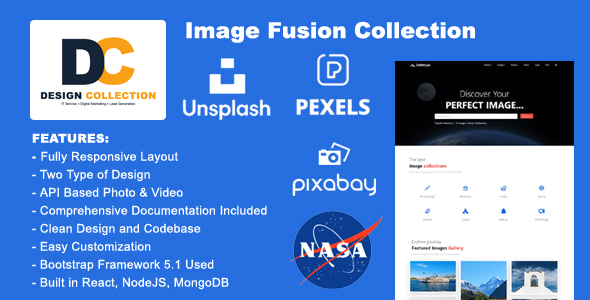
Image Fusion Collection images-and-media is a downloadable React and Node.js application that pulls photos and videos from third-party stock APIs — Pixabay, Pexels and Unsplash — and presents them through a searchable front end with a separate admin panel. It is sold on ThemeForest for $15 as a code package, not as hosted software, and it is aimed at developers and small agencies who want to launch a media browsing or stock-style site without building the API layer from scratch. Buyers should note up front that the package ships without any images and requires a MongoDB database plus a Node.js server to run.
What Image Fusion Collection images-and-media actually does under the hood
The product is best understood as a front-end shell wrapped around three public media APIs. The vendor does not bundle a media library; instead, the application queries Pixabay, Pexels and Unsplash at runtime and renders whatever those services return. That architectural choice shapes almost everything else about the product, for better and worse.
Aggregated search across three providers
Because the app connects to more than one source, a single search field can return results from several libraries at once. The listing describes advanced search filters, category-based browsing and real-time results, which in practice means the interface passes query parameters to each API and merges the responses. For a developer, the value here is the plumbing: authentication handling, request formatting and result normalisation for three different API schemas is tedious work that this package has already done.
User-facing browsing tools
The front end includes favourites, saved media, shareable links and light and dark modes. These are the features that make a media site feel like a product rather than a raw API demo — a visitor can build a shortlist of assets, copy a link to a specific item, and browse comfortably in either colour scheme. The responsive layout is built on Bootstrap 5, so the grid behaviour on mobile should be predictable to anyone familiar with that framework.
Admin panel and branding controls
The admin side is where the package tries to justify its price. It offers a dashboard overview, the ability to edit titles and content, API integration settings, custom branding, theme customisation and Google AdSense integration. In practical terms, that means a non-developer can change the site name, swap colours and paste in API credentials without touching code — and can place ad units to monetise traffic. The listing also mentions performance monitoring and integration with external tools, though the vendor does not specify what those integrations are or how monitoring is implemented.
Technology stack and deployment requirements
The stack is React on the front end, Node.js on the server and MongoDB for storage, with jQuery and Font Awesome 5 also listed among the credits. This is a conventional JavaScript stack, which is good news for hiring and maintenance, but it is not a drop-in WordPress plugin or a static site. It needs a Node-capable host and a database instance, which rules out cheap shared hosting.
Where Image Fusion Collection images-and-media fits, and where it does not
The clearest fit is a developer or small studio that has been asked to build a stock photo portal, an internal media asset browser, or a niche image discovery site and wants a working starting point rather than a blank repository. A freelancer quoting a fixed-price job benefits most: the API integration, search UI and admin scaffolding are already assembled, so the remaining work is branding, content strategy and deployment.
It also suits agencies building demonstration products or MVP prototypes for clients in the photography, design or education sectors — anywhere a browsable, filterable media library is the core interaction rather than a side feature.
It is the wrong choice in several common scenarios. Anyone wanting a personal photography portfolio should look elsewhere: this is a discovery and aggregation tool, not a gallery for a photographer’s own work, and the images it displays belong to third-party libraries. WordPress users who want stock image search inside their existing site will find the Node and MongoDB requirement disproportionate. And a buyer expecting a ready-to-monetise stock marketplace with licensing, contributor accounts and payment processing will be disappointed — the package offers AdSense placement, not a marketplace engine.
Strengths and limitations of the Image Fusion Collection images-and-media package
Strengths
- Real API integration work is done. Connecting to Pixabay, Pexels and Unsplash involves separate keys, rate limits and response formats; having that handled saves meaningful development hours.
- Low entry price. At $15, the package costs less than an hour of most freelancers’ time, which makes it easy to justify as a starting scaffold.
- Separate admin layer. Branding, titles, API settings and ad slots are editable without code, which is useful when handing a site to a non-technical client.
- Familiar, portable stack. React, Node.js, MongoDB and Bootstrap 5 are widely known, so future developers can pick the project up without a specialist learning curve.
- Both demo environments are public. The vendor exposes a user demo and admin credentials, so the interface can be evaluated before purchase rather than inferred from screenshots.
Limitations
- No images are included. The vendor states plainly that media is for demo purposes only. The site is empty of content until the buyer’s own API keys are configured and working.
- Installation costs extra. Setup is quoted at $20 on top of the $15 price — more than doubling the outlay — and the vendor does not describe what the installation service covers.
- Dependent on third-party terms. Every image and video served depends on Pixabay, Pexels and Unsplash API access. Changes to their quotas, attribution rules or commercial terms directly affect the site, and the package cannot insulate a buyer from that.
- Thin documentation in the listing. Beyond stack requirements and a changelog showing a single version 1.0 release, the listing gives no detail on code structure, update policy or what “performance monitoring” actually comprises.
- No marketplace mechanics. There is no contributor upload, licensing workflow or payment processing, despite the listing’s framing around monetising photography.
- No sales or rating history disclosed. There is no public track record to weigh, so the demo is the only evidence of quality available.
How Image Fusion Collection images-and-media compares with the alternatives
Buyers in this category generally choose between three routes: a hosted stock-search service embedded via widget or iframe, a WordPress plugin that adds media search to an existing site, or a self-hosted code package like this one.
Hosted widgets are the fastest path and require no server, but they offer little control over branding, data or monetisation, and the site owner never owns the application. WordPress plugins suit sites already running WordPress and are cheap or free, but they are constrained by the plugin’s own feature set and rarely include a standalone admin panel for API management.
A self-hosted React and Node package sits at the opposite end: maximum control, full ownership of the codebase, freedom to add custom features and place ads, but with real hosting, database and maintenance obligations. Compared with building from scratch, the package trades a small fee for a head start on API integration and UI scaffolding. Compared with a full stock marketplace script, it is far lighter — no contributor system, no licensing engine — which makes it cheaper and simpler but narrower in scope. The honest positioning is a prototype and MVP tool, not a turnkey business platform.
Frequently Asked Questions
Do I need coding knowledge to use Image Fusion Collection images-and-media?
Yes, some. The package requires a Node.js server and a MongoDB database, and deployment involves configuring environment variables and API credentials. The admin panel handles branding, titles and ad settings without code, but initial installation and hosting setup assume familiarity with JavaScript projects. The vendor offers a paid installation service for buyers who lack that experience.
Are the stock photos included in the download?
No. The vendor states explicitly that images are not part of the main downloadable file and appear in the demo for illustration only. All media is fetched live from Pixabay, Pexels and Unsplash through their APIs, so a buyer must register for API keys with each provider before the site displays any content.
Can Image Fusion Collection images-and-media be used to sell stock photos?
Not directly. The package has no contributor accounts, licensing terms, pricing or checkout, so it cannot process sales of images. Its monetisation feature is Google AdSense integration, which earns revenue from display advertising around free content. Selling licences would require substantial custom development on top of the base application.
What are the hosting requirements for this React and Node.js media app?
It needs a host that runs Node.js and can connect to a MongoDB database, plus a domain and SSL for production use. Standard shared PHP hosting will not work. Buyers should budget for a platform-as-a-service or VPS environment, and should confirm that outbound requests to the three media APIs are permitted by the host’s firewall.
Verdict on Image Fusion Collection images-and-media
This package makes sense for a developer or small agency that needs a working React and Node.js media search application quickly and is comfortable deploying and maintaining it. The API integration across three providers, the admin panel and the AdSense hook represent genuine time saved for $15, and the public demos let buyers verify the interface before committing. It is a poor fit for WordPress users, photographers wanting a portfolio, or anyone expecting a complete stock marketplace with licensing and payments. The absence of bundled media, the extra installation fee and the total dependence on third-party API terms are real costs that should be weighed against the low headline price. The developer, Design Collection, has released only version 1.0 so far, which means buyers are effectively adopting an early-stage codebase.