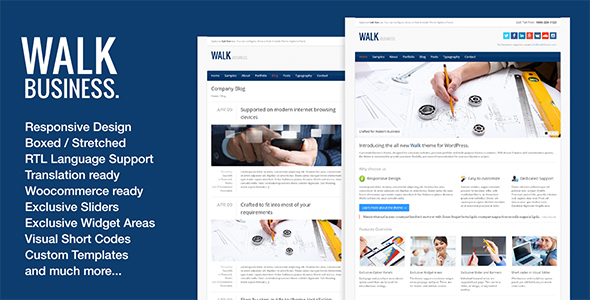
Walk is a responsive business WordPress theme sold on ThemeForest for $49, built by developer SaurabhSharma for corporate sites, agency portfolios and mixed-purpose commercial projects. It ships with WooCommerce support, per-page and per-post option panels, a visual shortcode system and a set of custom page templates, and it has been purchased 415 times. Anyone weighing a Walk business theme purchase should understand both its flexibility and its age before committing.
The listing was last updated in February 2021, which places the theme firmly in the pre-block-editor era of WordPress theme development. That single fact shapes almost everything else in this review: what the theme does well, what it cannot do, and which projects it still suits.
What the Walk business theme actually gives a site owner
The core proposition is granular control without a page builder. Walk provides separate option panels for individual pages and individual posts, meaning a homepage, a services page and a blog post can each carry different banners, layouts and widget areas. That is more control than most themes at this price point offer, and it is achieved through native WordPress admin screens rather than a third-party builder that would need to be maintained separately.
Header banners can be set per page as either a static image or an iframe, which allows embedded video or third-party content to sit at the top of a specific page without touching the rest of the site. The bundled jQuery FlexSlider can also be assigned per page, and the vendor notes it can be triggered from posts or pages, so a slider is not locked to the homepage template.
Layout options include boxed and stretched modes and four colour scheme variations. The theme options panel is unbranded, which matters for agencies that hand a finished site to a client and do not want another company’s logo sitting in the dashboard.
On the commerce side, Walk is WooCommerce ready, with the 2018 update adding support for product columns, image resizing and products-per-row settings inside the WordPress Customizer. For a business site that sells a small catalogue of products or takes deposits, that is sufficient. It is not a purpose-built storefront theme, and the vendor does not claim otherwise.
Content presentation is handled through three blog templates, three portfolio templates and three global archive templates, each usable an unlimited number of times. Portfolios use PrettyPhoto for lightbox image display. Six custom widgets are included — Flickr, social icons, recent posts, popular posts, custom categories and a mini portfolio — alongside exclusive widget areas that can differ page by page.
Smaller but practical inclusions: a contact page template with Ajax and PHP form validation, Facebook Open Graph meta tags, social sharing counters on single posts, author bios, related posts and nested comments with Gravatar support. There is also a user CSS field for overriding default styles without editing theme files, and a child theme is bundled in the main download.
Localisation is supported through sample .pot, .po and .mo files, and the theme ships with dummy content in both text and XML format. RTL support is present, which broadens the addressable market to Arabic and Hebrew-language projects.
Where Walk fits, and where it does not
A small agency building a five-to-fifteen page corporate brochure site is the clearest fit. The per-page option panels mean a designer can vary the presentation of each section without a page builder, and the unbranded options panel plus child theme make handover to a client straightforward.
Freelancers producing portfolio sites for photographers, designers or consultants are also well served. The three portfolio templates and PrettyPhoto lightbox cover the standard requirements, and the mini portfolio widget lets a portfolio grid appear in a sidebar or footer without a separate plugin.
Multilingual or RTL projects benefit from the bundled translation files and RTL styling, though the vendor does not state which page builders or translation plugins have been tested alongside it.
The theme is the wrong choice for a content-heavy publisher. There is no block editor integration, no full site editing support and no indication that the theme’s templates have been rebuilt for the WordPress block paradigm introduced in version 5.9. A site expecting to compose layouts with core blocks and theme.json will fight the theme rather than work with it. The same applies to any project requiring a modern block-based page builder as the primary editing experience.
It is also a poor fit for a large e-commerce operation. WooCommerce compatibility is present but shallow — the theme supports catalogue display settings, not the deeper checkout, cart and product template customisation that dedicated WooCommerce themes provide.
Strengths and limitations
Strengths
- Per-page and per-post option panels give unusually fine control for a theme in this price bracket, without requiring a page builder plugin.
- The unbranded options panel and bundled child theme suit agency workflows where a client receives a clean dashboard.
- Shortcodes and widgets are packaged as a separate plugin, so content shortcodes survive a theme switch rather than breaking.
- RTL support and included .pot/.po/.mo files cover internationalisation needs that many budget themes skip.
- Dummy content in both text and XML format shortens initial setup considerably.
- Documentation is described as step-by-step, and the vendor maintains a public changelog.
Limitations
- The last update was February 2021. The theme has not been refreshed for the block editor, full site editing or any WordPress release since then, so buyers should verify current compatibility before purchase rather than assume it.
- No block editor or theme.json support means the editing experience is the older customiser-and-shortcode model, which will feel dated to anyone accustomed to modern WordPress.
- WooCommerce integration covers catalogue display settings only; the vendor does not state support for newer WooCommerce template versions or checkout block customisation.
- Demo images come from photodune.net and are explicitly not included in the download, so a buyer must license or substitute all photography.
- Four colour schemes is a modest palette for a theme positioning itself as multi-purpose.
- 415 sales is a small install base, which means fewer community answers, third-party tutorials and forum threads when something breaks.
How Walk compares with the broader business theme category
The business theme market splits roughly into three groups. Block-based themes built for the modern WordPress editor offer forward compatibility and a native editing experience but often less granular per-page control out of the box. Page-builder-dependent themes offer enormous layout freedom but tie the site to a third-party plugin and its licensing. Walk sits in a third group: classic themes that bundle their own options framework and shortcode system.
Against block-based alternatives, Walk loses on longevity and wins on immediacy — the per-page panels and shortcode library are ready to use without learning a builder. Against page-builder themes, Walk is lighter and avoids an external dependency, but its layout flexibility is bounded by the templates the developer shipped rather than being open-ended.
On price, $49 is standard for a ThemeForest business theme and competitive with annual subscriptions elsewhere. The relevant comparison is not cost but lifespan: a theme last updated in 2021 carries a maintenance risk that a subscription product with regular releases does not.
Frequently Asked Questions
Is Walk theme compatible with the latest WordPress version?
The vendor’s most recent changelog entry, from February 2021, only states compatibility with PHP 7.4.9. No WordPress version compatibility claim appears after that date, so current compatibility is unconfirmed. Buyers should test on a staging install running their target WordPress and PHP versions before deploying to a live site.
Does the Walk business theme require a page builder plugin?
No. Walk uses its own visual shortcode system, per-page option panels and bundled page templates instead of a third-party builder. Shortcodes and widgets are delivered as a separate plugin, which means the content they generate remains intact if the theme is later switched, rather than being locked to the theme itself.
Can Walk be used for an online shop?
Yes, with limits. The theme is WooCommerce ready and its 2018 update added support for product columns, image resizing and products-per-row settings in the Customizer. It handles catalogue display well but does not offer deep customisation of cart, checkout or product templates, so complex stores should look elsewhere.
Is the Walk theme translation ready and does it support RTL languages?
Both are supported. The download includes sample .pot, .po and .mo files for translating the theme’s strings into other languages, and RTL styling is built in for right-to-left scripts such as Arabic and Hebrew. The vendor does not state which translation plugins have been tested with the theme, so compatibility with specific multilingual setups should be verified independently.
Verdict on the Walk business theme
Walk suits agencies and freelancers producing small corporate, portfolio or brochure sites who want per-page control without adopting a page builder, and who are comfortable working in the classic WordPress customiser. The unbranded options panel, bundled child theme and RTL support are genuine advantages at $49.
It does not suit publishers, block-editor-first teams or anyone building a store with complex checkout requirements. The February 2021 update date is the deciding factor: the theme is functional for the workflow it was designed around, but it has not been maintained through the major shifts in WordPress theme development since then.
Prospective buyers should treat Walk as a stable, feature-complete classic theme rather than an actively evolving product, and should confirm compatibility with their hosting environment before purchase. For the right project, that trade-off is acceptable. For a long-lived site expected to grow with WordPress, it is a risk worth weighing carefully.