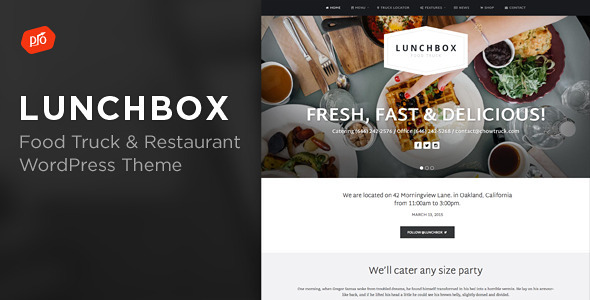
Lunchbox Entertainment is a WordPress theme built by ProgressionStudios for food trucks, restaurants, cafés, bars and other hospitality venues that need a location-aware website with menus and online ordering. It bundles the WPBakery page builder and Slider Revolution, adds a truck locator map and a dedicated menu builder, and sells for a one-off $59 on ThemeForest. It suits small operators who want a recognisable food-and-drink layout without commissioning custom development, and it is a poor fit for anyone who has already standardised on the block editor or a modern full-site-editing stack.
What Lunchbox Entertainment Actually Delivers
The defining feature is the truck locator map. Food trucks move, and a static address in a footer does not solve that problem. The theme ships a map element that lets an operator drop multiple pins and label each one, so a schedule of weekly pitches can live on a single page. Restaurants get the same element repurposed as a branch finder. The vendor does not state which mapping provider powers it or whether an API key is required, which is worth confirming before purchase, since Google Maps embeds have required a billing-enabled key for years.
Menus are handled by a purpose-built page builder element rather than a generic text block. That matters more than it sounds: menu items change prices constantly, and a structured element means a price edit does not break the column layout. Multiple menus can coexist, so a venue can run separate lunch, dinner and drinks lists, or a truck can publish a rotating weekly specials board alongside its permanent offering.
Two commercial plugins are bundled and licensed through the theme: WPBakery Page Builder and Slider Revolution. The vendor values them at $64 and $85 respectively, which is accurate against their standalone list prices and means the $59 theme price is effectively covered by the plugin bundle alone. Both are drag-and-drop tools with long track records. WPBakery uses shortcode-based content, which is the single most consequential technical detail in this review and is covered in the limitations below.
WooCommerce support is present and has been maintained consistently — the changelog shows template updates tracking WooCommerce 2.6 through to recent releases. A truck selling merchandise, a café selling beans by the bag, or a restaurant running a small retail line can all use it. The theme does not claim to be a full online-ordering or table-booking system, and it is not one; those would come from separate plugins.
Around the edges, the theme covers the practical housekeeping that hospitality sites need. One-click demo import gets a staging site populated in minutes rather than hours. The front-end customiser exposes unlimited colour control and font adjustment, so branding changes do not require touching CSS. Mega menu support handles the deep navigation that a multi-location restaurant group tends to accumulate. The sticky header keeps a phone number or order button permanently visible, which is a genuine conversion consideration on mobile. The footer column count adjusts between one and four. A contact form builder is included, the theme is translation-ready, and Photoshop source files ship with the download for anyone who wants to adapt the demo graphics.
Where Lunchbox Entertainment Fits and Where It Does Not
The strongest fit is a single food truck or a small fleet with a rotating schedule. The locator map, the menu builder and the sticky header address the three things a truck’s customers actually want: where it is today, what it serves, and how to get in touch. A café, diner, pub or bar with one or two sites is the next best match — the demo layouts cover those formats directly, and the tags the vendor applies (bar, cafe, chef, diner, dining, pub) reflect that spread.
Multi-location restaurant groups are a reasonable fit provided the site stays under a few dozen pages. Mega menus and the map element scale to that point. Beyond it, the shortcode-based content model becomes a liability rather than an inconvenience.
The clear wrong choice is an agency or in-house team that has moved to the WordPress block editor or full-site editing. Lunchbox Entertainment is a classic PHP-template theme with a page builder bolted on. Content is stored as shortcodes, so switching themes later means either keeping WPBakery active forever or manually rebuilding every page. Any project with a realistic chance of a redesign within two or three years should weigh that cost before buying. The same applies to anyone who needs headless delivery, a React front end, or a tightly controlled design system — this is a template, not a framework.
Strengths and Limitations
Strengths
- The truck locator map is a genuine differentiator. Most general-purpose restaurant themes treat location as an afterthought; here it is a first-class element.
- Bundled WPBakery and Slider Revolution licences mean the effective cost of the theme is close to zero once the plugin value is accounted for.
- WooCommerce templates have been kept current across many major WooCommerce releases, which is more than many older ThemeForest themes can claim.
- One-click demo import shortens the gap between purchase and a presentable site considerably.
- The structured menu element handles price and item changes without layout breakage.
- Translation-ready, retina-optimised and PHP 8 compatible as of the 2022 update.
Limitations
- Content is stored as WPBakery shortcodes. Deactivating the plugin leaves raw shortcode text visible on the front end, so the page builder becomes a permanent dependency.
- The vendor does not state which map provider the locator uses or whether a paid API key is needed. That is a real unknown for a feature this central.
- No booking, reservation or delivery-integration layer is included. Venues that need those will be adding third-party plugins on top.
- Several changelog entries consist only of “Updated Premium Plugins” with no detail, which makes it hard to judge how actively the theme itself is being developed versus simply kept alive.
- The bundled Photoshop files are useful only to designers; they add download weight for everyone else.
- Accessibility is not mentioned anywhere in the feature set, and page-builder output frequently produces heading-order and contrast issues that require manual remediation.
How It Compares to the Broader Restaurant Theme Market
Restaurant and food-truck themes on ThemeForest broadly split into three groups. The first is multipurpose themes with a restaurant demo attached — they offer more layout variety but almost never include a location-finder built for a moving business. The second is block-based themes built for the WordPress site editor, which offer cleaner long-term portability but far fewer ready-made hospitality layouts and no bundled premium plugins. The third is niche themes like this one, where the feature set is shaped around one trade.
Lunchbox Entertainment sits firmly in the third group, and that is its argument. The trade-off is explicit: more relevant features out of the box, less flexibility and less future-proofing. A block-based theme will be easier to migrate away from; a multipurpose theme will adapt to a non-hospitality project. Neither will give a food truck a working locator map on day one. Buyers should decide which of those three trade-offs they can live with before comparing prices, because at $59 the price difference between these options is not the deciding factor.
Frequently Asked Questions
Does Lunchbox Entertainment work for a food truck that changes location daily?
Yes, that is the scenario the theme is designed around. The truck locator map element supports multiple pinned locations, so a weekly schedule of pitches can be displayed and updated without rebuilding the page. The vendor does not document how frequently pins can be updated or whether the map supports recurring schedules, so operators with complex rotations should test the demo first.
Is a separate WPBakery licence needed after buying the theme?
No. WPBakery Page Builder and Slider Revolution are bundled and licensed through the theme purchase, which is why the vendor lists their combined $149 value against the $59 price. The caveat is that plugin updates arrive through the theme’s own update mechanism, not through the plugins’ standard update channels, so they can lag behind official releases.
Can Lunchbox Entertainment sell products online?
Yes, it includes WooCommerce support and has done since early versions. The changelog shows template files updated repeatedly to track WooCommerce releases, most recently in January 2023. It handles merchandise, packaged goods and retail items well. It does not include restaurant-specific ordering logic such as delivery zones, pickup slots or table booking.
What happens to the site if the theme is switched later?
Pages built with WPBakery store their content as shortcodes. Switching to a different theme without WPBakery active will leave that shortcode text visible as plain text on the front end. Migrating away therefore requires either keeping the plugin installed or manually rebuilding each page in the new editor. This is the theme’s most significant long-term constraint.
Verdict
Lunchbox Entertainment is a sensible purchase for a food truck, café, diner, pub or small restaurant that needs a location-aware site with menus and a shop, and wants it live quickly without hiring a developer. The bundled plugin licences alone justify the price, and the locator map solves a problem most competitors ignore. It is the wrong purchase for agencies working in the block editor, for anyone who expects to redesign within a couple of years, and for venues needing reservations or delivery integration built in. ProgressionStudios has maintained the theme since 2016 with 714 sales and a solid rating, which suggests a dependable but not spectacular track record. The shortcode dependency is the decision point: accept it and the theme performs well, reject it and the alternatives are all block-based.